Yang Zhao, Changyuan Xu, Yufan Chen, Tao Gong, Mengyuan Zhuo, Cheng Zhao, Zhanfang Sun, Weibo Chen, Yuanyuan Xiang, Guangbin Wang
{"title":"淋巴功能障碍通过引发帕金森病的皮质变性而加剧认知能力下降:来自弥散张量MRI的证据","authors":"Yang Zhao, Changyuan Xu, Yufan Chen, Tao Gong, Mengyuan Zhuo, Cheng Zhao, Zhanfang Sun, Weibo Chen, Yuanyuan Xiang, Guangbin Wang","doi":"10.1093/braincomms/fcaf029","DOIUrl":null,"url":null,"abstract":"<p><p>The glymphatic system may play a central role in cognitive impairment associated with Parkinson's disease, but its relationship with regional cortical atrophy is not fully explored. To explore associations among glymphatic dysfunction, regional cortical degeneration and cognitive impairment in Parkinson's disease participants, we evaluated 51 participants with documented Parkinson's disease (28 men; age, 61.65 ± 8.27 years) and 30 age- and sex-matched normal controls (11 men; age, 59.2 ± 5.90 years) who underwent 3.0-T MRI of the brain, including high-resolution T1-weighted imaging and diffusion-tensor imaging along the perivascular space as a surrogate for glymphatic flow. Cortical grey matter volume was segmented automatically based on three-dimensional T1-weighted sequences. Cognitive function was assessed by Mini-Mental State Examination. The relationship between glymphatic dysfunction, cognitive decline and regional cortical degeneration was explored. The participants with Parkinson's disease revealed lower diffusion-tensor imaging along the perivascular space (1.45 ± 0.17 versus 1.64 ± 0.17, <i>P</i> < 0.0001) as compared with normal controls, indicating disturbed glymphatic flow. Glymphatic dysfunction was associated with cognitive scores (<i>r</i> = 0.54, <i>P</i> = 0.003). Diffusion-tensor imaging along the perivascular space values were positively associated with the volume of specific cortical regions (all <i>P</i>-values <0.05) including the temporal pole, posterior orbital gyrus, orbital part of the inferior frontal gyrus, frontal operculum, central operculum and anterior cingulate gyrus. Mediation analysis within the Parkinson's disease participants indicated that the relationship between glymphatic dysfunction and cognitive scores was partially mediated by the integrity of orbital part of the inferior frontal gyrus and anterior cingulate gyrus. Glymphatic dysfunction is associated with cognitive decline in Parkinson's disease, whereas the distribution of regional cortical degeneration may constitute the link between glymphatic dysfunction and cognitive impairment.</p>","PeriodicalId":93915,"journal":{"name":"Brain communications","volume":"7 1","pages":"fcaf029"},"PeriodicalIF":4.5000,"publicationDate":"2025-02-20","publicationTypes":"Journal Article","fieldsOfStudy":null,"isOpenAccess":false,"openAccessPdf":"https://www.ncbi.nlm.nih.gov/pmc/articles/PMC11840164/pdf/","citationCount":"0","resultStr":"{\"title\":\"Glymphatic dysfunction exacerbates cognitive decline by triggering cortical degeneration in Parkinson's disease: evidence from diffusion-tensor MRI.\",\"authors\":\"Yang Zhao, Changyuan Xu, Yufan Chen, Tao Gong, Mengyuan Zhuo, Cheng Zhao, Zhanfang Sun, Weibo Chen, Yuanyuan Xiang, Guangbin Wang\",\"doi\":\"10.1093/braincomms/fcaf029\",\"DOIUrl\":null,\"url\":null,\"abstract\":\"<p><p>The glymphatic system may play a central role in cognitive impairment associated with Parkinson's disease, but its relationship with regional cortical atrophy is not fully explored. To explore associations among glymphatic dysfunction, regional cortical degeneration and cognitive impairment in Parkinson's disease participants, we evaluated 51 participants with documented Parkinson's disease (28 men; age, 61.65 ± 8.27 years) and 30 age- and sex-matched normal controls (11 men; age, 59.2 ± 5.90 years) who underwent 3.0-T MRI of the brain, including high-resolution T1-weighted imaging and diffusion-tensor imaging along the perivascular space as a surrogate for glymphatic flow. Cortical grey matter volume was segmented automatically based on three-dimensional T1-weighted sequences. Cognitive function was assessed by Mini-Mental State Examination. The relationship between glymphatic dysfunction, cognitive decline and regional cortical degeneration was explored. The participants with Parkinson's disease revealed lower diffusion-tensor imaging along the perivascular space (1.45 ± 0.17 versus 1.64 ± 0.17, <i>P</i> < 0.0001) as compared with normal controls, indicating disturbed glymphatic flow. Glymphatic dysfunction was associated with cognitive scores (<i>r</i> = 0.54, <i>P</i> = 0.003). Diffusion-tensor imaging along the perivascular space values were positively associated with the volume of specific cortical regions (all <i>P</i>-values <0.05) including the temporal pole, posterior orbital gyrus, orbital part of the inferior frontal gyrus, frontal operculum, central operculum and anterior cingulate gyrus. Mediation analysis within the Parkinson's disease participants indicated that the relationship between glymphatic dysfunction and cognitive scores was partially mediated by the integrity of orbital part of the inferior frontal gyrus and anterior cingulate gyrus. Glymphatic dysfunction is associated with cognitive decline in Parkinson's disease, whereas the distribution of regional cortical degeneration may constitute the link between glymphatic dysfunction and cognitive impairment.</p>\",\"PeriodicalId\":93915,\"journal\":{\"name\":\"Brain communications\",\"volume\":\"7 1\",\"pages\":\"fcaf029\"},\"PeriodicalIF\":4.5000,\"publicationDate\":\"2025-02-20\",\"publicationTypes\":\"Journal Article\",\"fieldsOfStudy\":null,\"isOpenAccess\":false,\"openAccessPdf\":\"https://www.ncbi.nlm.nih.gov/pmc/articles/PMC11840164/pdf/\",\"citationCount\":\"0\",\"resultStr\":null,\"platform\":\"Semanticscholar\",\"paperid\":null,\"PeriodicalName\":\"Brain communications\",\"FirstCategoryId\":\"1085\",\"ListUrlMain\":\"https://doi.org/10.1093/braincomms/fcaf029\",\"RegionNum\":0,\"RegionCategory\":null,\"ArticlePicture\":[],\"TitleCN\":null,\"AbstractTextCN\":null,\"PMCID\":null,\"EPubDate\":\"2025/1/1 0:00:00\",\"PubModel\":\"eCollection\",\"JCR\":\"Q1\",\"JCRName\":\"CLINICAL NEUROLOGY\",\"Score\":null,\"Total\":0}","platform":"Semanticscholar","paperid":null,"PeriodicalName":"Brain communications","FirstCategoryId":"1085","ListUrlMain":"https://doi.org/10.1093/braincomms/fcaf029","RegionNum":0,"RegionCategory":null,"ArticlePicture":[],"TitleCN":null,"AbstractTextCN":null,"PMCID":null,"EPubDate":"2025/1/1 0:00:00","PubModel":"eCollection","JCR":"Q1","JCRName":"CLINICAL NEUROLOGY","Score":null,"Total":0}
引用次数: 0
摘要
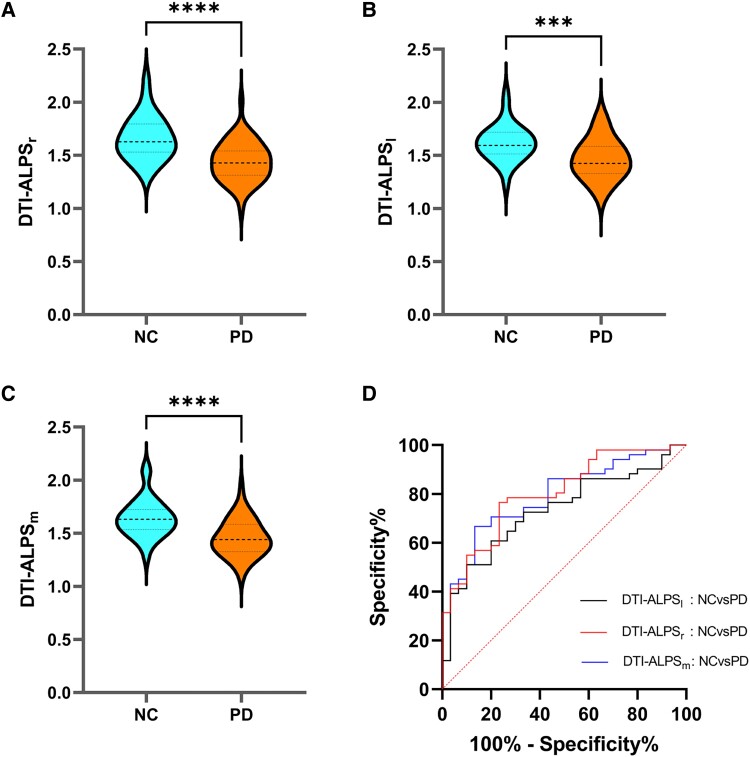
淋巴系统可能在帕金森病相关的认知障碍中发挥核心作用,但其与区域皮质萎缩的关系尚未得到充分探讨。为了探讨帕金森病患者的淋巴功能障碍、区域皮质退化和认知障碍之间的关系,我们评估了51名帕金森病患者(28名男性;年龄(61.65±8.27岁)和30名年龄和性别匹配的正常对照(男性11名;年龄59.2±5.90岁),接受3.0 t脑MRI检查,包括高分辨率t1加权成像和沿血管周围间隙扩散张量成像,作为淋巴血流的替代。基于三维t1加权序列自动分割皮层灰质体积。采用简易精神状态检查评估认知功能。探讨淋巴功能障碍、认知能力下降与区域皮质变性之间的关系。与正常对照相比,帕金森病患者沿血管周围空间的弥散张量成像(1.45±0.17 vs 1.64±0.17,P < 0.0001)较低,表明淋巴血流紊乱。淋巴功能障碍与认知评分相关(r = 0.54, P = 0.003)。沿血管周围空间的弥散张量成像值与特定皮质区域的体积呈正相关(所有p值)
Glymphatic dysfunction exacerbates cognitive decline by triggering cortical degeneration in Parkinson's disease: evidence from diffusion-tensor MRI.
The glymphatic system may play a central role in cognitive impairment associated with Parkinson's disease, but its relationship with regional cortical atrophy is not fully explored. To explore associations among glymphatic dysfunction, regional cortical degeneration and cognitive impairment in Parkinson's disease participants, we evaluated 51 participants with documented Parkinson's disease (28 men; age, 61.65 ± 8.27 years) and 30 age- and sex-matched normal controls (11 men; age, 59.2 ± 5.90 years) who underwent 3.0-T MRI of the brain, including high-resolution T1-weighted imaging and diffusion-tensor imaging along the perivascular space as a surrogate for glymphatic flow. Cortical grey matter volume was segmented automatically based on three-dimensional T1-weighted sequences. Cognitive function was assessed by Mini-Mental State Examination. The relationship between glymphatic dysfunction, cognitive decline and regional cortical degeneration was explored. The participants with Parkinson's disease revealed lower diffusion-tensor imaging along the perivascular space (1.45 ± 0.17 versus 1.64 ± 0.17, P < 0.0001) as compared with normal controls, indicating disturbed glymphatic flow. Glymphatic dysfunction was associated with cognitive scores (r = 0.54, P = 0.003). Diffusion-tensor imaging along the perivascular space values were positively associated with the volume of specific cortical regions (all P-values <0.05) including the temporal pole, posterior orbital gyrus, orbital part of the inferior frontal gyrus, frontal operculum, central operculum and anterior cingulate gyrus. Mediation analysis within the Parkinson's disease participants indicated that the relationship between glymphatic dysfunction and cognitive scores was partially mediated by the integrity of orbital part of the inferior frontal gyrus and anterior cingulate gyrus. Glymphatic dysfunction is associated with cognitive decline in Parkinson's disease, whereas the distribution of regional cortical degeneration may constitute the link between glymphatic dysfunction and cognitive impairment.






 京公网安备 11010802042870号
京ICP备2023020795号-1
京公网安备 11010802042870号
京ICP备2023020795号-1

 分享
分享

 求助内容:
求助内容: 应助结果提醒方式:
 扫码关注我们
