Tathiana M. Kokumai, Larissa E. R. Ferreira, Guilherme B. Strapasson, Lea Pasquale, Liberato Manna, Massimo Colombo, Daniela Zanchet
{"title":"从调制-激发光谱分析Pt几何位在WGS反应中的作用","authors":"Tathiana M. Kokumai, Larissa E. R. Ferreira, Guilherme B. Strapasson, Lea Pasquale, Liberato Manna, Massimo Colombo, Daniela Zanchet","doi":"10.1021/acsami.4c21397","DOIUrl":null,"url":null,"abstract":"Modulation-excitation spectroscopy coupled to diffuse reflectance infrared Fourier transform spectroscopy (ME-DRIFTS) was explored in this work to obtain valuable insights into the structure–reactivity relations in nanostructured Pt catalysts for the water–gas shift (WGS) reaction. By using model Pt catalytic systems composed of colloidal Pt nanoparticles (NPs) deposited on CeO<sub>2</sub> (i.e., reducible) and SiO<sub>2</sub> (i.e., nonreducible) supports, it was possible to probe distinct Pt active sites and correlate them to the reaction intermediates and pathways. The analysis revealed that PtNPs/SiO<sub>2</sub> favored the participation of well-coordinated (WC) and under-coordinated (UC) Pt sites in the reaction mechanism. In contrast, on PtNPs/CeO<sub>2</sub>/SiO<sub>2</sub>, the additional involvement of highly under-coordinated (HUC) Pt sites was also observed. Additionally, both fast and slow formate species were identified as active intermediates on the surface of the PtNPs/CeO<sub>2</sub>/SiO<sub>2</sub> catalyst by ME-DRIFTS. More importantly, the faster reaction pathway was correlated to HUC and UC Pt sites, while the slower route was associated with WC Pt sites. Carbonates, on the other hand, were spectators. ME-DRIFTS experimentally demonstrate differences in the participation of Pt active sites according to the support, the involvement of interfacial sites, and the correlation of Pt local coordination to the surface intermediates in the WGS reaction.","PeriodicalId":5,"journal":{"name":"ACS Applied Materials & Interfaces","volume":"85 1","pages":""},"PeriodicalIF":7.8000,"publicationDate":"2025-02-22","publicationTypes":"Journal Article","fieldsOfStudy":null,"isOpenAccess":false,"openAccessPdf":"","citationCount":"0","resultStr":"{\"title\":\"Insights from Modulation-Excitation Spectroscopy into the Role of Pt Geometrical Sites in the WGS Reaction\",\"authors\":\"Tathiana M. Kokumai, Larissa E. R. Ferreira, Guilherme B. Strapasson, Lea Pasquale, Liberato Manna, Massimo Colombo, Daniela Zanchet\",\"doi\":\"10.1021/acsami.4c21397\",\"DOIUrl\":null,\"url\":null,\"abstract\":\"Modulation-excitation spectroscopy coupled to diffuse reflectance infrared Fourier transform spectroscopy (ME-DRIFTS) was explored in this work to obtain valuable insights into the structure–reactivity relations in nanostructured Pt catalysts for the water–gas shift (WGS) reaction. By using model Pt catalytic systems composed of colloidal Pt nanoparticles (NPs) deposited on CeO<sub>2</sub> (i.e., reducible) and SiO<sub>2</sub> (i.e., nonreducible) supports, it was possible to probe distinct Pt active sites and correlate them to the reaction intermediates and pathways. The analysis revealed that PtNPs/SiO<sub>2</sub> favored the participation of well-coordinated (WC) and under-coordinated (UC) Pt sites in the reaction mechanism. In contrast, on PtNPs/CeO<sub>2</sub>/SiO<sub>2</sub>, the additional involvement of highly under-coordinated (HUC) Pt sites was also observed. Additionally, both fast and slow formate species were identified as active intermediates on the surface of the PtNPs/CeO<sub>2</sub>/SiO<sub>2</sub> catalyst by ME-DRIFTS. More importantly, the faster reaction pathway was correlated to HUC and UC Pt sites, while the slower route was associated with WC Pt sites. Carbonates, on the other hand, were spectators. ME-DRIFTS experimentally demonstrate differences in the participation of Pt active sites according to the support, the involvement of interfacial sites, and the correlation of Pt local coordination to the surface intermediates in the WGS reaction.\",\"PeriodicalId\":5,\"journal\":{\"name\":\"ACS Applied Materials & Interfaces\",\"volume\":\"85 1\",\"pages\":\"\"},\"PeriodicalIF\":7.8000,\"publicationDate\":\"2025-02-22\",\"publicationTypes\":\"Journal Article\",\"fieldsOfStudy\":null,\"isOpenAccess\":false,\"openAccessPdf\":\"\",\"citationCount\":\"0\",\"resultStr\":null,\"platform\":\"Semanticscholar\",\"paperid\":null,\"PeriodicalName\":\"ACS Applied Materials & Interfaces\",\"FirstCategoryId\":\"88\",\"ListUrlMain\":\"https://doi.org/10.1021/acsami.4c21397\",\"RegionNum\":2,\"RegionCategory\":\"材料科学\",\"ArticlePicture\":[],\"TitleCN\":null,\"AbstractTextCN\":null,\"PMCID\":null,\"EPubDate\":\"\",\"PubModel\":\"\",\"JCR\":\"Q1\",\"JCRName\":\"MATERIALS SCIENCE, MULTIDISCIPLINARY\",\"Score\":null,\"Total\":0}","platform":"Semanticscholar","paperid":null,"PeriodicalName":"ACS Applied Materials & Interfaces","FirstCategoryId":"88","ListUrlMain":"https://doi.org/10.1021/acsami.4c21397","RegionNum":2,"RegionCategory":"材料科学","ArticlePicture":[],"TitleCN":null,"AbstractTextCN":null,"PMCID":null,"EPubDate":"","PubModel":"","JCR":"Q1","JCRName":"MATERIALS SCIENCE, MULTIDISCIPLINARY","Score":null,"Total":0}
Insights from Modulation-Excitation Spectroscopy into the Role of Pt Geometrical Sites in the WGS Reaction
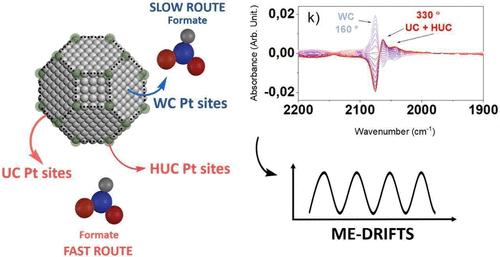
Modulation-excitation spectroscopy coupled to diffuse reflectance infrared Fourier transform spectroscopy (ME-DRIFTS) was explored in this work to obtain valuable insights into the structure–reactivity relations in nanostructured Pt catalysts for the water–gas shift (WGS) reaction. By using model Pt catalytic systems composed of colloidal Pt nanoparticles (NPs) deposited on CeO2 (i.e., reducible) and SiO2 (i.e., nonreducible) supports, it was possible to probe distinct Pt active sites and correlate them to the reaction intermediates and pathways. The analysis revealed that PtNPs/SiO2 favored the participation of well-coordinated (WC) and under-coordinated (UC) Pt sites in the reaction mechanism. In contrast, on PtNPs/CeO2/SiO2, the additional involvement of highly under-coordinated (HUC) Pt sites was also observed. Additionally, both fast and slow formate species were identified as active intermediates on the surface of the PtNPs/CeO2/SiO2 catalyst by ME-DRIFTS. More importantly, the faster reaction pathway was correlated to HUC and UC Pt sites, while the slower route was associated with WC Pt sites. Carbonates, on the other hand, were spectators. ME-DRIFTS experimentally demonstrate differences in the participation of Pt active sites according to the support, the involvement of interfacial sites, and the correlation of Pt local coordination to the surface intermediates in the WGS reaction.
期刊介绍:
ACS Applied Materials & Interfaces is a leading interdisciplinary journal that brings together chemists, engineers, physicists, and biologists to explore the development and utilization of newly-discovered materials and interfacial processes for specific applications. Our journal has experienced remarkable growth since its establishment in 2009, both in terms of the number of articles published and the impact of the research showcased. We are proud to foster a truly global community, with the majority of published articles originating from outside the United States, reflecting the rapid growth of applied research worldwide.




 京公网安备 11010802042870号
京ICP备2023020795号-1
京公网安备 11010802042870号
京ICP备2023020795号-1

 分享
分享
 求助内容:
求助内容: 应助结果提醒方式:
 扫码关注我们
