Min-Jun Sung, Kwan-Nyeong Kim, Chunghee Kim, Hyun-Haeng Lee, Seung-Woo Lee, Somin Kim, Dae-Gyo Seo, Huanyu Zhou, Tae-Woo Lee
{"title":"有机人工神经:神经形态机器人学和生物电子学","authors":"Min-Jun Sung, Kwan-Nyeong Kim, Chunghee Kim, Hyun-Haeng Lee, Seung-Woo Lee, Somin Kim, Dae-Gyo Seo, Huanyu Zhou, Tae-Woo Lee","doi":"10.1021/acs.chemrev.4c00571","DOIUrl":null,"url":null,"abstract":"Neuromorphic electronics are inspired by the human brain’s compact, energy-efficient nature and its parallel-processing capabilities. Beyond the brain, the entire human nervous system, with its hierarchical structure, efficiently preprocesses complex sensory information to support high-level neural functions such as perception and memory. Emulating these biological processes, artificial nerve electronics have been developed to replicate the energy-efficient preprocessing observed in human nerves. These systems integrate sensors, artificial neurons, artificial synapses, and actuators to mimic sensory and motor functions, surpassing conventional circuits in sensor-integrated electronics. Organic synaptic transistors (OSTs) are key components in constructing artificial nerves, offering tunable synaptic plasticity for complex sensory processing and the mechanical flexibility required for applications in soft robotics and bioelectronics. Compared to traditional sensor-integrated electronics, early implementations of organic artificial nerves (OANs) incorporating OSTs have demonstrated a higher signal-to-noise ratio, lower power consumption, and simpler circuit designs along with on-device processing capabilities and precise control of actuators and biological limbs, driving progress in neuromorphic robotics and bioelectronics. This paper reviews the materials, device engineering, and system integration of the OAN design, highlights recent advancements in neuromorphic robotics and bioelectronics utilizing the OANs, and discusses current challenges and future research directions.","PeriodicalId":32,"journal":{"name":"Chemical Reviews","volume":"29 1","pages":""},"PeriodicalIF":55.8000,"publicationDate":"2025-02-21","publicationTypes":"Journal Article","fieldsOfStudy":null,"isOpenAccess":false,"openAccessPdf":"","citationCount":"0","resultStr":"{\"title\":\"Organic Artificial Nerves: Neuromorphic Robotics and Bioelectronics\",\"authors\":\"Min-Jun Sung, Kwan-Nyeong Kim, Chunghee Kim, Hyun-Haeng Lee, Seung-Woo Lee, Somin Kim, Dae-Gyo Seo, Huanyu Zhou, Tae-Woo Lee\",\"doi\":\"10.1021/acs.chemrev.4c00571\",\"DOIUrl\":null,\"url\":null,\"abstract\":\"Neuromorphic electronics are inspired by the human brain’s compact, energy-efficient nature and its parallel-processing capabilities. Beyond the brain, the entire human nervous system, with its hierarchical structure, efficiently preprocesses complex sensory information to support high-level neural functions such as perception and memory. Emulating these biological processes, artificial nerve electronics have been developed to replicate the energy-efficient preprocessing observed in human nerves. These systems integrate sensors, artificial neurons, artificial synapses, and actuators to mimic sensory and motor functions, surpassing conventional circuits in sensor-integrated electronics. Organic synaptic transistors (OSTs) are key components in constructing artificial nerves, offering tunable synaptic plasticity for complex sensory processing and the mechanical flexibility required for applications in soft robotics and bioelectronics. Compared to traditional sensor-integrated electronics, early implementations of organic artificial nerves (OANs) incorporating OSTs have demonstrated a higher signal-to-noise ratio, lower power consumption, and simpler circuit designs along with on-device processing capabilities and precise control of actuators and biological limbs, driving progress in neuromorphic robotics and bioelectronics. This paper reviews the materials, device engineering, and system integration of the OAN design, highlights recent advancements in neuromorphic robotics and bioelectronics utilizing the OANs, and discusses current challenges and future research directions.\",\"PeriodicalId\":32,\"journal\":{\"name\":\"Chemical Reviews\",\"volume\":\"29 1\",\"pages\":\"\"},\"PeriodicalIF\":55.8000,\"publicationDate\":\"2025-02-21\",\"publicationTypes\":\"Journal Article\",\"fieldsOfStudy\":null,\"isOpenAccess\":false,\"openAccessPdf\":\"\",\"citationCount\":\"0\",\"resultStr\":null,\"platform\":\"Semanticscholar\",\"paperid\":null,\"PeriodicalName\":\"Chemical Reviews\",\"FirstCategoryId\":\"92\",\"ListUrlMain\":\"https://doi.org/10.1021/acs.chemrev.4c00571\",\"RegionNum\":1,\"RegionCategory\":\"化学\",\"ArticlePicture\":[],\"TitleCN\":null,\"AbstractTextCN\":null,\"PMCID\":null,\"EPubDate\":\"\",\"PubModel\":\"\",\"JCR\":\"Q1\",\"JCRName\":\"CHEMISTRY, MULTIDISCIPLINARY\",\"Score\":null,\"Total\":0}","platform":"Semanticscholar","paperid":null,"PeriodicalName":"Chemical Reviews","FirstCategoryId":"92","ListUrlMain":"https://doi.org/10.1021/acs.chemrev.4c00571","RegionNum":1,"RegionCategory":"化学","ArticlePicture":[],"TitleCN":null,"AbstractTextCN":null,"PMCID":null,"EPubDate":"","PubModel":"","JCR":"Q1","JCRName":"CHEMISTRY, MULTIDISCIPLINARY","Score":null,"Total":0}
Organic Artificial Nerves: Neuromorphic Robotics and Bioelectronics
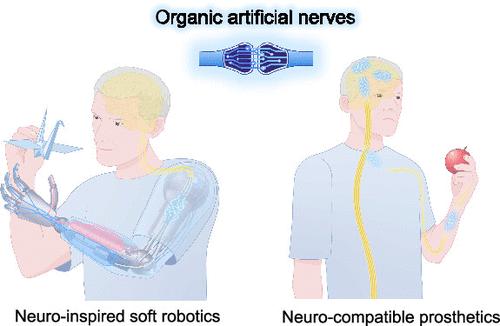
Neuromorphic electronics are inspired by the human brain’s compact, energy-efficient nature and its parallel-processing capabilities. Beyond the brain, the entire human nervous system, with its hierarchical structure, efficiently preprocesses complex sensory information to support high-level neural functions such as perception and memory. Emulating these biological processes, artificial nerve electronics have been developed to replicate the energy-efficient preprocessing observed in human nerves. These systems integrate sensors, artificial neurons, artificial synapses, and actuators to mimic sensory and motor functions, surpassing conventional circuits in sensor-integrated electronics. Organic synaptic transistors (OSTs) are key components in constructing artificial nerves, offering tunable synaptic plasticity for complex sensory processing and the mechanical flexibility required for applications in soft robotics and bioelectronics. Compared to traditional sensor-integrated electronics, early implementations of organic artificial nerves (OANs) incorporating OSTs have demonstrated a higher signal-to-noise ratio, lower power consumption, and simpler circuit designs along with on-device processing capabilities and precise control of actuators and biological limbs, driving progress in neuromorphic robotics and bioelectronics. This paper reviews the materials, device engineering, and system integration of the OAN design, highlights recent advancements in neuromorphic robotics and bioelectronics utilizing the OANs, and discusses current challenges and future research directions.
期刊介绍:
Chemical Reviews is a highly regarded and highest-ranked journal covering the general topic of chemistry. Its mission is to provide comprehensive, authoritative, critical, and readable reviews of important recent research in organic, inorganic, physical, analytical, theoretical, and biological chemistry.
Since 1985, Chemical Reviews has also published periodic thematic issues that focus on a single theme or direction of emerging research.





 京公网安备 11010802042870号
京ICP备2023020795号-1
京公网安备 11010802042870号
京ICP备2023020795号-1

 分享
分享
 求助内容:
求助内容: 应助结果提醒方式:
 扫码关注我们
