Jie Pi , Yangxin Tang , Ying Fu , Xu Wang , Linwei Liu , Xinhua Liu , Jianguo Xiang , Deliang Li
{"title":"双壳类植物Corbicula fluminea精子发生及三个倍性水平精子的超微结构","authors":"Jie Pi , Yangxin Tang , Ying Fu , Xu Wang , Linwei Liu , Xinhua Liu , Jianguo Xiang , Deliang Li","doi":"10.1016/j.tice.2025.102797","DOIUrl":null,"url":null,"abstract":"<div><div>A histological and ultrastructural examination of spermatogenesis and spermatozoa in diploid, triploid and tetraploid <em>Corbicula fluminea</em> was conducted. In the Yangtze River estuary, the spermatozoa of <em>C. flumiena</em> exhibited a primitive uniflagellate structure, whereas a modified biflagellate morphology was observed in inland freshwater habitats. This study presents the initial observation of sperm morula in spermatogenesis in <em>C. fluminea</em>. The mature spermatozoa were released as single cells and as spermatozeugmata. It was observed that uniflagellate spermatozoa undergo two meiotic divisions during it formation, whereas biflagellate spermatozoa undergo only one. The uniflagellate and biflagellate spermatozoa were observed to comprise of three distinct parts: the head, middle piece and tail. The longest and shortest spermatozoa (69.24 μm ± 1.70 <em>vs</em> 54.11 μm ± 1.26) were both biflagellate spermatozoa, originating from tetraploid and diploid individuals, respectively. The number of mitochondria was observed to increase in accordance with ploidy. In the uniflagellate spermatozoa, the two centrioles were observed to be oriented perpendicular to each other. In contrast, the two centrioles were oriented in parallel with each other in biflagellate spermatozoa, with each centriole attaching a flagellum. The undulating membrane of the tail contains a substantial number of glycogen granules. The differences in spermiogenesis, sperm morphology and structure between <em>C. flumiena</em> from estuarine (amphogenesis and in vitro development) and inland freshwater habitats (androgenesis and brooding larvae in the inner demibranch) result in better adaptations to the respective reproduction modes.</div></div>","PeriodicalId":23201,"journal":{"name":"Tissue & cell","volume":"94 ","pages":"Article 102797"},"PeriodicalIF":2.5000,"publicationDate":"2025-06-01","publicationTypes":"Journal Article","fieldsOfStudy":null,"isOpenAccess":false,"openAccessPdf":"","citationCount":"0","resultStr":"{\"title\":\"Spermatogenesis and ultrastructure of the spermatozoa at three ploidy levels in the bivalve species, Corbicula fluminea\",\"authors\":\"Jie Pi , Yangxin Tang , Ying Fu , Xu Wang , Linwei Liu , Xinhua Liu , Jianguo Xiang , Deliang Li\",\"doi\":\"10.1016/j.tice.2025.102797\",\"DOIUrl\":null,\"url\":null,\"abstract\":\"<div><div>A histological and ultrastructural examination of spermatogenesis and spermatozoa in diploid, triploid and tetraploid <em>Corbicula fluminea</em> was conducted. In the Yangtze River estuary, the spermatozoa of <em>C. flumiena</em> exhibited a primitive uniflagellate structure, whereas a modified biflagellate morphology was observed in inland freshwater habitats. This study presents the initial observation of sperm morula in spermatogenesis in <em>C. fluminea</em>. The mature spermatozoa were released as single cells and as spermatozeugmata. It was observed that uniflagellate spermatozoa undergo two meiotic divisions during it formation, whereas biflagellate spermatozoa undergo only one. The uniflagellate and biflagellate spermatozoa were observed to comprise of three distinct parts: the head, middle piece and tail. The longest and shortest spermatozoa (69.24 μm ± 1.70 <em>vs</em> 54.11 μm ± 1.26) were both biflagellate spermatozoa, originating from tetraploid and diploid individuals, respectively. The number of mitochondria was observed to increase in accordance with ploidy. In the uniflagellate spermatozoa, the two centrioles were observed to be oriented perpendicular to each other. In contrast, the two centrioles were oriented in parallel with each other in biflagellate spermatozoa, with each centriole attaching a flagellum. The undulating membrane of the tail contains a substantial number of glycogen granules. The differences in spermiogenesis, sperm morphology and structure between <em>C. flumiena</em> from estuarine (amphogenesis and in vitro development) and inland freshwater habitats (androgenesis and brooding larvae in the inner demibranch) result in better adaptations to the respective reproduction modes.</div></div>\",\"PeriodicalId\":23201,\"journal\":{\"name\":\"Tissue & cell\",\"volume\":\"94 \",\"pages\":\"Article 102797\"},\"PeriodicalIF\":2.5000,\"publicationDate\":\"2025-06-01\",\"publicationTypes\":\"Journal Article\",\"fieldsOfStudy\":null,\"isOpenAccess\":false,\"openAccessPdf\":\"\",\"citationCount\":\"0\",\"resultStr\":null,\"platform\":\"Semanticscholar\",\"paperid\":null,\"PeriodicalName\":\"Tissue & cell\",\"FirstCategoryId\":\"99\",\"ListUrlMain\":\"https://www.sciencedirect.com/science/article/pii/S0040816625000771\",\"RegionNum\":4,\"RegionCategory\":\"生物学\",\"ArticlePicture\":[],\"TitleCN\":null,\"AbstractTextCN\":null,\"PMCID\":null,\"EPubDate\":\"2025/2/17 0:00:00\",\"PubModel\":\"Epub\",\"JCR\":\"Q1\",\"JCRName\":\"ANATOMY & MORPHOLOGY\",\"Score\":null,\"Total\":0}","platform":"Semanticscholar","paperid":null,"PeriodicalName":"Tissue & cell","FirstCategoryId":"99","ListUrlMain":"https://www.sciencedirect.com/science/article/pii/S0040816625000771","RegionNum":4,"RegionCategory":"生物学","ArticlePicture":[],"TitleCN":null,"AbstractTextCN":null,"PMCID":null,"EPubDate":"2025/2/17 0:00:00","PubModel":"Epub","JCR":"Q1","JCRName":"ANATOMY & MORPHOLOGY","Score":null,"Total":0}
引用次数: 0
摘要
对二倍体、三倍体和四倍体河蚬的精子发生和精子进行了组织学和超微结构检查。在长江口地区,氟螺精子表现为原始的单鞭毛结构,而在内陆淡水生境中则表现为改良的双鞭毛形态。本研究报道了氟蝇精子发生过程中精子桑葚胚的初步观察。成熟精子分别以单细胞和精胚形式释放。单鞭毛精子在形成过程中经历两次减数分裂,而双鞭毛精子只经历一次减数分裂。观察到单鞭毛和双鞭毛精子由三个不同的部分组成:头部、中间部分和尾部。最长和最短的精子(69.24 μm± 1.70 vs 54.11 μm± 1.26)均为双鞭毛精子,分别来自四倍体和二倍体个体。线粒体数量随倍性的增加而增加。在单鞭毛精子中,观察到两个中心粒彼此垂直。而在双鞭毛精子中,两个中心粒平行排列,每个中心粒附着一个鞭毛。尾部的波状膜含有大量的糖原颗粒。来自河口(两性发生和体外发育)和内陆淡水生境(雄激素发生和内半分支孵育幼虫)的黄颡鱼在精子发生、精子形态和结构上的差异,使其更好地适应各自的生殖模式。
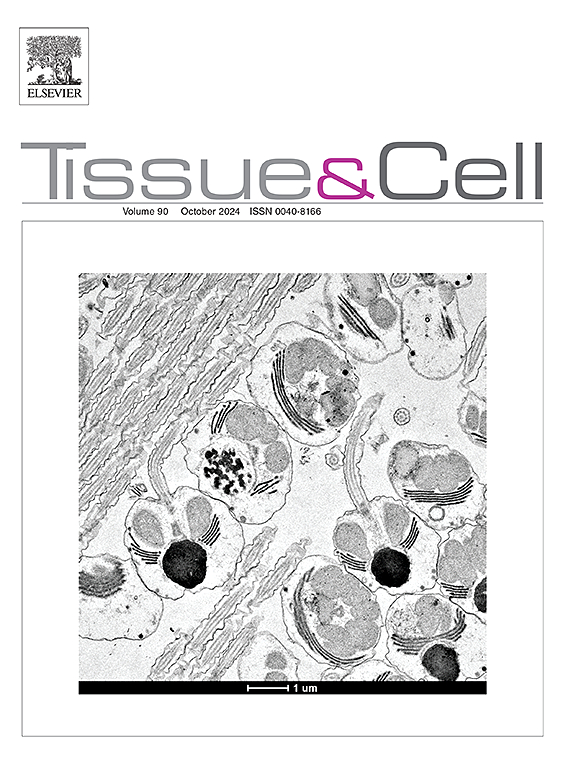
Spermatogenesis and ultrastructure of the spermatozoa at three ploidy levels in the bivalve species, Corbicula fluminea
A histological and ultrastructural examination of spermatogenesis and spermatozoa in diploid, triploid and tetraploid Corbicula fluminea was conducted. In the Yangtze River estuary, the spermatozoa of C. flumiena exhibited a primitive uniflagellate structure, whereas a modified biflagellate morphology was observed in inland freshwater habitats. This study presents the initial observation of sperm morula in spermatogenesis in C. fluminea. The mature spermatozoa were released as single cells and as spermatozeugmata. It was observed that uniflagellate spermatozoa undergo two meiotic divisions during it formation, whereas biflagellate spermatozoa undergo only one. The uniflagellate and biflagellate spermatozoa were observed to comprise of three distinct parts: the head, middle piece and tail. The longest and shortest spermatozoa (69.24 μm ± 1.70 vs 54.11 μm ± 1.26) were both biflagellate spermatozoa, originating from tetraploid and diploid individuals, respectively. The number of mitochondria was observed to increase in accordance with ploidy. In the uniflagellate spermatozoa, the two centrioles were observed to be oriented perpendicular to each other. In contrast, the two centrioles were oriented in parallel with each other in biflagellate spermatozoa, with each centriole attaching a flagellum. The undulating membrane of the tail contains a substantial number of glycogen granules. The differences in spermiogenesis, sperm morphology and structure between C. flumiena from estuarine (amphogenesis and in vitro development) and inland freshwater habitats (androgenesis and brooding larvae in the inner demibranch) result in better adaptations to the respective reproduction modes.
期刊介绍:
Tissue and Cell is devoted to original research on the organization of cells, subcellular and extracellular components at all levels, including the grouping and interrelations of cells in tissues and organs. The journal encourages submission of ultrastructural studies that provide novel insights into structure, function and physiology of cells and tissues, in health and disease. Bioengineering and stem cells studies focused on the description of morphological and/or histological data are also welcomed.
Studies investigating the effect of compounds and/or substances on structure of cells and tissues are generally outside the scope of this journal. For consideration, studies should contain a clear rationale on the use of (a) given substance(s), have a compelling morphological and structural focus and present novel incremental findings from previous literature.




 京公网安备 11010802042870号
京ICP备2023020795号-1
京公网安备 11010802042870号
京ICP备2023020795号-1

 分享
分享
 求助内容:
求助内容: 应助结果提醒方式:
 扫码关注我们
