Junyi Pi , Zilong Zhu , Xinxin Sang , Hongchen Ji , Ren Liu
{"title":"近红外诱导光热协同固化:提高玻璃纤维增强复合材料的施工效率和固化均匀性","authors":"Junyi Pi , Zilong Zhu , Xinxin Sang , Hongchen Ji , Ren Liu","doi":"10.1016/j.compositesb.2025.112320","DOIUrl":null,"url":null,"abstract":"<div><div>The efficient, mild, and convenient photopolymerization technology offers a promising green fabrication method for composites and has already been successfully applied in structural repair and outdoor manufacture. In previous studies, a method was developed for producing thick glass fiber-reinforced composites (GFRPC) of up to 20 mm based on upconversion assisted near-infrared photopolymerization (UCAP). Photo-thermal dual curing can further improve both curing uniformity and efficiency. The present work fully utilized the synergistic photothermal effects of UCAP. Near-infrared induced the cleavage of Phenylbis(2,4,6-trimethylbenzoyl)phosphine oxide (BAPO) to generate benzoyl radicals, while benzopinacol (BPNC) thermally decomposed into benzophenone radicals, jointly promoting acrylate matrix crosslinking. When the thickness of GFRPC reached 15 mm, the curing time was reduced to 60 s, achieving double bond conversion of 81 % and 71 % on the top and bottom surfaces, respectively. Compared to the BAPO/UCAP photoinitiated system, the BPNC/BAPO/UCAP photo-thermal synergistic system significantly enhanced both the curing efficiency and uniformity of GFRPC. The resulting GFRPC exhibited an interfacial shear strength (IFSS) of 37.15 MPa, a flexural strength of 506.85 MPa, and an increased impact toughness of 242.70 kJ/m<sup>2</sup>. The photo-thermal synergistic curing method effectively facilitated the construction of reliable GFRPC with enhanced properties, thereby bolstering the potential for rapid manufacturing of high-performance GFRPC in outdoor applications using photopolymerization techniques.</div></div>","PeriodicalId":10660,"journal":{"name":"Composites Part B: Engineering","volume":"297 ","pages":"Article 112320"},"PeriodicalIF":14.2000,"publicationDate":"2025-05-15","publicationTypes":"Journal Article","fieldsOfStudy":null,"isOpenAccess":false,"openAccessPdf":"","citationCount":"0","resultStr":"{\"title\":\"Near-infrared induced photo-thermal synergistic curing: Enhancing the construction efficiency and curing uniformity of glass fiber reinforced composites\",\"authors\":\"Junyi Pi , Zilong Zhu , Xinxin Sang , Hongchen Ji , Ren Liu\",\"doi\":\"10.1016/j.compositesb.2025.112320\",\"DOIUrl\":null,\"url\":null,\"abstract\":\"<div><div>The efficient, mild, and convenient photopolymerization technology offers a promising green fabrication method for composites and has already been successfully applied in structural repair and outdoor manufacture. In previous studies, a method was developed for producing thick glass fiber-reinforced composites (GFRPC) of up to 20 mm based on upconversion assisted near-infrared photopolymerization (UCAP). Photo-thermal dual curing can further improve both curing uniformity and efficiency. The present work fully utilized the synergistic photothermal effects of UCAP. Near-infrared induced the cleavage of Phenylbis(2,4,6-trimethylbenzoyl)phosphine oxide (BAPO) to generate benzoyl radicals, while benzopinacol (BPNC) thermally decomposed into benzophenone radicals, jointly promoting acrylate matrix crosslinking. When the thickness of GFRPC reached 15 mm, the curing time was reduced to 60 s, achieving double bond conversion of 81 % and 71 % on the top and bottom surfaces, respectively. Compared to the BAPO/UCAP photoinitiated system, the BPNC/BAPO/UCAP photo-thermal synergistic system significantly enhanced both the curing efficiency and uniformity of GFRPC. The resulting GFRPC exhibited an interfacial shear strength (IFSS) of 37.15 MPa, a flexural strength of 506.85 MPa, and an increased impact toughness of 242.70 kJ/m<sup>2</sup>. The photo-thermal synergistic curing method effectively facilitated the construction of reliable GFRPC with enhanced properties, thereby bolstering the potential for rapid manufacturing of high-performance GFRPC in outdoor applications using photopolymerization techniques.</div></div>\",\"PeriodicalId\":10660,\"journal\":{\"name\":\"Composites Part B: Engineering\",\"volume\":\"297 \",\"pages\":\"Article 112320\"},\"PeriodicalIF\":14.2000,\"publicationDate\":\"2025-05-15\",\"publicationTypes\":\"Journal Article\",\"fieldsOfStudy\":null,\"isOpenAccess\":false,\"openAccessPdf\":\"\",\"citationCount\":\"0\",\"resultStr\":null,\"platform\":\"Semanticscholar\",\"paperid\":null,\"PeriodicalName\":\"Composites Part B: Engineering\",\"FirstCategoryId\":\"5\",\"ListUrlMain\":\"https://www.sciencedirect.com/science/article/pii/S1359836825002100\",\"RegionNum\":1,\"RegionCategory\":\"材料科学\",\"ArticlePicture\":[],\"TitleCN\":null,\"AbstractTextCN\":null,\"PMCID\":null,\"EPubDate\":\"2025/2/19 0:00:00\",\"PubModel\":\"Epub\",\"JCR\":\"Q1\",\"JCRName\":\"ENGINEERING, MULTIDISCIPLINARY\",\"Score\":null,\"Total\":0}","platform":"Semanticscholar","paperid":null,"PeriodicalName":"Composites Part B: Engineering","FirstCategoryId":"5","ListUrlMain":"https://www.sciencedirect.com/science/article/pii/S1359836825002100","RegionNum":1,"RegionCategory":"材料科学","ArticlePicture":[],"TitleCN":null,"AbstractTextCN":null,"PMCID":null,"EPubDate":"2025/2/19 0:00:00","PubModel":"Epub","JCR":"Q1","JCRName":"ENGINEERING, MULTIDISCIPLINARY","Score":null,"Total":0}
Near-infrared induced photo-thermal synergistic curing: Enhancing the construction efficiency and curing uniformity of glass fiber reinforced composites
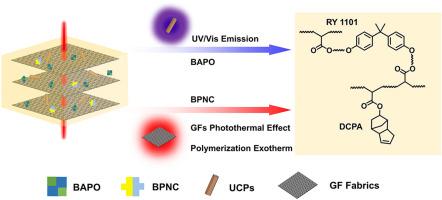
The efficient, mild, and convenient photopolymerization technology offers a promising green fabrication method for composites and has already been successfully applied in structural repair and outdoor manufacture. In previous studies, a method was developed for producing thick glass fiber-reinforced composites (GFRPC) of up to 20 mm based on upconversion assisted near-infrared photopolymerization (UCAP). Photo-thermal dual curing can further improve both curing uniformity and efficiency. The present work fully utilized the synergistic photothermal effects of UCAP. Near-infrared induced the cleavage of Phenylbis(2,4,6-trimethylbenzoyl)phosphine oxide (BAPO) to generate benzoyl radicals, while benzopinacol (BPNC) thermally decomposed into benzophenone radicals, jointly promoting acrylate matrix crosslinking. When the thickness of GFRPC reached 15 mm, the curing time was reduced to 60 s, achieving double bond conversion of 81 % and 71 % on the top and bottom surfaces, respectively. Compared to the BAPO/UCAP photoinitiated system, the BPNC/BAPO/UCAP photo-thermal synergistic system significantly enhanced both the curing efficiency and uniformity of GFRPC. The resulting GFRPC exhibited an interfacial shear strength (IFSS) of 37.15 MPa, a flexural strength of 506.85 MPa, and an increased impact toughness of 242.70 kJ/m2. The photo-thermal synergistic curing method effectively facilitated the construction of reliable GFRPC with enhanced properties, thereby bolstering the potential for rapid manufacturing of high-performance GFRPC in outdoor applications using photopolymerization techniques.
期刊介绍:
Composites Part B: Engineering is a journal that publishes impactful research of high quality on composite materials. This research is supported by fundamental mechanics and materials science and engineering approaches. The targeted research can cover a wide range of length scales, ranging from nano to micro and meso, and even to the full product and structure level. The journal specifically focuses on engineering applications that involve high performance composites. These applications can range from low volume and high cost to high volume and low cost composite development.
The main goal of the journal is to provide a platform for the prompt publication of original and high quality research. The emphasis is on design, development, modeling, validation, and manufacturing of engineering details and concepts. The journal welcomes both basic research papers and proposals for review articles. Authors are encouraged to address challenges across various application areas. These areas include, but are not limited to, aerospace, automotive, and other surface transportation. The journal also covers energy-related applications, with a focus on renewable energy. Other application areas include infrastructure, off-shore and maritime projects, health care technology, and recreational products.




 京公网安备 11010802042870号
京ICP备2023020795号-1
京公网安备 11010802042870号
京ICP备2023020795号-1

 分享
分享
 求助内容:
求助内容: 应助结果提醒方式:
 扫码关注我们
