Yijian Li , Xin Zhou , Anqi Zhang , Lei Sun , Shuai Wang , Feng Liu
{"title":"一锅法合成硫自掺杂分层多孔碳材料高效吸附铊(I)","authors":"Yijian Li , Xin Zhou , Anqi Zhang , Lei Sun , Shuai Wang , Feng Liu","doi":"10.1016/j.seppur.2025.132261","DOIUrl":null,"url":null,"abstract":"<div><div>In this work, sulfur self-doped hierarchical porous carbons (KLC-X-Y) were fabricated via one-pot method using inexpensive sodium lignosulphonate as carbon and sulfur source and potassium hydroxide (KOH) as activator. Through detailed analysis, it was found that the carbonization temperature and KOH addition exhibited significant effects on the porosity, phase composition, functional groups and morphology of KLC-X-Y. Among them, KLC-700–2 possessed a hierarchical porous structure, high specific surface area (851.3 m<sup>2</sup>·g<sup>−1</sup>), large pore volume (0.53 cm<sup>3</sup>·g<sup>−1</sup>), appropriate pore size distribution (D = 2.49 nm), and abundant oxygen- (<img>COOH and <img>OH) and sulfur-containing (<img>SO<sub>3</sub>H and <img>SH) functional groups. Notably, the synthesized KLC-700–2 displayed excellent adsorption performance for Tl(I) with a maximum adsorption amount of 523.7 mg·g<sup>−1</sup>. After five consecutive adsorption–desorption processes, the adsorption amount of Tl(Ⅰ) by KLC-700–2 decreased slightly, which still reached 85.6 % of the initial adsorption amount, and its own structural properties didn’t change significantly, indicating that KLC-700–2 had good stability and reusability. The adsorption process of Tl(Ⅰ) on KLC-700–2 was verified to be spontaneous and endothermic, and conformed to the pseudo second order and Langmuir models by adsorption kinetic, isotherm, and thermodynamic studies. By comparing the physicochemical properties of KLC-700–2 before and after adsorption of Tl(I), it was confirmed that the adsorption of Tl(Ⅰ) on KLC-700–2 was co-controlled by chemical and physical adsorption, including ion exchange, precipitation reaction, surface complexation, pore filling and electrostatic attraction.</div></div>","PeriodicalId":427,"journal":{"name":"Separation and Purification Technology","volume":"363 ","pages":"Article 132261"},"PeriodicalIF":9.1000,"publicationDate":"2025-08-14","publicationTypes":"Journal Article","fieldsOfStudy":null,"isOpenAccess":false,"openAccessPdf":"","citationCount":"0","resultStr":"{\"title\":\"Sulfur self-doped hierarchical porous carbon materials synthesized by one-pot method for efficient adsorption of thallium(I)\",\"authors\":\"Yijian Li , Xin Zhou , Anqi Zhang , Lei Sun , Shuai Wang , Feng Liu\",\"doi\":\"10.1016/j.seppur.2025.132261\",\"DOIUrl\":null,\"url\":null,\"abstract\":\"<div><div>In this work, sulfur self-doped hierarchical porous carbons (KLC-X-Y) were fabricated via one-pot method using inexpensive sodium lignosulphonate as carbon and sulfur source and potassium hydroxide (KOH) as activator. Through detailed analysis, it was found that the carbonization temperature and KOH addition exhibited significant effects on the porosity, phase composition, functional groups and morphology of KLC-X-Y. Among them, KLC-700–2 possessed a hierarchical porous structure, high specific surface area (851.3 m<sup>2</sup>·g<sup>−1</sup>), large pore volume (0.53 cm<sup>3</sup>·g<sup>−1</sup>), appropriate pore size distribution (D = 2.49 nm), and abundant oxygen- (<img>COOH and <img>OH) and sulfur-containing (<img>SO<sub>3</sub>H and <img>SH) functional groups. Notably, the synthesized KLC-700–2 displayed excellent adsorption performance for Tl(I) with a maximum adsorption amount of 523.7 mg·g<sup>−1</sup>. After five consecutive adsorption–desorption processes, the adsorption amount of Tl(Ⅰ) by KLC-700–2 decreased slightly, which still reached 85.6 % of the initial adsorption amount, and its own structural properties didn’t change significantly, indicating that KLC-700–2 had good stability and reusability. The adsorption process of Tl(Ⅰ) on KLC-700–2 was verified to be spontaneous and endothermic, and conformed to the pseudo second order and Langmuir models by adsorption kinetic, isotherm, and thermodynamic studies. By comparing the physicochemical properties of KLC-700–2 before and after adsorption of Tl(I), it was confirmed that the adsorption of Tl(Ⅰ) on KLC-700–2 was co-controlled by chemical and physical adsorption, including ion exchange, precipitation reaction, surface complexation, pore filling and electrostatic attraction.</div></div>\",\"PeriodicalId\":427,\"journal\":{\"name\":\"Separation and Purification Technology\",\"volume\":\"363 \",\"pages\":\"Article 132261\"},\"PeriodicalIF\":9.1000,\"publicationDate\":\"2025-08-14\",\"publicationTypes\":\"Journal Article\",\"fieldsOfStudy\":null,\"isOpenAccess\":false,\"openAccessPdf\":\"\",\"citationCount\":\"0\",\"resultStr\":null,\"platform\":\"Semanticscholar\",\"paperid\":null,\"PeriodicalName\":\"Separation and Purification Technology\",\"FirstCategoryId\":\"5\",\"ListUrlMain\":\"https://www.sciencedirect.com/science/article/pii/S1383586625008585\",\"RegionNum\":1,\"RegionCategory\":\"工程技术\",\"ArticlePicture\":[],\"TitleCN\":null,\"AbstractTextCN\":null,\"PMCID\":null,\"EPubDate\":\"2025/2/25 0:00:00\",\"PubModel\":\"Epub\",\"JCR\":\"Q1\",\"JCRName\":\"ENGINEERING, CHEMICAL\",\"Score\":null,\"Total\":0}","platform":"Semanticscholar","paperid":null,"PeriodicalName":"Separation and Purification Technology","FirstCategoryId":"5","ListUrlMain":"https://www.sciencedirect.com/science/article/pii/S1383586625008585","RegionNum":1,"RegionCategory":"工程技术","ArticlePicture":[],"TitleCN":null,"AbstractTextCN":null,"PMCID":null,"EPubDate":"2025/2/25 0:00:00","PubModel":"Epub","JCR":"Q1","JCRName":"ENGINEERING, CHEMICAL","Score":null,"Total":0}
Sulfur self-doped hierarchical porous carbon materials synthesized by one-pot method for efficient adsorption of thallium(I)
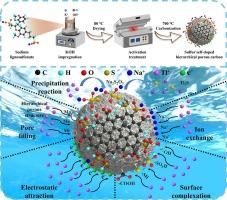
In this work, sulfur self-doped hierarchical porous carbons (KLC-X-Y) were fabricated via one-pot method using inexpensive sodium lignosulphonate as carbon and sulfur source and potassium hydroxide (KOH) as activator. Through detailed analysis, it was found that the carbonization temperature and KOH addition exhibited significant effects on the porosity, phase composition, functional groups and morphology of KLC-X-Y. Among them, KLC-700–2 possessed a hierarchical porous structure, high specific surface area (851.3 m2·g−1), large pore volume (0.53 cm3·g−1), appropriate pore size distribution (D = 2.49 nm), and abundant oxygen- (COOH and OH) and sulfur-containing (SO3H and SH) functional groups. Notably, the synthesized KLC-700–2 displayed excellent adsorption performance for Tl(I) with a maximum adsorption amount of 523.7 mg·g−1. After five consecutive adsorption–desorption processes, the adsorption amount of Tl(Ⅰ) by KLC-700–2 decreased slightly, which still reached 85.6 % of the initial adsorption amount, and its own structural properties didn’t change significantly, indicating that KLC-700–2 had good stability and reusability. The adsorption process of Tl(Ⅰ) on KLC-700–2 was verified to be spontaneous and endothermic, and conformed to the pseudo second order and Langmuir models by adsorption kinetic, isotherm, and thermodynamic studies. By comparing the physicochemical properties of KLC-700–2 before and after adsorption of Tl(I), it was confirmed that the adsorption of Tl(Ⅰ) on KLC-700–2 was co-controlled by chemical and physical adsorption, including ion exchange, precipitation reaction, surface complexation, pore filling and electrostatic attraction.
期刊介绍:
Separation and Purification Technology is a premier journal committed to sharing innovative methods for separation and purification in chemical and environmental engineering, encompassing both homogeneous solutions and heterogeneous mixtures. Our scope includes the separation and/or purification of liquids, vapors, and gases, as well as carbon capture and separation techniques. However, it's important to note that methods solely intended for analytical purposes are not within the scope of the journal. Additionally, disciplines such as soil science, polymer science, and metallurgy fall outside the purview of Separation and Purification Technology. Join us in advancing the field of separation and purification methods for sustainable solutions in chemical and environmental engineering.




 京公网安备 11010802042870号
京ICP备2023020795号-1
京公网安备 11010802042870号
京ICP备2023020795号-1

 分享
分享
 求助内容:
求助内容: 应助结果提醒方式:
 扫码关注我们
