{"title":"血清促肾上腺素水平作为预测糖尿病肾病进展的潜在生物标志物。","authors":"I-Wen Chen, Cheng-Wei Lin, Chia-Ni Lin, Szu-Tah Chen","doi":"10.3389/fendo.2025.1511730","DOIUrl":null,"url":null,"abstract":"<p><strong>Background: </strong>To investigate the value of serum adropin in predicting chronic kidney disease (CKD) progression in subjects with type 2 diabetes (T2D).</p><p><strong>Materials and methods: </strong>Serum adropin levels were measured in normal control and T2D patients with various stage of CKD. CKD progression was defined as ≥ 30% decline from the baseline estimated glomerular filtration rate. Logistic regression analysis was applied to assess the association between adropin levels and CKD progression.</p><p><strong>Results: </strong>The study included 58 subjects with T2D (18 early CKD and 40 advanced CKD) and 9 subjects without diabetes (control). Subjects with T2D had significantly higher adropin levels than controls (6393.10 ± 1611.84 vs. 3470.30 ± 1284.41 pg/ml; <i>P</i> < 0.001). Meanwhile, T2D patients with advanced CKD had higher adropin levels than those with early CKD (6848.89 ± 1287.04 vs. 5380.25 ± 1826.44 pg/ml; <i>P</i> = 0.003). Among T2D patients, subjects experienced CKD progression had higher adropin levels than those without (7520.15 ± 843.21 vs. 6151.16 ± 1661.61 pg/mL, <i>P</i> =0.003). Thus, adropin predicts CKD progression in T2D patients with 86% sensitivity and 70% specificity at 6872.24 pg/ml cutoff value. The association with CKD progression was still significant after adjusting for age, gender and body mass index (adjusted odds ratio = 27.188, 95% confidence interval 1.415-522.527, <i>P</i> =0.029).</p><p><strong>Conclusions: </strong>The above findings suggest that serum adropin could be applied as a potential biomarker for predicting CKD progression in subjects with T2D. Further research is needed to validate these results and explore the underlying mechanisms.</p>","PeriodicalId":12447,"journal":{"name":"Frontiers in Endocrinology","volume":"16 ","pages":"1511730"},"PeriodicalIF":4.6000,"publicationDate":"2025-02-07","publicationTypes":"Journal Article","fieldsOfStudy":null,"isOpenAccess":false,"openAccessPdf":"https://www.ncbi.nlm.nih.gov/pmc/articles/PMC11842233/pdf/","citationCount":"0","resultStr":"{\"title\":\"Serum adropin levels as a potential biomarker for predicting diabetic kidney disease progression.\",\"authors\":\"I-Wen Chen, Cheng-Wei Lin, Chia-Ni Lin, Szu-Tah Chen\",\"doi\":\"10.3389/fendo.2025.1511730\",\"DOIUrl\":null,\"url\":null,\"abstract\":\"<p><strong>Background: </strong>To investigate the value of serum adropin in predicting chronic kidney disease (CKD) progression in subjects with type 2 diabetes (T2D).</p><p><strong>Materials and methods: </strong>Serum adropin levels were measured in normal control and T2D patients with various stage of CKD. CKD progression was defined as ≥ 30% decline from the baseline estimated glomerular filtration rate. Logistic regression analysis was applied to assess the association between adropin levels and CKD progression.</p><p><strong>Results: </strong>The study included 58 subjects with T2D (18 early CKD and 40 advanced CKD) and 9 subjects without diabetes (control). Subjects with T2D had significantly higher adropin levels than controls (6393.10 ± 1611.84 vs. 3470.30 ± 1284.41 pg/ml; <i>P</i> < 0.001). Meanwhile, T2D patients with advanced CKD had higher adropin levels than those with early CKD (6848.89 ± 1287.04 vs. 5380.25 ± 1826.44 pg/ml; <i>P</i> = 0.003). Among T2D patients, subjects experienced CKD progression had higher adropin levels than those without (7520.15 ± 843.21 vs. 6151.16 ± 1661.61 pg/mL, <i>P</i> =0.003). Thus, adropin predicts CKD progression in T2D patients with 86% sensitivity and 70% specificity at 6872.24 pg/ml cutoff value. The association with CKD progression was still significant after adjusting for age, gender and body mass index (adjusted odds ratio = 27.188, 95% confidence interval 1.415-522.527, <i>P</i> =0.029).</p><p><strong>Conclusions: </strong>The above findings suggest that serum adropin could be applied as a potential biomarker for predicting CKD progression in subjects with T2D. Further research is needed to validate these results and explore the underlying mechanisms.</p>\",\"PeriodicalId\":12447,\"journal\":{\"name\":\"Frontiers in Endocrinology\",\"volume\":\"16 \",\"pages\":\"1511730\"},\"PeriodicalIF\":4.6000,\"publicationDate\":\"2025-02-07\",\"publicationTypes\":\"Journal Article\",\"fieldsOfStudy\":null,\"isOpenAccess\":false,\"openAccessPdf\":\"https://www.ncbi.nlm.nih.gov/pmc/articles/PMC11842233/pdf/\",\"citationCount\":\"0\",\"resultStr\":null,\"platform\":\"Semanticscholar\",\"paperid\":null,\"PeriodicalName\":\"Frontiers in Endocrinology\",\"FirstCategoryId\":\"3\",\"ListUrlMain\":\"https://doi.org/10.3389/fendo.2025.1511730\",\"RegionNum\":2,\"RegionCategory\":\"医学\",\"ArticlePicture\":[],\"TitleCN\":null,\"AbstractTextCN\":null,\"PMCID\":null,\"EPubDate\":\"2025/1/1 0:00:00\",\"PubModel\":\"eCollection\",\"JCR\":\"Q2\",\"JCRName\":\"ENDOCRINOLOGY & METABOLISM\",\"Score\":null,\"Total\":0}","platform":"Semanticscholar","paperid":null,"PeriodicalName":"Frontiers in Endocrinology","FirstCategoryId":"3","ListUrlMain":"https://doi.org/10.3389/fendo.2025.1511730","RegionNum":2,"RegionCategory":"医学","ArticlePicture":[],"TitleCN":null,"AbstractTextCN":null,"PMCID":null,"EPubDate":"2025/1/1 0:00:00","PubModel":"eCollection","JCR":"Q2","JCRName":"ENDOCRINOLOGY & METABOLISM","Score":null,"Total":0}
引用次数: 0
摘要
背景:探讨血清adropin在预测2型糖尿病(T2D)患者慢性肾脏疾病(CKD)进展中的价值。材料与方法:测定正常对照和t2dm合并不同分期CKD患者血清促肾上腺素水平。CKD进展定义为肾小球滤过率较基线估计下降≥30%。应用Logistic回归分析评估adropin水平与CKD进展之间的关系。结果:研究纳入了58例T2D患者(18例早期CKD和40例晚期CKD)和9例非糖尿病患者(对照组)。T2D患者的adropin水平显著高于对照组(6393.10±1611.84比3470.30±1284.41 pg/ml;P < 0.001)。与此同时,T2D合并晚期CKD患者的adropin水平高于早期CKD患者(6848.89±1287.04 vs 5380.25±1826.44 pg/ml;P = 0.003)。在T2D患者中,经历CKD进展的受试者的adropin水平高于未经历CKD进展的患者(7520.15±843.21比6151.16±1661.61 pg/mL, P =0.003)。因此,adropin预测T2D患者CKD进展的敏感性为86%,特异性为70%,临界值为6872.24 pg/ml。在调整年龄、性别和体重指数后,与CKD进展的相关性仍然显著(校正优势比= 27.188,95%可信区间1.415-522.527,P =0.029)。结论:以上结果提示血清adropin可作为预测t2dm患者CKD进展的潜在生物标志物。需要进一步的研究来验证这些结果并探索潜在的机制。
Serum adropin levels as a potential biomarker for predicting diabetic kidney disease progression.
Background: To investigate the value of serum adropin in predicting chronic kidney disease (CKD) progression in subjects with type 2 diabetes (T2D).
Materials and methods: Serum adropin levels were measured in normal control and T2D patients with various stage of CKD. CKD progression was defined as ≥ 30% decline from the baseline estimated glomerular filtration rate. Logistic regression analysis was applied to assess the association between adropin levels and CKD progression.
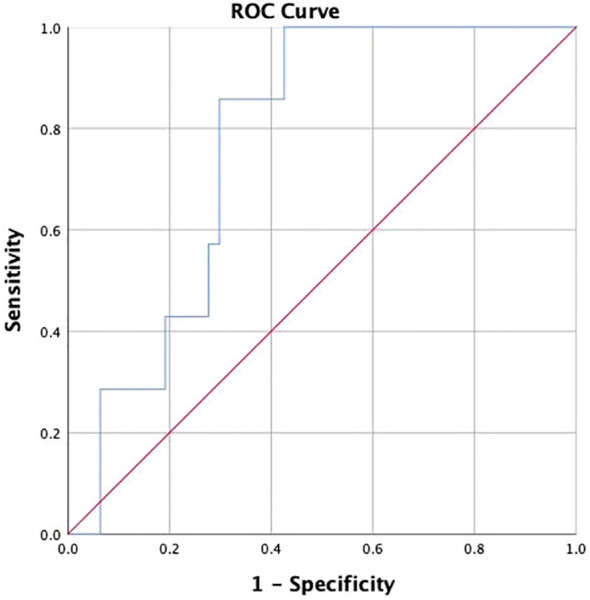
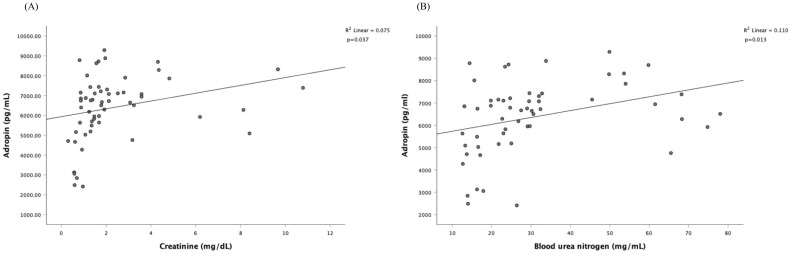
Results: The study included 58 subjects with T2D (18 early CKD and 40 advanced CKD) and 9 subjects without diabetes (control). Subjects with T2D had significantly higher adropin levels than controls (6393.10 ± 1611.84 vs. 3470.30 ± 1284.41 pg/ml; P < 0.001). Meanwhile, T2D patients with advanced CKD had higher adropin levels than those with early CKD (6848.89 ± 1287.04 vs. 5380.25 ± 1826.44 pg/ml; P = 0.003). Among T2D patients, subjects experienced CKD progression had higher adropin levels than those without (7520.15 ± 843.21 vs. 6151.16 ± 1661.61 pg/mL, P =0.003). Thus, adropin predicts CKD progression in T2D patients with 86% sensitivity and 70% specificity at 6872.24 pg/ml cutoff value. The association with CKD progression was still significant after adjusting for age, gender and body mass index (adjusted odds ratio = 27.188, 95% confidence interval 1.415-522.527, P =0.029).
Conclusions: The above findings suggest that serum adropin could be applied as a potential biomarker for predicting CKD progression in subjects with T2D. Further research is needed to validate these results and explore the underlying mechanisms.
期刊介绍:
Frontiers in Endocrinology is a field journal of the "Frontiers in" journal series.
In today’s world, endocrinology is becoming increasingly important as it underlies many of the challenges societies face - from obesity and diabetes to reproduction, population control and aging. Endocrinology covers a broad field from basic molecular and cellular communication through to clinical care and some of the most crucial public health issues. The journal, thus, welcomes outstanding contributions in any domain of endocrinology.
Frontiers in Endocrinology publishes articles on the most outstanding discoveries across a wide research spectrum of Endocrinology. The mission of Frontiers in Endocrinology is to bring all relevant Endocrinology areas together on a single platform.





 京公网安备 11010802042870号
京ICP备2023020795号-1
京公网安备 11010802042870号
京ICP备2023020795号-1

 分享
分享
 求助内容:
求助内容: 应助结果提醒方式:
 扫码关注我们
