Mariya Kadiri , Ayoub Tanji , Xuesong Fan , Peter K Liaw , T M Indra Mahlia , Hendra Hermawan
{"title":"TiHfZrNbx高熵合金在质子交换膜水电解槽模拟条件下的腐蚀","authors":"Mariya Kadiri , Ayoub Tanji , Xuesong Fan , Peter K Liaw , T M Indra Mahlia , Hendra Hermawan","doi":"10.1016/j.electacta.2025.145925","DOIUrl":null,"url":null,"abstract":"<div><div>In the present work, the corrosion behavior and passive film properties of TiHfZrNb<sub>x</sub> (<em>x</em> = 0.2, 0.3 and 0.4) high-entropy alloys (HEAs) were evaluated under a simulated condition of a proton exchange membrane water electrolyser (PEMWE) in view of their application as bipolar plates. Results from electrochemical-impedance spectroscopy, cyclic- and static-polarizations evaluation revealed that in a 0.5 M H<sub>2</sub>SO<sub>4</sub> + 5 ppm F<sup>–</sup> solution at 70 °C the HEAs exhibited about 600 times higher polarization resistance than that of CP-Ti, with the highest achieved at 79.57 kΩ.cm<sup>2</sup> for TiHfZrNb<sub>0.2</sub>, leading to a sharp contrast in the corrosion-current density, 805.11 µA.cm<sup>-2</sup> for the CP-Ti vs. 0.92 µA.cm<sup>-2</sup> for the TiHfZrNb<sub>0.2</sub>, reflecting a far superior corrosion resistance of the HEAs. X-ray photoelectron spectroscopy analysis confirmed the formation of a multi-oxide passive film, predominantly by HfO<sub>2</sub> > ZrO<sub>2</sub> > TiO<sub>2</sub>, with a presence of Nb<sub>2</sub>O<sub>5</sub> only in TiHfZrNb<sub>0.4</sub>, all possess an n-type semiconducting characteristic and a much lower electron-donor concentration in the HEAs than in the CP-Ti. The complementary analyses of scanning electron microscopy, atomic force microscopy and solution chemistry highlighted the synergistic effects of Hf, Zr, and Nb in enhancing protectiveness of the passive film, but the absence of Nb<sub>2</sub>O<sub>5</sub> on the top surface of TiHfZrNb<sub>0.2</sub> and TiHfZrNb<sub>0.3</sub> indicated a small role of Nb toward passivation.</div></div>","PeriodicalId":305,"journal":{"name":"Electrochimica Acta","volume":"521 ","pages":"Article 145925"},"PeriodicalIF":5.6000,"publicationDate":"2025-05-01","publicationTypes":"Journal Article","fieldsOfStudy":null,"isOpenAccess":false,"openAccessPdf":"","citationCount":"0","resultStr":"{\"title\":\"Corrosion of TiHfZrNbx high-entropy alloys in a simulated condition of proton exchange membrane water electrolyser\",\"authors\":\"Mariya Kadiri , Ayoub Tanji , Xuesong Fan , Peter K Liaw , T M Indra Mahlia , Hendra Hermawan\",\"doi\":\"10.1016/j.electacta.2025.145925\",\"DOIUrl\":null,\"url\":null,\"abstract\":\"<div><div>In the present work, the corrosion behavior and passive film properties of TiHfZrNb<sub>x</sub> (<em>x</em> = 0.2, 0.3 and 0.4) high-entropy alloys (HEAs) were evaluated under a simulated condition of a proton exchange membrane water electrolyser (PEMWE) in view of their application as bipolar plates. Results from electrochemical-impedance spectroscopy, cyclic- and static-polarizations evaluation revealed that in a 0.5 M H<sub>2</sub>SO<sub>4</sub> + 5 ppm F<sup>–</sup> solution at 70 °C the HEAs exhibited about 600 times higher polarization resistance than that of CP-Ti, with the highest achieved at 79.57 kΩ.cm<sup>2</sup> for TiHfZrNb<sub>0.2</sub>, leading to a sharp contrast in the corrosion-current density, 805.11 µA.cm<sup>-2</sup> for the CP-Ti vs. 0.92 µA.cm<sup>-2</sup> for the TiHfZrNb<sub>0.2</sub>, reflecting a far superior corrosion resistance of the HEAs. X-ray photoelectron spectroscopy analysis confirmed the formation of a multi-oxide passive film, predominantly by HfO<sub>2</sub> > ZrO<sub>2</sub> > TiO<sub>2</sub>, with a presence of Nb<sub>2</sub>O<sub>5</sub> only in TiHfZrNb<sub>0.4</sub>, all possess an n-type semiconducting characteristic and a much lower electron-donor concentration in the HEAs than in the CP-Ti. The complementary analyses of scanning electron microscopy, atomic force microscopy and solution chemistry highlighted the synergistic effects of Hf, Zr, and Nb in enhancing protectiveness of the passive film, but the absence of Nb<sub>2</sub>O<sub>5</sub> on the top surface of TiHfZrNb<sub>0.2</sub> and TiHfZrNb<sub>0.3</sub> indicated a small role of Nb toward passivation.</div></div>\",\"PeriodicalId\":305,\"journal\":{\"name\":\"Electrochimica Acta\",\"volume\":\"521 \",\"pages\":\"Article 145925\"},\"PeriodicalIF\":5.6000,\"publicationDate\":\"2025-05-01\",\"publicationTypes\":\"Journal Article\",\"fieldsOfStudy\":null,\"isOpenAccess\":false,\"openAccessPdf\":\"\",\"citationCount\":\"0\",\"resultStr\":null,\"platform\":\"Semanticscholar\",\"paperid\":null,\"PeriodicalName\":\"Electrochimica Acta\",\"FirstCategoryId\":\"88\",\"ListUrlMain\":\"https://www.sciencedirect.com/science/article/pii/S0013468625002889\",\"RegionNum\":3,\"RegionCategory\":\"材料科学\",\"ArticlePicture\":[],\"TitleCN\":null,\"AbstractTextCN\":null,\"PMCID\":null,\"EPubDate\":\"2025/2/25 0:00:00\",\"PubModel\":\"Epub\",\"JCR\":\"Q1\",\"JCRName\":\"ELECTROCHEMISTRY\",\"Score\":null,\"Total\":0}","platform":"Semanticscholar","paperid":null,"PeriodicalName":"Electrochimica Acta","FirstCategoryId":"88","ListUrlMain":"https://www.sciencedirect.com/science/article/pii/S0013468625002889","RegionNum":3,"RegionCategory":"材料科学","ArticlePicture":[],"TitleCN":null,"AbstractTextCN":null,"PMCID":null,"EPubDate":"2025/2/25 0:00:00","PubModel":"Epub","JCR":"Q1","JCRName":"ELECTROCHEMISTRY","Score":null,"Total":0}
引用次数: 0
摘要
在质子交换膜水电解槽(PEMWE)的模拟条件下,研究了TiHfZrNbx (x = 0.2,0.3和0.4)高熵合金(HEAs)作为双极板的腐蚀行为和钝化膜性能。电化学阻抗谱、循环极化和静态极化评价结果表明,在0.5 M H2SO4 + 5 ppm F -溶液中,HEAs的极化电阻比CP-Ti高约600倍,最高达到79.57 kΩ。TiHfZrNb0.2的腐蚀电流密度为805.11µa。CP-Ti相对于0.92µA。TiHfZrNb0.2为cm-2,反映出HEAs具有优异的耐腐蚀性。x射线光电子能谱分析证实了多氧化物钝化膜的形成,主要由HfO2 >;锆比;TiO2仅在TiHfZrNb0.4中存在Nb2O5,均具有n型半导体特性,HEAs中的电子给体浓度远低于CP-Ti。扫描电镜、原子力显微镜和溶液化学的互补分析表明,Hf、Zr和Nb对钝化膜的保护作用有协同作用,但TiHfZrNb0.2和TiHfZrNb0.3的表面没有Nb2O5,表明Nb对钝化膜的钝化作用很小。
Corrosion of TiHfZrNbx high-entropy alloys in a simulated condition of proton exchange membrane water electrolyser
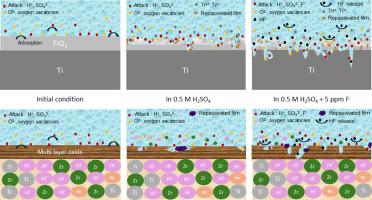
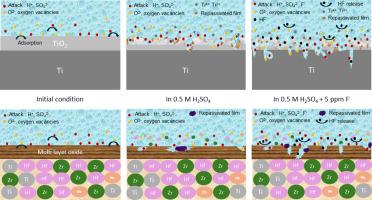
In the present work, the corrosion behavior and passive film properties of TiHfZrNbx (x = 0.2, 0.3 and 0.4) high-entropy alloys (HEAs) were evaluated under a simulated condition of a proton exchange membrane water electrolyser (PEMWE) in view of their application as bipolar plates. Results from electrochemical-impedance spectroscopy, cyclic- and static-polarizations evaluation revealed that in a 0.5 M H2SO4 + 5 ppm F– solution at 70 °C the HEAs exhibited about 600 times higher polarization resistance than that of CP-Ti, with the highest achieved at 79.57 kΩ.cm2 for TiHfZrNb0.2, leading to a sharp contrast in the corrosion-current density, 805.11 µA.cm-2 for the CP-Ti vs. 0.92 µA.cm-2 for the TiHfZrNb0.2, reflecting a far superior corrosion resistance of the HEAs. X-ray photoelectron spectroscopy analysis confirmed the formation of a multi-oxide passive film, predominantly by HfO2 > ZrO2 > TiO2, with a presence of Nb2O5 only in TiHfZrNb0.4, all possess an n-type semiconducting characteristic and a much lower electron-donor concentration in the HEAs than in the CP-Ti. The complementary analyses of scanning electron microscopy, atomic force microscopy and solution chemistry highlighted the synergistic effects of Hf, Zr, and Nb in enhancing protectiveness of the passive film, but the absence of Nb2O5 on the top surface of TiHfZrNb0.2 and TiHfZrNb0.3 indicated a small role of Nb toward passivation.
期刊介绍:
Electrochimica Acta is an international journal. It is intended for the publication of both original work and reviews in the field of electrochemistry. Electrochemistry should be interpreted to mean any of the research fields covered by the Divisions of the International Society of Electrochemistry listed below, as well as emerging scientific domains covered by ISE New Topics Committee.




 京公网安备 11010802042870号
京ICP备2023020795号-1
京公网安备 11010802042870号
京ICP备2023020795号-1

 分享
分享
 求助内容:
求助内容: 应助结果提醒方式:
 扫码关注我们
