Zhenggang Li , Xiaoxue Tan , M.A. Yarmolenko , Keneshbekova A , Ao Wang , Xin Liu , Xiaohong Jiang
{"title":"低能电子束分散沉积乙基纤维素载药涂层及其抑菌性能","authors":"Zhenggang Li , Xiaoxue Tan , M.A. Yarmolenko , Keneshbekova A , Ao Wang , Xin Liu , Xiaohong Jiang","doi":"10.1016/j.vacuum.2025.114136","DOIUrl":null,"url":null,"abstract":"<div><div>In this study, an EC-based dual drug-carrying composite film with ethyl cellulose (EC): silver nitrate = 1: 1 as the upper layer and EC: fluconazole (FCZ) = 1: 1 as the lower layer was prepared using the low-energy electron beam dispersion (EBD) technique. The film molecular structure, chemical composition and morphology were studied by FT-IR, XPS, and SEM methods. The results showed that the EC powder and FCZ powder used had excellent film-forming ability and the prepared films retained the majority of the molecular structure of the original powder. The films exhibited no obvious defects on the surface and their thickness reached the micrometer scale. The contact angle test confirmed good hydrophilicity of the films. With immersion in phosphate buffered saline (PBS), the porous structure formed on the surface of the films facilitated drug release. The kinetic properties of FCZ release from the composite layer into the aqueous environment were investigated, and a long-lasting release of FCZ in the composite layer for about 9 days was tailed. The performance of the films was characterized and the results showed that the EC-based dual drug-carrying composite film exhibited optimal inhibition of <em>Candida albicans</em>.</div></div>","PeriodicalId":23559,"journal":{"name":"Vacuum","volume":"236 ","pages":"Article 114136"},"PeriodicalIF":4.3000,"publicationDate":"2025-06-01","publicationTypes":"Journal Article","fieldsOfStudy":null,"isOpenAccess":false,"openAccessPdf":"","citationCount":"0","resultStr":"{\"title\":\"Deposition of ethyl cellulose-based drug-carrying coating by low-energy electron beam dispersion and its antifungal properties\",\"authors\":\"Zhenggang Li , Xiaoxue Tan , M.A. Yarmolenko , Keneshbekova A , Ao Wang , Xin Liu , Xiaohong Jiang\",\"doi\":\"10.1016/j.vacuum.2025.114136\",\"DOIUrl\":null,\"url\":null,\"abstract\":\"<div><div>In this study, an EC-based dual drug-carrying composite film with ethyl cellulose (EC): silver nitrate = 1: 1 as the upper layer and EC: fluconazole (FCZ) = 1: 1 as the lower layer was prepared using the low-energy electron beam dispersion (EBD) technique. The film molecular structure, chemical composition and morphology were studied by FT-IR, XPS, and SEM methods. The results showed that the EC powder and FCZ powder used had excellent film-forming ability and the prepared films retained the majority of the molecular structure of the original powder. The films exhibited no obvious defects on the surface and their thickness reached the micrometer scale. The contact angle test confirmed good hydrophilicity of the films. With immersion in phosphate buffered saline (PBS), the porous structure formed on the surface of the films facilitated drug release. The kinetic properties of FCZ release from the composite layer into the aqueous environment were investigated, and a long-lasting release of FCZ in the composite layer for about 9 days was tailed. The performance of the films was characterized and the results showed that the EC-based dual drug-carrying composite film exhibited optimal inhibition of <em>Candida albicans</em>.</div></div>\",\"PeriodicalId\":23559,\"journal\":{\"name\":\"Vacuum\",\"volume\":\"236 \",\"pages\":\"Article 114136\"},\"PeriodicalIF\":4.3000,\"publicationDate\":\"2025-06-01\",\"publicationTypes\":\"Journal Article\",\"fieldsOfStudy\":null,\"isOpenAccess\":false,\"openAccessPdf\":\"\",\"citationCount\":\"0\",\"resultStr\":null,\"platform\":\"Semanticscholar\",\"paperid\":null,\"PeriodicalName\":\"Vacuum\",\"FirstCategoryId\":\"88\",\"ListUrlMain\":\"https://www.sciencedirect.com/science/article/pii/S0042207X25001265\",\"RegionNum\":2,\"RegionCategory\":\"材料科学\",\"ArticlePicture\":[],\"TitleCN\":null,\"AbstractTextCN\":null,\"PMCID\":null,\"EPubDate\":\"2025/2/21 0:00:00\",\"PubModel\":\"Epub\",\"JCR\":\"Q2\",\"JCRName\":\"MATERIALS SCIENCE, MULTIDISCIPLINARY\",\"Score\":null,\"Total\":0}","platform":"Semanticscholar","paperid":null,"PeriodicalName":"Vacuum","FirstCategoryId":"88","ListUrlMain":"https://www.sciencedirect.com/science/article/pii/S0042207X25001265","RegionNum":2,"RegionCategory":"材料科学","ArticlePicture":[],"TitleCN":null,"AbstractTextCN":null,"PMCID":null,"EPubDate":"2025/2/21 0:00:00","PubModel":"Epub","JCR":"Q2","JCRName":"MATERIALS SCIENCE, MULTIDISCIPLINARY","Score":null,"Total":0}
Deposition of ethyl cellulose-based drug-carrying coating by low-energy electron beam dispersion and its antifungal properties
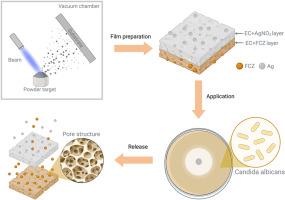
In this study, an EC-based dual drug-carrying composite film with ethyl cellulose (EC): silver nitrate = 1: 1 as the upper layer and EC: fluconazole (FCZ) = 1: 1 as the lower layer was prepared using the low-energy electron beam dispersion (EBD) technique. The film molecular structure, chemical composition and morphology were studied by FT-IR, XPS, and SEM methods. The results showed that the EC powder and FCZ powder used had excellent film-forming ability and the prepared films retained the majority of the molecular structure of the original powder. The films exhibited no obvious defects on the surface and their thickness reached the micrometer scale. The contact angle test confirmed good hydrophilicity of the films. With immersion in phosphate buffered saline (PBS), the porous structure formed on the surface of the films facilitated drug release. The kinetic properties of FCZ release from the composite layer into the aqueous environment were investigated, and a long-lasting release of FCZ in the composite layer for about 9 days was tailed. The performance of the films was characterized and the results showed that the EC-based dual drug-carrying composite film exhibited optimal inhibition of Candida albicans.
期刊介绍:
Vacuum is an international rapid publications journal with a focus on short communication. All papers are peer-reviewed, with the review process for short communication geared towards very fast turnaround times. The journal also published full research papers, thematic issues and selected papers from leading conferences.
A report in Vacuum should represent a major advance in an area that involves a controlled environment at pressures of one atmosphere or below.
The scope of the journal includes:
1. Vacuum; original developments in vacuum pumping and instrumentation, vacuum measurement, vacuum gas dynamics, gas-surface interactions, surface treatment for UHV applications and low outgassing, vacuum melting, sintering, and vacuum metrology. Technology and solutions for large-scale facilities (e.g., particle accelerators and fusion devices). New instrumentation ( e.g., detectors and electron microscopes).
2. Plasma science; advances in PVD, CVD, plasma-assisted CVD, ion sources, deposition processes and analysis.
3. Surface science; surface engineering, surface chemistry, surface analysis, crystal growth, ion-surface interactions and etching, nanometer-scale processing, surface modification.
4. Materials science; novel functional or structural materials. Metals, ceramics, and polymers. Experiments, simulations, and modelling for understanding structure-property relationships. Thin films and coatings. Nanostructures and ion implantation.




 京公网安备 11010802042870号
京ICP备2023020795号-1
京公网安备 11010802042870号
京ICP备2023020795号-1

 分享
分享
 求助内容:
求助内容: 应助结果提醒方式:
 扫码关注我们
