Yunhong Yang, Huaqian Qi, Jiahao Zhang, Jie Jia, Yunsong Yang, Hong Zhao
{"title":"基于2017-2020 NHANES数据库评估抑郁症状与血清叶酸和红细胞叶酸水平的关系","authors":"Yunhong Yang, Huaqian Qi, Jiahao Zhang, Jie Jia, Yunsong Yang, Hong Zhao","doi":"10.3389/fnut.2025.1505700","DOIUrl":null,"url":null,"abstract":"<p><strong>Objective: </strong>To improve further the management of the nutritional status and dietary habits of depressed patients.</p><p><strong>Methods: </strong>This study investigated the effect of different severity states of depressive symptoms on serum and erythrocyte folate levels using the Nutrition Examination Survey (NHANES) database from 2017 to 2020. We comprised a sample of 4,872 cases from NHANES database. We developed 3 linear regression models to assess the effect of depressive symptoms on erythrocyte folate and serum folate by collating and analyzing the data. The relationship between depression severity and erythrocyte folate as well as serum folate was also mutually validated by the results of multiple logistic regression. Finally, we made restricted cubic spline plots using the glm function of R.</p><p><strong>Results: </strong>Depression remained negatively correlated with serum folate levels with a OR value of -0.02, 95% CI of -0.05 ~ -0.00. Moderate depression was negatively correlated with folate, with a OR value of -0.03, 95% CI of -0.05 ~ -0.00. When exploring the association between different degrees of depressive symptoms and erythrocyte folate, it was unexpectedly found that major depression was negatively associated with erythrocyte folate with a OR value of -0.18, 95% CI of -0.31 ~ -0.04 after adjusting for all covariates.</p><p><strong>Conclusion: </strong>Depression is associated with folate levels. The risk of serum folate insufficiency or erythrocyte folate insufficiency is higher after a positive depression. For different degrees of depressive symptoms, serum folate levels were significantly lower than normal in patients with moderate depression, while erythrocyte folate levels were lower than normal in patients with major depression. Therefore, attention should be paid to the dietary habits and nutritional status of patients with depression or depressive symptoms when they are undergoing long-term antidepressant treatment. Folic acid supplementation is recommended for patients with moderate or severe depression or for depressed patients who have developed unhealthy eating habits.</p>","PeriodicalId":12473,"journal":{"name":"Frontiers in Nutrition","volume":"12 ","pages":"1505700"},"PeriodicalIF":5.5000,"publicationDate":"2025-02-10","publicationTypes":"Journal Article","fieldsOfStudy":null,"isOpenAccess":false,"openAccessPdf":"https://www.ncbi.nlm.nih.gov/pmc/articles/PMC11847701/pdf/","citationCount":"0","resultStr":"{\"title\":\"Evaluating the association of depressive symptoms on serum folate and erythrocyte folate levels based on the 2017-2020 NHANES database.\",\"authors\":\"Yunhong Yang, Huaqian Qi, Jiahao Zhang, Jie Jia, Yunsong Yang, Hong Zhao\",\"doi\":\"10.3389/fnut.2025.1505700\",\"DOIUrl\":null,\"url\":null,\"abstract\":\"<p><strong>Objective: </strong>To improve further the management of the nutritional status and dietary habits of depressed patients.</p><p><strong>Methods: </strong>This study investigated the effect of different severity states of depressive symptoms on serum and erythrocyte folate levels using the Nutrition Examination Survey (NHANES) database from 2017 to 2020. We comprised a sample of 4,872 cases from NHANES database. We developed 3 linear regression models to assess the effect of depressive symptoms on erythrocyte folate and serum folate by collating and analyzing the data. The relationship between depression severity and erythrocyte folate as well as serum folate was also mutually validated by the results of multiple logistic regression. Finally, we made restricted cubic spline plots using the glm function of R.</p><p><strong>Results: </strong>Depression remained negatively correlated with serum folate levels with a OR value of -0.02, 95% CI of -0.05 ~ -0.00. Moderate depression was negatively correlated with folate, with a OR value of -0.03, 95% CI of -0.05 ~ -0.00. When exploring the association between different degrees of depressive symptoms and erythrocyte folate, it was unexpectedly found that major depression was negatively associated with erythrocyte folate with a OR value of -0.18, 95% CI of -0.31 ~ -0.04 after adjusting for all covariates.</p><p><strong>Conclusion: </strong>Depression is associated with folate levels. The risk of serum folate insufficiency or erythrocyte folate insufficiency is higher after a positive depression. For different degrees of depressive symptoms, serum folate levels were significantly lower than normal in patients with moderate depression, while erythrocyte folate levels were lower than normal in patients with major depression. Therefore, attention should be paid to the dietary habits and nutritional status of patients with depression or depressive symptoms when they are undergoing long-term antidepressant treatment. Folic acid supplementation is recommended for patients with moderate or severe depression or for depressed patients who have developed unhealthy eating habits.</p>\",\"PeriodicalId\":12473,\"journal\":{\"name\":\"Frontiers in Nutrition\",\"volume\":\"12 \",\"pages\":\"1505700\"},\"PeriodicalIF\":5.5000,\"publicationDate\":\"2025-02-10\",\"publicationTypes\":\"Journal Article\",\"fieldsOfStudy\":null,\"isOpenAccess\":false,\"openAccessPdf\":\"https://www.ncbi.nlm.nih.gov/pmc/articles/PMC11847701/pdf/\",\"citationCount\":\"0\",\"resultStr\":null,\"platform\":\"Semanticscholar\",\"paperid\":null,\"PeriodicalName\":\"Frontiers in Nutrition\",\"FirstCategoryId\":\"97\",\"ListUrlMain\":\"https://doi.org/10.3389/fnut.2025.1505700\",\"RegionNum\":2,\"RegionCategory\":\"农林科学\",\"ArticlePicture\":[],\"TitleCN\":null,\"AbstractTextCN\":null,\"PMCID\":null,\"EPubDate\":\"2025/1/1 0:00:00\",\"PubModel\":\"eCollection\",\"JCR\":\"Q2\",\"JCRName\":\"NUTRITION & DIETETICS\",\"Score\":null,\"Total\":0}","platform":"Semanticscholar","paperid":null,"PeriodicalName":"Frontiers in Nutrition","FirstCategoryId":"97","ListUrlMain":"https://doi.org/10.3389/fnut.2025.1505700","RegionNum":2,"RegionCategory":"农林科学","ArticlePicture":[],"TitleCN":null,"AbstractTextCN":null,"PMCID":null,"EPubDate":"2025/1/1 0:00:00","PubModel":"eCollection","JCR":"Q2","JCRName":"NUTRITION & DIETETICS","Score":null,"Total":0}
Evaluating the association of depressive symptoms on serum folate and erythrocyte folate levels based on the 2017-2020 NHANES database.
Objective: To improve further the management of the nutritional status and dietary habits of depressed patients.
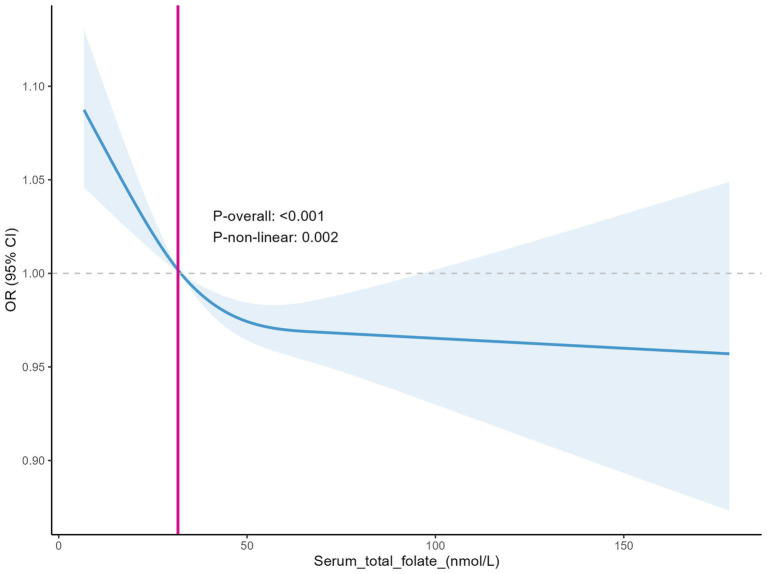
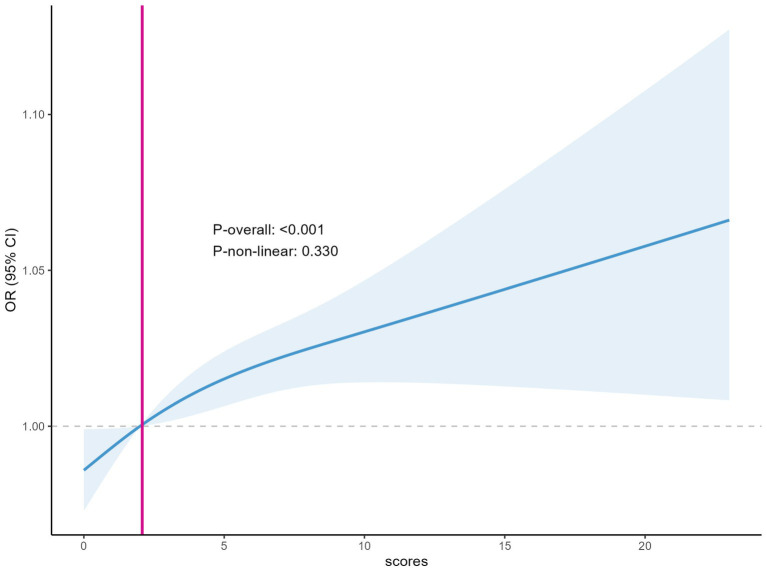
Methods: This study investigated the effect of different severity states of depressive symptoms on serum and erythrocyte folate levels using the Nutrition Examination Survey (NHANES) database from 2017 to 2020. We comprised a sample of 4,872 cases from NHANES database. We developed 3 linear regression models to assess the effect of depressive symptoms on erythrocyte folate and serum folate by collating and analyzing the data. The relationship between depression severity and erythrocyte folate as well as serum folate was also mutually validated by the results of multiple logistic regression. Finally, we made restricted cubic spline plots using the glm function of R.
Results: Depression remained negatively correlated with serum folate levels with a OR value of -0.02, 95% CI of -0.05 ~ -0.00. Moderate depression was negatively correlated with folate, with a OR value of -0.03, 95% CI of -0.05 ~ -0.00. When exploring the association between different degrees of depressive symptoms and erythrocyte folate, it was unexpectedly found that major depression was negatively associated with erythrocyte folate with a OR value of -0.18, 95% CI of -0.31 ~ -0.04 after adjusting for all covariates.
Conclusion: Depression is associated with folate levels. The risk of serum folate insufficiency or erythrocyte folate insufficiency is higher after a positive depression. For different degrees of depressive symptoms, serum folate levels were significantly lower than normal in patients with moderate depression, while erythrocyte folate levels were lower than normal in patients with major depression. Therefore, attention should be paid to the dietary habits and nutritional status of patients with depression or depressive symptoms when they are undergoing long-term antidepressant treatment. Folic acid supplementation is recommended for patients with moderate or severe depression or for depressed patients who have developed unhealthy eating habits.
期刊介绍:
No subject pertains more to human life than nutrition. The aim of Frontiers in Nutrition is to integrate major scientific disciplines in this vast field in order to address the most relevant and pertinent questions and developments. Our ambition is to create an integrated podium based on original research, clinical trials, and contemporary reviews to build a reputable knowledge forum in the domains of human health, dietary behaviors, agronomy & 21st century food science. Through the recognized open-access Frontiers platform we welcome manuscripts to our dedicated sections relating to different areas in the field of nutrition with a focus on human health.
Specialty sections in Frontiers in Nutrition include, for example, Clinical Nutrition, Nutrition & Sustainable Diets, Nutrition and Food Science Technology, Nutrition Methodology, Sport & Exercise Nutrition, Food Chemistry, and Nutritional Immunology. Based on the publication of rigorous scientific research, we thrive to achieve a visible impact on the global nutrition agenda addressing the grand challenges of our time, including obesity, malnutrition, hunger, food waste, sustainability and consumer health.





 京公网安备 11010802042870号
京ICP备2023020795号-1
京公网安备 11010802042870号
京ICP备2023020795号-1

 分享
分享
 求助内容:
求助内容: 应助结果提醒方式:
 扫码关注我们
