{"title":"溴氰菊酯和磺胺甲噁唑对成年斑马鱼的急性毒性、神经毒性、免疫毒性和行为影响:洞察化学相互作用和环境影响。","authors":"Yueyue Liu, Fengyu Liu, Chen Wang","doi":"10.3390/toxics13020128","DOIUrl":null,"url":null,"abstract":"<p><p>The increasing presence of antimicrobial agents and pesticides in aquatic environments raises concerns about their potential impacts on non-target organisms. Among these chemicals, deltamethrin (DM), a widely used pesticide, and sulfamethoxazole (SMX), an antimicrobial commonly detected in water bodies, pose significant ecological risks. This study investigates the acute toxicity, neurotoxic effects, oxidative stress responses, immune-related gene expression, and feeding behavior of adult zebrafish exposed to DM and SMX. The 96 h LC<sub>50</sub> for DM was 4.84 µg/L, indicating significant acute toxicity, while the LC<sub>50</sub> for the DM + SMX mixture was 11.32 µg/L, suggesting that SMX may mitigate the toxicity of DM. Neurotransmitter alterations, including reduced levels of γ-aminobutyric acid (γ-GABA), serotonin (5-HT), and acetylcholinesterase (AChE), were observed, with the combination of DM and SMX showing partial restoration of AChE activity. Oxidative stress markers revealed significant changes in antioxidant enzyme activities, with DM exposure increasing superoxide dismutase (SOD) and glutathione-S-transferase (GST) activities, while decreasing catalase (CAT) and glutathione peroxidase (GPX) activities. Immune-related gene expression demonstrated suppressed IgM, IgD, and IgZ levels, along with altered inflammatory responses, with both DM and DM + SMX exposure inducing pro-inflammatory cytokines. Finally, feeding behavior was significantly impaired in the DM group at the 3 min mark, while the DM + SMX group showed partial mitigation of this effect. These findings highlight the neurotoxic, immunotoxic, and behavioral effects of DM and SMX, and underscore the potential for chemical interactions to modulate toxicity in aquatic organisms.</p>","PeriodicalId":23195,"journal":{"name":"Toxics","volume":"13 2","pages":""},"PeriodicalIF":4.1000,"publicationDate":"2025-02-10","publicationTypes":"Journal Article","fieldsOfStudy":null,"isOpenAccess":false,"openAccessPdf":"https://www.ncbi.nlm.nih.gov/pmc/articles/PMC11860506/pdf/","citationCount":"0","resultStr":"{\"title\":\"Acute Toxicity, Neurotoxic, Immunotoxic, and Behavioral Effects of Deltamethrin and Sulfamethoxazole in Adult Zebrafish: Insights into Chemical Interactions and Environmental Implications.\",\"authors\":\"Yueyue Liu, Fengyu Liu, Chen Wang\",\"doi\":\"10.3390/toxics13020128\",\"DOIUrl\":null,\"url\":null,\"abstract\":\"<p><p>The increasing presence of antimicrobial agents and pesticides in aquatic environments raises concerns about their potential impacts on non-target organisms. Among these chemicals, deltamethrin (DM), a widely used pesticide, and sulfamethoxazole (SMX), an antimicrobial commonly detected in water bodies, pose significant ecological risks. This study investigates the acute toxicity, neurotoxic effects, oxidative stress responses, immune-related gene expression, and feeding behavior of adult zebrafish exposed to DM and SMX. The 96 h LC<sub>50</sub> for DM was 4.84 µg/L, indicating significant acute toxicity, while the LC<sub>50</sub> for the DM + SMX mixture was 11.32 µg/L, suggesting that SMX may mitigate the toxicity of DM. Neurotransmitter alterations, including reduced levels of γ-aminobutyric acid (γ-GABA), serotonin (5-HT), and acetylcholinesterase (AChE), were observed, with the combination of DM and SMX showing partial restoration of AChE activity. Oxidative stress markers revealed significant changes in antioxidant enzyme activities, with DM exposure increasing superoxide dismutase (SOD) and glutathione-S-transferase (GST) activities, while decreasing catalase (CAT) and glutathione peroxidase (GPX) activities. Immune-related gene expression demonstrated suppressed IgM, IgD, and IgZ levels, along with altered inflammatory responses, with both DM and DM + SMX exposure inducing pro-inflammatory cytokines. Finally, feeding behavior was significantly impaired in the DM group at the 3 min mark, while the DM + SMX group showed partial mitigation of this effect. These findings highlight the neurotoxic, immunotoxic, and behavioral effects of DM and SMX, and underscore the potential for chemical interactions to modulate toxicity in aquatic organisms.</p>\",\"PeriodicalId\":23195,\"journal\":{\"name\":\"Toxics\",\"volume\":\"13 2\",\"pages\":\"\"},\"PeriodicalIF\":4.1000,\"publicationDate\":\"2025-02-10\",\"publicationTypes\":\"Journal Article\",\"fieldsOfStudy\":null,\"isOpenAccess\":false,\"openAccessPdf\":\"https://www.ncbi.nlm.nih.gov/pmc/articles/PMC11860506/pdf/\",\"citationCount\":\"0\",\"resultStr\":null,\"platform\":\"Semanticscholar\",\"paperid\":null,\"PeriodicalName\":\"Toxics\",\"FirstCategoryId\":\"93\",\"ListUrlMain\":\"https://doi.org/10.3390/toxics13020128\",\"RegionNum\":3,\"RegionCategory\":\"环境科学与生态学\",\"ArticlePicture\":[],\"TitleCN\":null,\"AbstractTextCN\":null,\"PMCID\":null,\"EPubDate\":\"\",\"PubModel\":\"\",\"JCR\":\"Q2\",\"JCRName\":\"ENVIRONMENTAL SCIENCES\",\"Score\":null,\"Total\":0}","platform":"Semanticscholar","paperid":null,"PeriodicalName":"Toxics","FirstCategoryId":"93","ListUrlMain":"https://doi.org/10.3390/toxics13020128","RegionNum":3,"RegionCategory":"环境科学与生态学","ArticlePicture":[],"TitleCN":null,"AbstractTextCN":null,"PMCID":null,"EPubDate":"","PubModel":"","JCR":"Q2","JCRName":"ENVIRONMENTAL SCIENCES","Score":null,"Total":0}
引用次数: 0
摘要
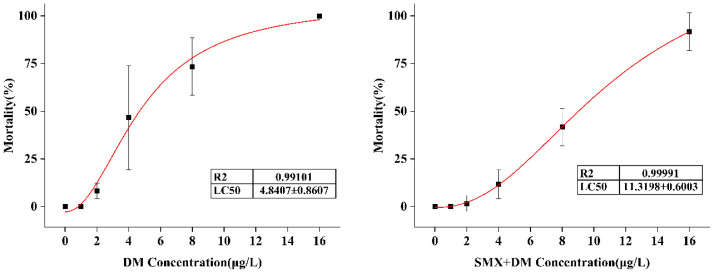
抗菌剂和农药在水生环境中越来越多的存在引起了人们对其对非目标生物的潜在影响的关注。在这些化学物质中,广泛使用的杀虫剂溴氰菊酯(DM)和水体中常见的抗微生物药物磺胺甲恶唑(SMX)构成了重大的生态风险。本研究研究了暴露于DM和SMX的成年斑马鱼的急性毒性、神经毒性作用、氧化应激反应、免疫相关基因表达和摄食行为。DM的96 h LC50为4.84µg/L,具有明显的急性毒性,而DM + SMX的LC50为11.32µg/L,提示SMX可能减轻DM的毒性。神经递质改变,包括γ-氨基丁酸(γ-GABA)、5-羟色胺(5-HT)和乙酰胆碱酯酶(AChE)水平降低,DM和SMX联合使用可部分恢复AChE活性。氧化应激标志物显示抗氧化酶活性发生显著变化,DM暴露增加了超氧化物歧化酶(SOD)和谷胱甘肽- s -转移酶(GST)活性,降低了过氧化氢酶(CAT)和谷胱甘肽过氧化物酶(GPX)活性。免疫相关基因表达显示IgM、IgD和IgZ水平受到抑制,炎症反应发生改变,DM和DM + SMX暴露均可诱导促炎细胞因子。最后,DM组的摄食行为在3 min时明显受损,而DM + SMX组则部分缓解了这种影响。这些发现强调了DM和SMX的神经毒性、免疫毒性和行为效应,并强调了化学相互作用调节水生生物毒性的潜力。
Acute Toxicity, Neurotoxic, Immunotoxic, and Behavioral Effects of Deltamethrin and Sulfamethoxazole in Adult Zebrafish: Insights into Chemical Interactions and Environmental Implications.
The increasing presence of antimicrobial agents and pesticides in aquatic environments raises concerns about their potential impacts on non-target organisms. Among these chemicals, deltamethrin (DM), a widely used pesticide, and sulfamethoxazole (SMX), an antimicrobial commonly detected in water bodies, pose significant ecological risks. This study investigates the acute toxicity, neurotoxic effects, oxidative stress responses, immune-related gene expression, and feeding behavior of adult zebrafish exposed to DM and SMX. The 96 h LC50 for DM was 4.84 µg/L, indicating significant acute toxicity, while the LC50 for the DM + SMX mixture was 11.32 µg/L, suggesting that SMX may mitigate the toxicity of DM. Neurotransmitter alterations, including reduced levels of γ-aminobutyric acid (γ-GABA), serotonin (5-HT), and acetylcholinesterase (AChE), were observed, with the combination of DM and SMX showing partial restoration of AChE activity. Oxidative stress markers revealed significant changes in antioxidant enzyme activities, with DM exposure increasing superoxide dismutase (SOD) and glutathione-S-transferase (GST) activities, while decreasing catalase (CAT) and glutathione peroxidase (GPX) activities. Immune-related gene expression demonstrated suppressed IgM, IgD, and IgZ levels, along with altered inflammatory responses, with both DM and DM + SMX exposure inducing pro-inflammatory cytokines. Finally, feeding behavior was significantly impaired in the DM group at the 3 min mark, while the DM + SMX group showed partial mitigation of this effect. These findings highlight the neurotoxic, immunotoxic, and behavioral effects of DM and SMX, and underscore the potential for chemical interactions to modulate toxicity in aquatic organisms.
ToxicsChemical Engineering-Chemical Health and Safety
CiteScore
4.50
自引率
10.90%
发文量
681
审稿时长
6 weeks
期刊介绍:
Toxics (ISSN 2305-6304) is an international, peer-reviewed, open access journal which provides an advanced forum for studies related to all aspects of toxic chemicals and materials. It publishes reviews, regular research papers, and short communications. Our aim is to encourage scientists to publish their experimental and theoretical results in detail. There is, therefore, no restriction on the maximum length of the papers, although authors should write their papers in a clear and concise way. The full experimental details must be provided so that the results can be reproduced. Electronic files or software regarding the full details of calculations and experimental procedure can be deposited as supplementary material, if it is not possible to publish them along with the text.






 京公网安备 11010802042870号
京ICP备2023020795号-1
京公网安备 11010802042870号
京ICP备2023020795号-1

 分享
分享
 求助内容:
求助内容: 应助结果提醒方式:
 扫码关注我们
