Alex Ojeda-Aravena, Rafael L Kons, Jairo Azócar-Gallardo, Xurxo Dopico-Calvo, Aida Fernández, Marcelo Tuesta-Roa, Mauricio Cresp-Barria, Jorge Olivares-Arancibia, Eduardo Báez-San Martín
{"title":"巴西男性柔术运动员身体成分不对称的程度和方向分析:初步研究。","authors":"Alex Ojeda-Aravena, Rafael L Kons, Jairo Azócar-Gallardo, Xurxo Dopico-Calvo, Aida Fernández, Marcelo Tuesta-Roa, Mauricio Cresp-Barria, Jorge Olivares-Arancibia, Eduardo Báez-San Martín","doi":"10.3390/sports13020054","DOIUrl":null,"url":null,"abstract":"<p><p>In order to optimize body composition and its components, it is of interest to analyze inter-limb asymmetries in athletes of popular combat sports such as Brazilian Jiu-Jitsu (BJJ). This study aimed to assess the magnitude and direction of body composition asymmetry in competitive male BJJ athletes. Seventeen experienced and competitive male BJJ athletes (age 34.59 ± 8.00 years, 172.94 ± 5.46 cm, BJJ experience 7.88 ± 5.57 years, and 3.71 ± 1.05 days of weekly volume training), including Guard Fighters (<i>n</i> = 7) and Pass Fighters (n = 10), participated in this study. In a single session, whole-body and segmental upper limb and lower limb body composition (BC) was assessed utilizing dual-energy X-ray absorptiometry (DXA). The assessment included total mass (TM), fat mass (FM), fat mass percentage (%FM), fat-free mass (FFM), and bone mineral content (BMC). Absolute differences between limbs were analyzed using a paired <i>t</i>-test. A comparison of BC asymmetries according to combat styles was conducted using an independent <i>t</i>-test. The effect size (ES) was interpreted as Cohen's d. The main results revealed significant asymmetries in the upper limbs (ULs) of the total group; greater values were found on the left side for TM (<i>p</i> = 0.009, ES = 0.725), FM (<i>p</i> = 0.016, ES = 0.650), FFM (<i>p</i> = 0.026, ES = 0.594), and BMC (<i>p</i> < 0.001, ES = 0.993). In Pass Fighters, differences favored the right side in TM (<i>p</i> = 0.003, ES = 1.277), FM (<i>p</i> = 0.009, ES = 1.039), FFM (<i>p</i> = 0.011, ES = 1.000), and BMC (<i>p</i> < 0.001, ES = 1.916). In contrast, Guard Fighters showed no discrepancies in these parameters. No notable disparities were observed in the lower limbs. This pilot study reveals that BJJ athletes present significant asymmetries in BC, particularly in the ULs, with a marked predominance on the right side, especially in Pass Fighters.</p>","PeriodicalId":53303,"journal":{"name":"Sports","volume":"13 2","pages":""},"PeriodicalIF":2.9000,"publicationDate":"2025-02-12","publicationTypes":"Journal Article","fieldsOfStudy":null,"isOpenAccess":false,"openAccessPdf":"https://www.ncbi.nlm.nih.gov/pmc/articles/PMC11860482/pdf/","citationCount":"0","resultStr":"{\"title\":\"Analysis of Magnitude and Direction of Body Composition Asymmetries in Male Brazilian Jiu-Jitsu Athletes: Pilot Study.\",\"authors\":\"Alex Ojeda-Aravena, Rafael L Kons, Jairo Azócar-Gallardo, Xurxo Dopico-Calvo, Aida Fernández, Marcelo Tuesta-Roa, Mauricio Cresp-Barria, Jorge Olivares-Arancibia, Eduardo Báez-San Martín\",\"doi\":\"10.3390/sports13020054\",\"DOIUrl\":null,\"url\":null,\"abstract\":\"<p><p>In order to optimize body composition and its components, it is of interest to analyze inter-limb asymmetries in athletes of popular combat sports such as Brazilian Jiu-Jitsu (BJJ). This study aimed to assess the magnitude and direction of body composition asymmetry in competitive male BJJ athletes. Seventeen experienced and competitive male BJJ athletes (age 34.59 ± 8.00 years, 172.94 ± 5.46 cm, BJJ experience 7.88 ± 5.57 years, and 3.71 ± 1.05 days of weekly volume training), including Guard Fighters (<i>n</i> = 7) and Pass Fighters (n = 10), participated in this study. In a single session, whole-body and segmental upper limb and lower limb body composition (BC) was assessed utilizing dual-energy X-ray absorptiometry (DXA). The assessment included total mass (TM), fat mass (FM), fat mass percentage (%FM), fat-free mass (FFM), and bone mineral content (BMC). Absolute differences between limbs were analyzed using a paired <i>t</i>-test. A comparison of BC asymmetries according to combat styles was conducted using an independent <i>t</i>-test. The effect size (ES) was interpreted as Cohen's d. The main results revealed significant asymmetries in the upper limbs (ULs) of the total group; greater values were found on the left side for TM (<i>p</i> = 0.009, ES = 0.725), FM (<i>p</i> = 0.016, ES = 0.650), FFM (<i>p</i> = 0.026, ES = 0.594), and BMC (<i>p</i> < 0.001, ES = 0.993). In Pass Fighters, differences favored the right side in TM (<i>p</i> = 0.003, ES = 1.277), FM (<i>p</i> = 0.009, ES = 1.039), FFM (<i>p</i> = 0.011, ES = 1.000), and BMC (<i>p</i> < 0.001, ES = 1.916). In contrast, Guard Fighters showed no discrepancies in these parameters. No notable disparities were observed in the lower limbs. This pilot study reveals that BJJ athletes present significant asymmetries in BC, particularly in the ULs, with a marked predominance on the right side, especially in Pass Fighters.</p>\",\"PeriodicalId\":53303,\"journal\":{\"name\":\"Sports\",\"volume\":\"13 2\",\"pages\":\"\"},\"PeriodicalIF\":2.9000,\"publicationDate\":\"2025-02-12\",\"publicationTypes\":\"Journal Article\",\"fieldsOfStudy\":null,\"isOpenAccess\":false,\"openAccessPdf\":\"https://www.ncbi.nlm.nih.gov/pmc/articles/PMC11860482/pdf/\",\"citationCount\":\"0\",\"resultStr\":null,\"platform\":\"Semanticscholar\",\"paperid\":null,\"PeriodicalName\":\"Sports\",\"FirstCategoryId\":\"1085\",\"ListUrlMain\":\"https://doi.org/10.3390/sports13020054\",\"RegionNum\":0,\"RegionCategory\":null,\"ArticlePicture\":[],\"TitleCN\":null,\"AbstractTextCN\":null,\"PMCID\":null,\"EPubDate\":\"\",\"PubModel\":\"\",\"JCR\":\"Q2\",\"JCRName\":\"SPORT SCIENCES\",\"Score\":null,\"Total\":0}","platform":"Semanticscholar","paperid":null,"PeriodicalName":"Sports","FirstCategoryId":"1085","ListUrlMain":"https://doi.org/10.3390/sports13020054","RegionNum":0,"RegionCategory":null,"ArticlePicture":[],"TitleCN":null,"AbstractTextCN":null,"PMCID":null,"EPubDate":"","PubModel":"","JCR":"Q2","JCRName":"SPORT SCIENCES","Score":null,"Total":0}
引用次数: 0
摘要
对巴西柔术等热门格斗项目运动员的肢体间不对称进行分析,以优化运动员的身体组成及其各组成部分。本研究旨在评估巴西柔术竞技男运动员身体成分不对称的程度和方向。17名有经验的巴西柔术竞技男性运动员(年龄34.59±8.00岁,身高172.94±5.46 cm,巴西柔术经验7.88±5.57年,每周量训练3.71±1.05天),包括Guard fighter (n = 7)和Pass fighter (n = 10)。在单次治疗中,利用双能x射线吸收仪(DXA)评估全身和节段性上肢和下肢身体成分(BC)。评估包括总质量(TM)、脂肪质量(FM)、脂肪质量百分比(%FM)、无脂质量(FFM)和骨矿物质含量(BMC)。四肢之间的绝对差异采用配对t检验进行分析。使用独立t检验对不同战斗风格的BC不对称进行比较。效应量(ES)解释为Cohen’s d。主要结果显示,整个组的上肢(ULs)明显不对称;TM (p = 0.009, ES = 0.725)、FM (p = 0.016, ES = 0.650)、FFM (p = 0.026, ES = 0.594)和BMC (p < 0.001, ES = 0.993)在左侧值较高。在Pass Fighters中,TM (p = 0.003, ES = 1.277)、FM (p = 0.009, ES = 1.039)、FFM (p = 0.011, ES = 1.000)和BMC (p < 0.001, ES = 1.916)的差异偏向右侧。相比之下,卫队战斗机在这些参数上没有差异。下肢未见明显差异。这项初步研究表明,巴西柔术运动员在BC,特别是在ULs中表现出明显的不对称,在右侧明显占优势,特别是在Pass fighter中。
Analysis of Magnitude and Direction of Body Composition Asymmetries in Male Brazilian Jiu-Jitsu Athletes: Pilot Study.
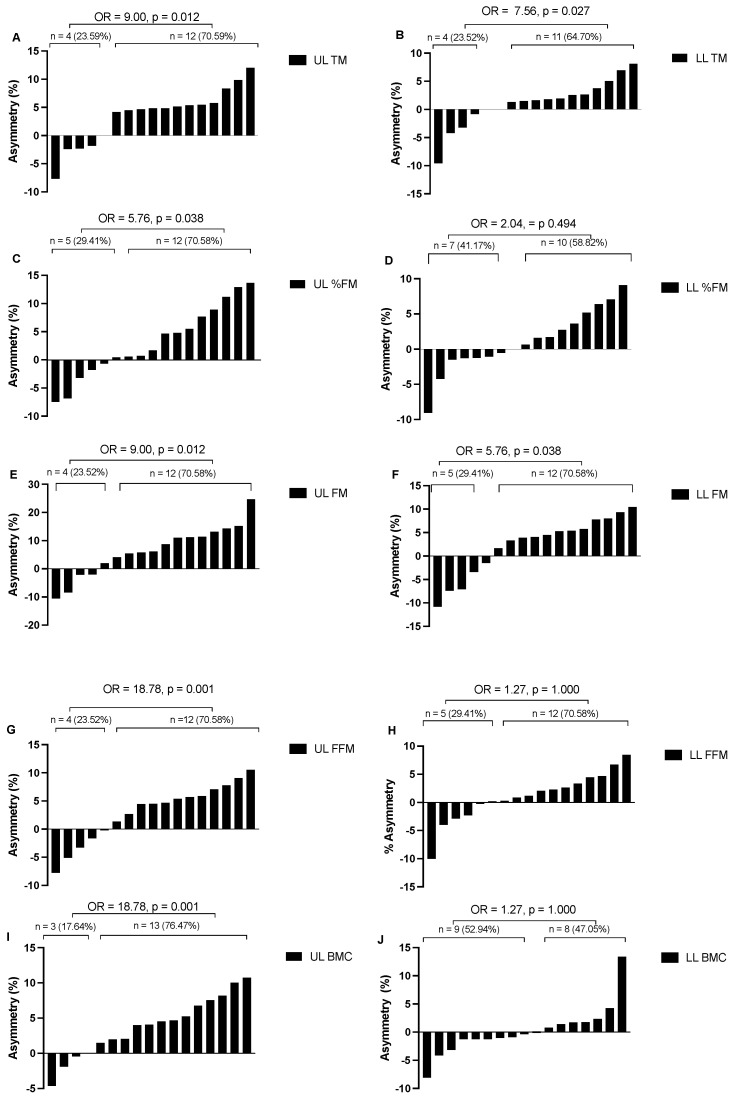
In order to optimize body composition and its components, it is of interest to analyze inter-limb asymmetries in athletes of popular combat sports such as Brazilian Jiu-Jitsu (BJJ). This study aimed to assess the magnitude and direction of body composition asymmetry in competitive male BJJ athletes. Seventeen experienced and competitive male BJJ athletes (age 34.59 ± 8.00 years, 172.94 ± 5.46 cm, BJJ experience 7.88 ± 5.57 years, and 3.71 ± 1.05 days of weekly volume training), including Guard Fighters (n = 7) and Pass Fighters (n = 10), participated in this study. In a single session, whole-body and segmental upper limb and lower limb body composition (BC) was assessed utilizing dual-energy X-ray absorptiometry (DXA). The assessment included total mass (TM), fat mass (FM), fat mass percentage (%FM), fat-free mass (FFM), and bone mineral content (BMC). Absolute differences between limbs were analyzed using a paired t-test. A comparison of BC asymmetries according to combat styles was conducted using an independent t-test. The effect size (ES) was interpreted as Cohen's d. The main results revealed significant asymmetries in the upper limbs (ULs) of the total group; greater values were found on the left side for TM (p = 0.009, ES = 0.725), FM (p = 0.016, ES = 0.650), FFM (p = 0.026, ES = 0.594), and BMC (p < 0.001, ES = 0.993). In Pass Fighters, differences favored the right side in TM (p = 0.003, ES = 1.277), FM (p = 0.009, ES = 1.039), FFM (p = 0.011, ES = 1.000), and BMC (p < 0.001, ES = 1.916). In contrast, Guard Fighters showed no discrepancies in these parameters. No notable disparities were observed in the lower limbs. This pilot study reveals that BJJ athletes present significant asymmetries in BC, particularly in the ULs, with a marked predominance on the right side, especially in Pass Fighters.




 京公网安备 11010802042870号
京ICP备2023020795号-1
京公网安备 11010802042870号
京ICP备2023020795号-1

 分享
分享
 求助内容:
求助内容: 应助结果提醒方式:
 扫码关注我们
