Tingting Yang, Shengmei Huang, Jun Wang, Hongtao He, Jie Xu, Guofeng Hu, Jianping Zhou, Hongbo Liang, Chunhui Zhao
{"title":"耐久的交联聚(咔唑)基碱性电解阴离子交换膜","authors":"Tingting Yang, Shengmei Huang, Jun Wang, Hongtao He, Jie Xu, Guofeng Hu, Jianping Zhou, Hongbo Liang, Chunhui Zhao","doi":"10.1016/j.polymer.2025.128195","DOIUrl":null,"url":null,"abstract":"<div><div>Anion exchange membranes (AEMs) are crucial materials in hydrogen production techniques via water electrolysis. Whereas, the \"trade-off\" between the conductivity and dimensional stability of AEMs, as well as poor alkaline stability, hinders the advancement of AEMs and water electrolysis technologies. Cross-linking serves as a pivotal strategy for addressing the \"trade-off\" effect, thereby facilitating the fabrication of highly conductive and durable AEMs. In this study, a series of poly (carbazole)-based AEMs, designated as QPBHC-x, were synthesized utilizing the flexible cross-linker N,N,N′,N′-tetramethyl-1,6-hexanediamine (TMHDA). The synthesized AEMs demonstrated reduced water uptake and enhanced alkaline stability in comparison to uncross-linked AEMs, while maintaining a conductivity retention exceeding 92 % after immersion in 1 M NaOH solution at 80 °C for 720 h. AFM and SAXS analyses revealed the microphase separation structure in the prepared AEMs, which construct continuous ion channels and promote ion conduction. Specifically, the QPBHC-0.5 demonstrated a conductivity of 102.3 mS cm<sup>−1</sup> at 80 °C and exhibited a tensile strength of 46.6 MPa. Furthermore, anion exchange membrane water electrolysis (AEMWE) single cell (cathode: Pt/C and anode: NiFe<sub>2</sub>O<sub>4</sub>) based on QPBHC-0.75 achieved a current density of 1.40 A cm<sup>−1</sup> at 2 V in 1 M KOH (80 °C). Meanwhile, QPBHC-0.5 maintained stable operation for over 470 h at 1.0 A cm<sup>−1</sup> in 1 M KOH (80 °C) with a voltage decay rate of 352 μV h<sup>−1</sup>. These results indicate promising applications of cross-linked poly (carbazole)-based AEMs in water electrolysis.</div></div>","PeriodicalId":405,"journal":{"name":"Polymer","volume":"323 ","pages":"Article 128195"},"PeriodicalIF":4.5000,"publicationDate":"2025-04-10","publicationTypes":"Journal Article","fieldsOfStudy":null,"isOpenAccess":false,"openAccessPdf":"","citationCount":"0","resultStr":"{\"title\":\"Durable cross-linked poly(carbazole)-based anion exchange membranes for alkaline water electrolysis\",\"authors\":\"Tingting Yang, Shengmei Huang, Jun Wang, Hongtao He, Jie Xu, Guofeng Hu, Jianping Zhou, Hongbo Liang, Chunhui Zhao\",\"doi\":\"10.1016/j.polymer.2025.128195\",\"DOIUrl\":null,\"url\":null,\"abstract\":\"<div><div>Anion exchange membranes (AEMs) are crucial materials in hydrogen production techniques via water electrolysis. Whereas, the \\\"trade-off\\\" between the conductivity and dimensional stability of AEMs, as well as poor alkaline stability, hinders the advancement of AEMs and water electrolysis technologies. Cross-linking serves as a pivotal strategy for addressing the \\\"trade-off\\\" effect, thereby facilitating the fabrication of highly conductive and durable AEMs. In this study, a series of poly (carbazole)-based AEMs, designated as QPBHC-x, were synthesized utilizing the flexible cross-linker N,N,N′,N′-tetramethyl-1,6-hexanediamine (TMHDA). The synthesized AEMs demonstrated reduced water uptake and enhanced alkaline stability in comparison to uncross-linked AEMs, while maintaining a conductivity retention exceeding 92 % after immersion in 1 M NaOH solution at 80 °C for 720 h. AFM and SAXS analyses revealed the microphase separation structure in the prepared AEMs, which construct continuous ion channels and promote ion conduction. Specifically, the QPBHC-0.5 demonstrated a conductivity of 102.3 mS cm<sup>−1</sup> at 80 °C and exhibited a tensile strength of 46.6 MPa. Furthermore, anion exchange membrane water electrolysis (AEMWE) single cell (cathode: Pt/C and anode: NiFe<sub>2</sub>O<sub>4</sub>) based on QPBHC-0.75 achieved a current density of 1.40 A cm<sup>−1</sup> at 2 V in 1 M KOH (80 °C). Meanwhile, QPBHC-0.5 maintained stable operation for over 470 h at 1.0 A cm<sup>−1</sup> in 1 M KOH (80 °C) with a voltage decay rate of 352 μV h<sup>−1</sup>. These results indicate promising applications of cross-linked poly (carbazole)-based AEMs in water electrolysis.</div></div>\",\"PeriodicalId\":405,\"journal\":{\"name\":\"Polymer\",\"volume\":\"323 \",\"pages\":\"Article 128195\"},\"PeriodicalIF\":4.5000,\"publicationDate\":\"2025-04-10\",\"publicationTypes\":\"Journal Article\",\"fieldsOfStudy\":null,\"isOpenAccess\":false,\"openAccessPdf\":\"\",\"citationCount\":\"0\",\"resultStr\":null,\"platform\":\"Semanticscholar\",\"paperid\":null,\"PeriodicalName\":\"Polymer\",\"FirstCategoryId\":\"92\",\"ListUrlMain\":\"https://www.sciencedirect.com/science/article/pii/S0032386125001818\",\"RegionNum\":2,\"RegionCategory\":\"化学\",\"ArticlePicture\":[],\"TitleCN\":null,\"AbstractTextCN\":null,\"PMCID\":null,\"EPubDate\":\"2025/2/26 0:00:00\",\"PubModel\":\"Epub\",\"JCR\":\"Q2\",\"JCRName\":\"POLYMER SCIENCE\",\"Score\":null,\"Total\":0}","platform":"Semanticscholar","paperid":null,"PeriodicalName":"Polymer","FirstCategoryId":"92","ListUrlMain":"https://www.sciencedirect.com/science/article/pii/S0032386125001818","RegionNum":2,"RegionCategory":"化学","ArticlePicture":[],"TitleCN":null,"AbstractTextCN":null,"PMCID":null,"EPubDate":"2025/2/26 0:00:00","PubModel":"Epub","JCR":"Q2","JCRName":"POLYMER SCIENCE","Score":null,"Total":0}
引用次数: 0
摘要
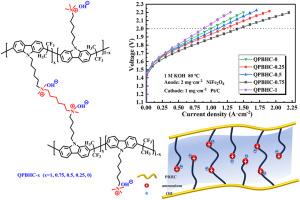
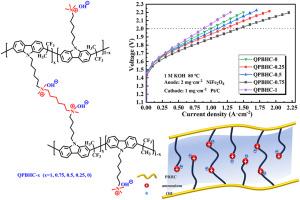
阴离子交换膜(AEMs)是水电解制氢技术中的关键材料。然而,AEMs的导电性和尺寸稳定性之间的“权衡”,以及碱性稳定性差,阻碍了AEMs和水电解技术的发展。交联是解决“权衡”效应的关键策略,从而促进了高导电性和耐用性AEMs的制造。本研究利用柔性交联剂N,N,N‘,N’-四甲基-1,6-己二胺(TMHDA)合成了一系列聚咔唑基AEMs,命名为qphhc -x。与未交联的AEMs相比,合成的AEMs的吸水率降低,碱性稳定性增强,同时在1m NaOH溶液中浸泡720小时后,电导率保持在92%以上。AFM和SAXS分析揭示了制备的AEMs中存在微相分离结构,构建了连续的离子通道,促进了离子传导。具体而言,qphhc -0.5在80℃时的电导率为102.3 mS·cm-1,抗拉强度为46.6 MPa。此外,基于qphhc -0.75的阴离子交换膜电解(AEMWE)单电池(阴极:Pt/C,阳极:NiFe2O4)在2 V下,在1 M KOH(80°C)中获得了1.40 a·cm-1的电流密度。同时,qphhc -0.5在1.0 A·cm-1条件下,在1 M KOH(80°C)下稳定工作470小时以上,电压衰减率为352 μV·h-1。这些结果表明了交联聚咔唑基AEMs在水电解中的应用前景。
Durable cross-linked poly(carbazole)-based anion exchange membranes for alkaline water electrolysis
Anion exchange membranes (AEMs) are crucial materials in hydrogen production techniques via water electrolysis. Whereas, the "trade-off" between the conductivity and dimensional stability of AEMs, as well as poor alkaline stability, hinders the advancement of AEMs and water electrolysis technologies. Cross-linking serves as a pivotal strategy for addressing the "trade-off" effect, thereby facilitating the fabrication of highly conductive and durable AEMs. In this study, a series of poly (carbazole)-based AEMs, designated as QPBHC-x, were synthesized utilizing the flexible cross-linker N,N,N′,N′-tetramethyl-1,6-hexanediamine (TMHDA). The synthesized AEMs demonstrated reduced water uptake and enhanced alkaline stability in comparison to uncross-linked AEMs, while maintaining a conductivity retention exceeding 92 % after immersion in 1 M NaOH solution at 80 °C for 720 h. AFM and SAXS analyses revealed the microphase separation structure in the prepared AEMs, which construct continuous ion channels and promote ion conduction. Specifically, the QPBHC-0.5 demonstrated a conductivity of 102.3 mS cm−1 at 80 °C and exhibited a tensile strength of 46.6 MPa. Furthermore, anion exchange membrane water electrolysis (AEMWE) single cell (cathode: Pt/C and anode: NiFe2O4) based on QPBHC-0.75 achieved a current density of 1.40 A cm−1 at 2 V in 1 M KOH (80 °C). Meanwhile, QPBHC-0.5 maintained stable operation for over 470 h at 1.0 A cm−1 in 1 M KOH (80 °C) with a voltage decay rate of 352 μV h−1. These results indicate promising applications of cross-linked poly (carbazole)-based AEMs in water electrolysis.
期刊介绍:
Polymer is an interdisciplinary journal dedicated to publishing innovative and significant advances in Polymer Physics, Chemistry and Technology. We welcome submissions on polymer hybrids, nanocomposites, characterisation and self-assembly. Polymer also publishes work on the technological application of polymers in energy and optoelectronics.
The main scope is covered but not limited to the following core areas:
Polymer Materials
Nanocomposites and hybrid nanomaterials
Polymer blends, films, fibres, networks and porous materials
Physical Characterization
Characterisation, modelling and simulation* of molecular and materials properties in bulk, solution, and thin films
Polymer Engineering
Advanced multiscale processing methods
Polymer Synthesis, Modification and Self-assembly
Including designer polymer architectures, mechanisms and kinetics, and supramolecular polymerization
Technological Applications
Polymers for energy generation and storage
Polymer membranes for separation technology
Polymers for opto- and microelectronics.




 京公网安备 11010802042870号
京ICP备2023020795号-1
京公网安备 11010802042870号
京ICP备2023020795号-1

 分享
分享
 求助内容:
求助内容: 应助结果提醒方式:
 扫码关注我们
