{"title":"高熵合金高d波段中心实现锂硫电池的高倍率和长循环寿命","authors":"Fengfeng Han, Lirong Zhang, Qi Jin, Xinzhi Ma, Zhiguo Zhang, Zhenhua Sun, Xitian Zhang, Lili Wu","doi":"10.1021/acsnano.4c18642","DOIUrl":null,"url":null,"abstract":"Efficient catalysis of intermediate lithium polysulfide (LiPS) conversion in lithium–sulfur batteries is crucial for enhancing sulfur reduction reaction (SRR) kinetics and suppressing the shuttle effect of LiPSs. High-entropy alloys (HEAs), with their compositional flexibility, structural diversity, and multielement synergy, are promising high-efficiency catalyst candidates. Herein, a work function-dominated d-band center rule is proposed to modulate the chemical absorption ability of LiPSs and the catalytic performance of HEA catalysts. The d-band center of the as-screened PtCuFeCoNi HEAs (PCFCN–HEAs) is modulated via distinct work functions of its five metallic elements. In addition, detailed density functional theory (DFT) calculations and X-ray absorption spectroscopy are performed to reveal the roles of individual metallic elements in HEAs. Optimizing the d-band center of PCFCN–HEAs notably enhances the adsorption of LiPSs and accelerates the SRR. PCFCN–HEA nanoparticles are deposited on the surface of hollow carbon spheres (HCSs) and they combine with hyphae carbon nanobelts (HCNBs) to form a PCFCN–HEA/HCS/HCNB composite as the sulfur host. The cathode with PCNFC-HEA catalyst exhibits stable cycling at 6C and delivers a high reversible capacity of 652 mAh g<sup>–1</sup> even at a high rate of 8C. DFT calculations further elucidate the stepwise catalytic mechanism of PCFCN–HEAs, offering a pathway for designing high-efficiency catalysts.","PeriodicalId":21,"journal":{"name":"ACS Nano","volume":"15 1","pages":""},"PeriodicalIF":16.0000,"publicationDate":"2025-02-26","publicationTypes":"Journal Article","fieldsOfStudy":null,"isOpenAccess":false,"openAccessPdf":"","citationCount":"0","resultStr":"{\"title\":\"High Rate and Long-Cycle Life of Lithium–Sulfur Battery Enabled by High d-Band Center of High-Entropy Alloys\",\"authors\":\"Fengfeng Han, Lirong Zhang, Qi Jin, Xinzhi Ma, Zhiguo Zhang, Zhenhua Sun, Xitian Zhang, Lili Wu\",\"doi\":\"10.1021/acsnano.4c18642\",\"DOIUrl\":null,\"url\":null,\"abstract\":\"Efficient catalysis of intermediate lithium polysulfide (LiPS) conversion in lithium–sulfur batteries is crucial for enhancing sulfur reduction reaction (SRR) kinetics and suppressing the shuttle effect of LiPSs. High-entropy alloys (HEAs), with their compositional flexibility, structural diversity, and multielement synergy, are promising high-efficiency catalyst candidates. Herein, a work function-dominated d-band center rule is proposed to modulate the chemical absorption ability of LiPSs and the catalytic performance of HEA catalysts. The d-band center of the as-screened PtCuFeCoNi HEAs (PCFCN–HEAs) is modulated via distinct work functions of its five metallic elements. In addition, detailed density functional theory (DFT) calculations and X-ray absorption spectroscopy are performed to reveal the roles of individual metallic elements in HEAs. Optimizing the d-band center of PCFCN–HEAs notably enhances the adsorption of LiPSs and accelerates the SRR. PCFCN–HEA nanoparticles are deposited on the surface of hollow carbon spheres (HCSs) and they combine with hyphae carbon nanobelts (HCNBs) to form a PCFCN–HEA/HCS/HCNB composite as the sulfur host. The cathode with PCNFC-HEA catalyst exhibits stable cycling at 6C and delivers a high reversible capacity of 652 mAh g<sup>–1</sup> even at a high rate of 8C. DFT calculations further elucidate the stepwise catalytic mechanism of PCFCN–HEAs, offering a pathway for designing high-efficiency catalysts.\",\"PeriodicalId\":21,\"journal\":{\"name\":\"ACS Nano\",\"volume\":\"15 1\",\"pages\":\"\"},\"PeriodicalIF\":16.0000,\"publicationDate\":\"2025-02-26\",\"publicationTypes\":\"Journal Article\",\"fieldsOfStudy\":null,\"isOpenAccess\":false,\"openAccessPdf\":\"\",\"citationCount\":\"0\",\"resultStr\":null,\"platform\":\"Semanticscholar\",\"paperid\":null,\"PeriodicalName\":\"ACS Nano\",\"FirstCategoryId\":\"88\",\"ListUrlMain\":\"https://doi.org/10.1021/acsnano.4c18642\",\"RegionNum\":1,\"RegionCategory\":\"材料科学\",\"ArticlePicture\":[],\"TitleCN\":null,\"AbstractTextCN\":null,\"PMCID\":null,\"EPubDate\":\"\",\"PubModel\":\"\",\"JCR\":\"Q1\",\"JCRName\":\"CHEMISTRY, MULTIDISCIPLINARY\",\"Score\":null,\"Total\":0}","platform":"Semanticscholar","paperid":null,"PeriodicalName":"ACS Nano","FirstCategoryId":"88","ListUrlMain":"https://doi.org/10.1021/acsnano.4c18642","RegionNum":1,"RegionCategory":"材料科学","ArticlePicture":[],"TitleCN":null,"AbstractTextCN":null,"PMCID":null,"EPubDate":"","PubModel":"","JCR":"Q1","JCRName":"CHEMISTRY, MULTIDISCIPLINARY","Score":null,"Total":0}
引用次数: 0
摘要
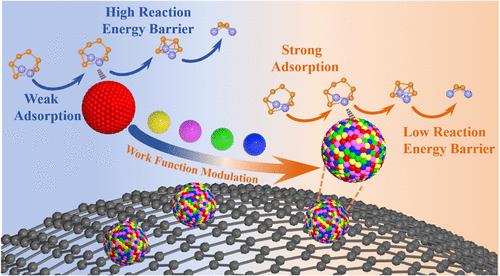
高效催化锂硫电池中间多硫锂(LiPS)的转化对于提高硫还原反应动力学和抑制LiPS的穿梭效应至关重要。高熵合金(HEAs)由于其组成的灵活性、结构的多样性和多元素协同作用,是很有前途的高效催化剂候选材料。本文提出了一个以功函数为主导的d波段中心规则来调节LiPSs的化学吸收能力和HEA催化剂的催化性能。所筛选的PtCuFeCoNi HEAs (PCFCN-HEAs)的d波段中心通过其五种金属元素的不同功函数进行调制。此外,还进行了详细的密度泛函理论(DFT)计算和x射线吸收光谱分析,以揭示单个金属元素在HEAs中的作用。优化PCFCN-HEAs的d波段中心可显著提高对LiPSs的吸附,加快SRR。将PCFCN-HEA纳米颗粒沉积在空心碳球(HCS)表面,并与菌丝碳纳米带(HCNBs)结合,形成PCFCN-HEA /HCS/HCNB复合材料作为硫宿主。使用PCNFC-HEA催化剂的阴极在6C下具有稳定的循环,即使在8C的高倍率下也能提供652 mAh g-1的高可逆容量。DFT计算进一步阐明了PCFCN-HEAs的分步催化机理,为设计高效催化剂提供了途径。
High Rate and Long-Cycle Life of Lithium–Sulfur Battery Enabled by High d-Band Center of High-Entropy Alloys
Efficient catalysis of intermediate lithium polysulfide (LiPS) conversion in lithium–sulfur batteries is crucial for enhancing sulfur reduction reaction (SRR) kinetics and suppressing the shuttle effect of LiPSs. High-entropy alloys (HEAs), with their compositional flexibility, structural diversity, and multielement synergy, are promising high-efficiency catalyst candidates. Herein, a work function-dominated d-band center rule is proposed to modulate the chemical absorption ability of LiPSs and the catalytic performance of HEA catalysts. The d-band center of the as-screened PtCuFeCoNi HEAs (PCFCN–HEAs) is modulated via distinct work functions of its five metallic elements. In addition, detailed density functional theory (DFT) calculations and X-ray absorption spectroscopy are performed to reveal the roles of individual metallic elements in HEAs. Optimizing the d-band center of PCFCN–HEAs notably enhances the adsorption of LiPSs and accelerates the SRR. PCFCN–HEA nanoparticles are deposited on the surface of hollow carbon spheres (HCSs) and they combine with hyphae carbon nanobelts (HCNBs) to form a PCFCN–HEA/HCS/HCNB composite as the sulfur host. The cathode with PCNFC-HEA catalyst exhibits stable cycling at 6C and delivers a high reversible capacity of 652 mAh g–1 even at a high rate of 8C. DFT calculations further elucidate the stepwise catalytic mechanism of PCFCN–HEAs, offering a pathway for designing high-efficiency catalysts.
期刊介绍:
ACS Nano, published monthly, serves as an international forum for comprehensive articles on nanoscience and nanotechnology research at the intersections of chemistry, biology, materials science, physics, and engineering. The journal fosters communication among scientists in these communities, facilitating collaboration, new research opportunities, and advancements through discoveries. ACS Nano covers synthesis, assembly, characterization, theory, and simulation of nanostructures, nanobiotechnology, nanofabrication, methods and tools for nanoscience and nanotechnology, and self- and directed-assembly. Alongside original research articles, it offers thorough reviews, perspectives on cutting-edge research, and discussions envisioning the future of nanoscience and nanotechnology.




 京公网安备 11010802042870号
京ICP备2023020795号-1
京公网安备 11010802042870号
京ICP备2023020795号-1

 分享
分享
 求助内容:
求助内容: 应助结果提醒方式:
 扫码关注我们
