{"title":"蓝色CsPbBr3纳米晶:合成进展及明亮光致发光","authors":"Wenbin Shi, Ping Yang, Xiao Zhang","doi":"10.1021/acs.langmuir.4c05108","DOIUrl":null,"url":null,"abstract":"All-inorganic perovskite (CsPbX<sub>3</sub>, X = Cl, Br, I) nanomaterials as novel optoelectronic semiconductors have attracted much attention due to their unique photoelectric properties in lighting, display, and photovoltaic applications. Meanwhile, green and red light-emitting diodes (LEDs) based on bromine and iodine groups have developed rapidly, in which the high external quantum efficiency (EQE) is close to that of the current commercial green and red LEDs. However, the EQE of perovskite-based blue LEDs is far behind. Blue LEDs are often made by CsPbCl<sub>3</sub> and CsPb(Cl/Br)<sub>3</sub> nanocrystals (NCs) with low photoluminescence (PL) quantum yields. Their phase segregation seriously limits their practical applications. The PL peak of CsPbBr<sub>3</sub> NCs is usually located in the green region. In the case of a strong quantum confinement effect, blue PL can be observed from CsPbBr<sub>3</sub> NCs. Therefore, blue emitting CsPbBr<sub>3</sub> NCs have become a hot topic. This review focused on the synthesis, ligand selection, and morphology control of blue emitting CsPbBr<sub>3</sub> NCs, in which the microstructure, luminescence, and synthesis method were first discussed. In addition, the influence of capping ligands on the PL properties and stability is indicated. Furthermore, the size and morphology adjustment are also discussed. Finally, the application and existing problems of blue-emitting CsPbBr<sub>3</sub> in blue LEDs are summarized. This review aims to provide new insights into the preparation of efficient and stable blue-emitting CsPbBr<sub>3</sub> and the design-based manufacturing of blue LEDs.","PeriodicalId":50,"journal":{"name":"Langmuir","volume":"25 1","pages":""},"PeriodicalIF":3.9000,"publicationDate":"2025-02-26","publicationTypes":"Journal Article","fieldsOfStudy":null,"isOpenAccess":false,"openAccessPdf":"","citationCount":"0","resultStr":"{\"title\":\"Blue-Emitting CsPbBr3 Nanocrystals: Synthesis Progress and Bright Photoluminescence\",\"authors\":\"Wenbin Shi, Ping Yang, Xiao Zhang\",\"doi\":\"10.1021/acs.langmuir.4c05108\",\"DOIUrl\":null,\"url\":null,\"abstract\":\"All-inorganic perovskite (CsPbX<sub>3</sub>, X = Cl, Br, I) nanomaterials as novel optoelectronic semiconductors have attracted much attention due to their unique photoelectric properties in lighting, display, and photovoltaic applications. Meanwhile, green and red light-emitting diodes (LEDs) based on bromine and iodine groups have developed rapidly, in which the high external quantum efficiency (EQE) is close to that of the current commercial green and red LEDs. However, the EQE of perovskite-based blue LEDs is far behind. Blue LEDs are often made by CsPbCl<sub>3</sub> and CsPb(Cl/Br)<sub>3</sub> nanocrystals (NCs) with low photoluminescence (PL) quantum yields. Their phase segregation seriously limits their practical applications. The PL peak of CsPbBr<sub>3</sub> NCs is usually located in the green region. In the case of a strong quantum confinement effect, blue PL can be observed from CsPbBr<sub>3</sub> NCs. Therefore, blue emitting CsPbBr<sub>3</sub> NCs have become a hot topic. This review focused on the synthesis, ligand selection, and morphology control of blue emitting CsPbBr<sub>3</sub> NCs, in which the microstructure, luminescence, and synthesis method were first discussed. In addition, the influence of capping ligands on the PL properties and stability is indicated. Furthermore, the size and morphology adjustment are also discussed. Finally, the application and existing problems of blue-emitting CsPbBr<sub>3</sub> in blue LEDs are summarized. This review aims to provide new insights into the preparation of efficient and stable blue-emitting CsPbBr<sub>3</sub> and the design-based manufacturing of blue LEDs.\",\"PeriodicalId\":50,\"journal\":{\"name\":\"Langmuir\",\"volume\":\"25 1\",\"pages\":\"\"},\"PeriodicalIF\":3.9000,\"publicationDate\":\"2025-02-26\",\"publicationTypes\":\"Journal Article\",\"fieldsOfStudy\":null,\"isOpenAccess\":false,\"openAccessPdf\":\"\",\"citationCount\":\"0\",\"resultStr\":null,\"platform\":\"Semanticscholar\",\"paperid\":null,\"PeriodicalName\":\"Langmuir\",\"FirstCategoryId\":\"92\",\"ListUrlMain\":\"https://doi.org/10.1021/acs.langmuir.4c05108\",\"RegionNum\":2,\"RegionCategory\":\"化学\",\"ArticlePicture\":[],\"TitleCN\":null,\"AbstractTextCN\":null,\"PMCID\":null,\"EPubDate\":\"\",\"PubModel\":\"\",\"JCR\":\"Q2\",\"JCRName\":\"CHEMISTRY, MULTIDISCIPLINARY\",\"Score\":null,\"Total\":0}","platform":"Semanticscholar","paperid":null,"PeriodicalName":"Langmuir","FirstCategoryId":"92","ListUrlMain":"https://doi.org/10.1021/acs.langmuir.4c05108","RegionNum":2,"RegionCategory":"化学","ArticlePicture":[],"TitleCN":null,"AbstractTextCN":null,"PMCID":null,"EPubDate":"","PubModel":"","JCR":"Q2","JCRName":"CHEMISTRY, MULTIDISCIPLINARY","Score":null,"Total":0}
引用次数: 0
摘要
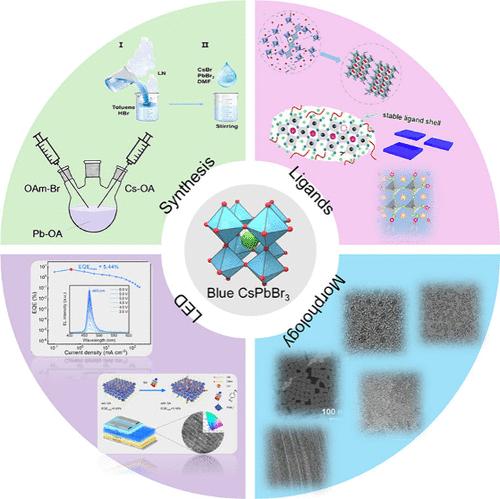
全无机钙钛矿(CsPbX3, X = Cl, Br, I)纳米材料因其独特的光电性能在照明、显示和光伏等领域的应用而备受关注。与此同时,基于溴和碘基团的绿色和红色发光二极管(led)发展迅速,其高外量子效率(EQE)接近目前商用的绿色和红色led。然而,钙钛矿基蓝光led的EQE远远落后。蓝色led通常由CsPbCl3和CsPb(Cl/Br)3纳米晶体(NCs)制成,具有较低的光致发光量子产率。它们的相偏析严重限制了它们的实际应用。CsPbBr3 NCs的PL峰通常位于绿色区域。在强量子约束效应的情况下,可以从CsPbBr3 NCs中观察到蓝色PL。因此,蓝色发光CsPbBr3纳米材料已成为研究热点。本文综述了蓝色发光CsPbBr3纳米材料的合成、配体选择和形貌控制,并对CsPbBr3纳米材料的微观结构、发光特性和合成方法进行了综述。此外,还指出了盖层配体对PL性质和稳定性的影响。此外,还讨论了尺寸和形貌的调整。最后总结了蓝色发光CsPbBr3在蓝色led中的应用及存在的问题。本文旨在为高效稳定蓝光发光CsPbBr3的制备和蓝光led的设计制造提供新的见解。
Blue-Emitting CsPbBr3 Nanocrystals: Synthesis Progress and Bright Photoluminescence
All-inorganic perovskite (CsPbX3, X = Cl, Br, I) nanomaterials as novel optoelectronic semiconductors have attracted much attention due to their unique photoelectric properties in lighting, display, and photovoltaic applications. Meanwhile, green and red light-emitting diodes (LEDs) based on bromine and iodine groups have developed rapidly, in which the high external quantum efficiency (EQE) is close to that of the current commercial green and red LEDs. However, the EQE of perovskite-based blue LEDs is far behind. Blue LEDs are often made by CsPbCl3 and CsPb(Cl/Br)3 nanocrystals (NCs) with low photoluminescence (PL) quantum yields. Their phase segregation seriously limits their practical applications. The PL peak of CsPbBr3 NCs is usually located in the green region. In the case of a strong quantum confinement effect, blue PL can be observed from CsPbBr3 NCs. Therefore, blue emitting CsPbBr3 NCs have become a hot topic. This review focused on the synthesis, ligand selection, and morphology control of blue emitting CsPbBr3 NCs, in which the microstructure, luminescence, and synthesis method were first discussed. In addition, the influence of capping ligands on the PL properties and stability is indicated. Furthermore, the size and morphology adjustment are also discussed. Finally, the application and existing problems of blue-emitting CsPbBr3 in blue LEDs are summarized. This review aims to provide new insights into the preparation of efficient and stable blue-emitting CsPbBr3 and the design-based manufacturing of blue LEDs.
期刊介绍:
Langmuir is an interdisciplinary journal publishing articles in the following subject categories:
Colloids: surfactants and self-assembly, dispersions, emulsions, foams
Interfaces: adsorption, reactions, films, forces
Biological Interfaces: biocolloids, biomolecular and biomimetic materials
Materials: nano- and mesostructured materials, polymers, gels, liquid crystals
Electrochemistry: interfacial charge transfer, charge transport, electrocatalysis, electrokinetic phenomena, bioelectrochemistry
Devices and Applications: sensors, fluidics, patterning, catalysis, photonic crystals
However, when high-impact, original work is submitted that does not fit within the above categories, decisions to accept or decline such papers will be based on one criteria: What Would Irving Do?
Langmuir ranks #2 in citations out of 136 journals in the category of Physical Chemistry with 113,157 total citations. The journal received an Impact Factor of 4.384*.
This journal is also indexed in the categories of Materials Science (ranked #1) and Multidisciplinary Chemistry (ranked #5).




 京公网安备 11010802042870号
京ICP备2023020795号-1
京公网安备 11010802042870号
京ICP备2023020795号-1

 分享
分享
 求助内容:
求助内容: 应助结果提醒方式:
 扫码关注我们
