{"title":"2.45 GHz Wi-Fi暴露时间对精子质量和睾丸组织病理学的影响:一种过氧化损伤的探索。","authors":"Norazurashima Jamaludin, Siti Fatimah Ibrahim, Farah Hanan Fathihah Jaffar, Aini Farzana Zulkefli, Khairul Osman","doi":"10.3390/antiox14020179","DOIUrl":null,"url":null,"abstract":"<p><p>Concerns have arisen about the impact of wireless technology on male fertility, particularly regarding the duration of 2.45 GHz Wi-Fi radiation exposure. This study examines the influence of various exposure durations on sperm parameters and testicular histopathology, focusing on malondialdehyde as an oxidative stress marker. Twenty-four Sprague Dawley rats were exposed for eight weeks, after which their sperm concentration, motility, and viability and testicular histopathology were assessed. Malondialdehyde levels were measured using an Enzyme-Linked Immunosorbent Assay. One-way ANOVAs with Tukey's post hoc tests were conducted for the sperm concentration, motility, and viability; the seminiferous epithelium height; and malondialdehyde. The Kruskal-Wallis H test was used for the Johnsen Score and seminiferous tubule diameter. The results indicated that 4 h of exposure to 2.45 GHz radiation induced oxidative stress and adversely affected sperm parameters and the testicular ultrastructure. Gradual recovery was observed at 8 h, with further improvement at 24 h, suggesting the activation of cell repair mechanisms. This was supported by significant changes in testicular organ coefficients, indicating potential recovery. Our findings suggest that Wi-Fi exposure reduces sperm fertility potential, with the body showing limited capacity for complete recovery from the damage.</p>","PeriodicalId":7984,"journal":{"name":"Antioxidants","volume":"14 2","pages":""},"PeriodicalIF":6.6000,"publicationDate":"2025-02-04","publicationTypes":"Journal Article","fieldsOfStudy":null,"isOpenAccess":false,"openAccessPdf":"https://www.ncbi.nlm.nih.gov/pmc/articles/PMC11852241/pdf/","citationCount":"0","resultStr":"{\"title\":\"The Influence of 2.45 GHz Wi-Fi Exposure Duration on Sperm Quality and Testicular Histopathology: An Exploration of Peroxidative Injury.\",\"authors\":\"Norazurashima Jamaludin, Siti Fatimah Ibrahim, Farah Hanan Fathihah Jaffar, Aini Farzana Zulkefli, Khairul Osman\",\"doi\":\"10.3390/antiox14020179\",\"DOIUrl\":null,\"url\":null,\"abstract\":\"<p><p>Concerns have arisen about the impact of wireless technology on male fertility, particularly regarding the duration of 2.45 GHz Wi-Fi radiation exposure. This study examines the influence of various exposure durations on sperm parameters and testicular histopathology, focusing on malondialdehyde as an oxidative stress marker. Twenty-four Sprague Dawley rats were exposed for eight weeks, after which their sperm concentration, motility, and viability and testicular histopathology were assessed. Malondialdehyde levels were measured using an Enzyme-Linked Immunosorbent Assay. One-way ANOVAs with Tukey's post hoc tests were conducted for the sperm concentration, motility, and viability; the seminiferous epithelium height; and malondialdehyde. The Kruskal-Wallis H test was used for the Johnsen Score and seminiferous tubule diameter. The results indicated that 4 h of exposure to 2.45 GHz radiation induced oxidative stress and adversely affected sperm parameters and the testicular ultrastructure. Gradual recovery was observed at 8 h, with further improvement at 24 h, suggesting the activation of cell repair mechanisms. This was supported by significant changes in testicular organ coefficients, indicating potential recovery. Our findings suggest that Wi-Fi exposure reduces sperm fertility potential, with the body showing limited capacity for complete recovery from the damage.</p>\",\"PeriodicalId\":7984,\"journal\":{\"name\":\"Antioxidants\",\"volume\":\"14 2\",\"pages\":\"\"},\"PeriodicalIF\":6.6000,\"publicationDate\":\"2025-02-04\",\"publicationTypes\":\"Journal Article\",\"fieldsOfStudy\":null,\"isOpenAccess\":false,\"openAccessPdf\":\"https://www.ncbi.nlm.nih.gov/pmc/articles/PMC11852241/pdf/\",\"citationCount\":\"0\",\"resultStr\":null,\"platform\":\"Semanticscholar\",\"paperid\":null,\"PeriodicalName\":\"Antioxidants\",\"FirstCategoryId\":\"3\",\"ListUrlMain\":\"https://doi.org/10.3390/antiox14020179\",\"RegionNum\":2,\"RegionCategory\":\"医学\",\"ArticlePicture\":[],\"TitleCN\":null,\"AbstractTextCN\":null,\"PMCID\":null,\"EPubDate\":\"\",\"PubModel\":\"\",\"JCR\":\"Q1\",\"JCRName\":\"BIOCHEMISTRY & MOLECULAR BIOLOGY\",\"Score\":null,\"Total\":0}","platform":"Semanticscholar","paperid":null,"PeriodicalName":"Antioxidants","FirstCategoryId":"3","ListUrlMain":"https://doi.org/10.3390/antiox14020179","RegionNum":2,"RegionCategory":"医学","ArticlePicture":[],"TitleCN":null,"AbstractTextCN":null,"PMCID":null,"EPubDate":"","PubModel":"","JCR":"Q1","JCRName":"BIOCHEMISTRY & MOLECULAR BIOLOGY","Score":null,"Total":0}
The Influence of 2.45 GHz Wi-Fi Exposure Duration on Sperm Quality and Testicular Histopathology: An Exploration of Peroxidative Injury.
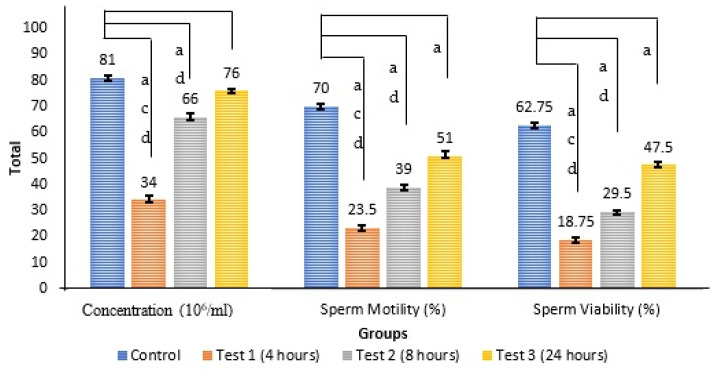
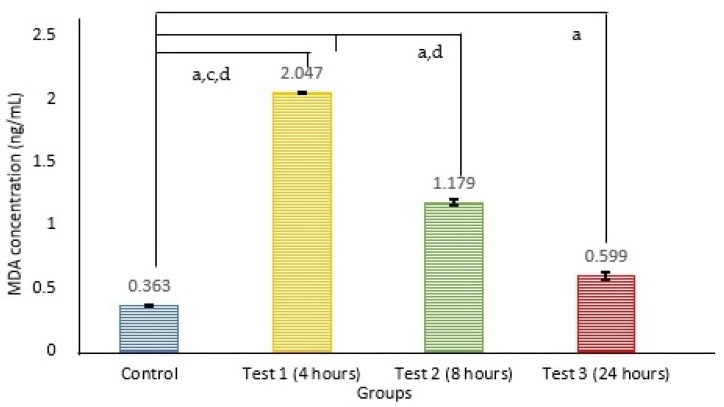
Concerns have arisen about the impact of wireless technology on male fertility, particularly regarding the duration of 2.45 GHz Wi-Fi radiation exposure. This study examines the influence of various exposure durations on sperm parameters and testicular histopathology, focusing on malondialdehyde as an oxidative stress marker. Twenty-four Sprague Dawley rats were exposed for eight weeks, after which their sperm concentration, motility, and viability and testicular histopathology were assessed. Malondialdehyde levels were measured using an Enzyme-Linked Immunosorbent Assay. One-way ANOVAs with Tukey's post hoc tests were conducted for the sperm concentration, motility, and viability; the seminiferous epithelium height; and malondialdehyde. The Kruskal-Wallis H test was used for the Johnsen Score and seminiferous tubule diameter. The results indicated that 4 h of exposure to 2.45 GHz radiation induced oxidative stress and adversely affected sperm parameters and the testicular ultrastructure. Gradual recovery was observed at 8 h, with further improvement at 24 h, suggesting the activation of cell repair mechanisms. This was supported by significant changes in testicular organ coefficients, indicating potential recovery. Our findings suggest that Wi-Fi exposure reduces sperm fertility potential, with the body showing limited capacity for complete recovery from the damage.
AntioxidantsBiochemistry, Genetics and Molecular Biology-Physiology
CiteScore
10.60
自引率
11.40%
发文量
2123
审稿时长
16.3 days
期刊介绍:
Antioxidants (ISSN 2076-3921), provides an advanced forum for studies related to the science and technology of antioxidants. It publishes research papers, reviews and communications. Our aim is to encourage scientists to publish their experimental and theoretical results in as much detail as possible. There is no restriction on the length of the papers. The full experimental details must be provided so that the results can be reproduced. Electronic files and software regarding the full details of the calculation or experimental procedure, if unable to be published in a normal way, can be deposited as supplementary electronic material.





 京公网安备 11010802042870号
京ICP备2023020795号-1
京公网安备 11010802042870号
京ICP备2023020795号-1

 分享
分享
 求助内容:
求助内容: 应助结果提醒方式:
 扫码关注我们
