Zafer Akcali, Hazal Selvi Cubuk, Arzu Oguz, Murat Kocak, Aydan Farzaliyeva, Fatih Guven, Mehmet Nezir Ramazanoglu, Efe Hasdemir, Ozden Altundag, Ahmet Muhtesem Agildere
{"title":"使用命名实体识别和快速工程从非英语乳房x光检查报告中自动提取关键实体。","authors":"Zafer Akcali, Hazal Selvi Cubuk, Arzu Oguz, Murat Kocak, Aydan Farzaliyeva, Fatih Guven, Mehmet Nezir Ramazanoglu, Efe Hasdemir, Ozden Altundag, Ahmet Muhtesem Agildere","doi":"10.3390/bioengineering12020168","DOIUrl":null,"url":null,"abstract":"<p><strong>Objective: </strong>Named entity recognition (NER) offers a powerful method for automatically extracting key clinical information from text, but current models often lack sufficient support for non-English languages.</p><p><strong>Materials and methods: </strong>This study investigated a prompt-based NER approach using Google's Gemini 1.5 Pro, a large language model (LLM) with a 1.5-million-token context window. We focused on extracting important clinical entities from Turkish mammography reports, a language with limited available natural language processing (NLP) tools. Our method employed many-shot learning, incorporating 165 examples within a 26,000-token prompt derived from 75 initial reports. We tested the model on a separate set of 85 unannotated reports, concentrating on five key entities: anatomy (ANAT), impression (IMP), observation presence (OBS-P), absence (OBS-A), and uncertainty (OBS-U).</p><p><strong>Results: </strong>Our approach achieved high accuracy, with a macro-averaged F1 score of 0.99 for relaxed match and 0.84 for exact match. In relaxed matching, the model achieved F1 scores of 0.99 for ANAT, 0.99 for IMP, 1.00 for OBS-P, 1.00 for OBS-A, and 0.99 for OBS-U. For exact match, the F1 scores were 0.88 for ANAT, 0.79 for IMP, 0.78 for OBS-P, 0.94 for OBS-A, and 0.82 for OBS-U.</p><p><strong>Discussion: </strong>These results indicate that a many-shot prompt engineering approach with large language models provides an effective way to automate clinical information extraction for languages where NLP resources are less developed, and as reported in the literature, generally outperforms zero-shot, five-shot, and other few-shot methods.</p><p><strong>Conclusion: </strong>This approach has the potential to significantly improve clinical workflows and research efforts in multilingual healthcare environments.</p>","PeriodicalId":8874,"journal":{"name":"Bioengineering","volume":"12 2","pages":""},"PeriodicalIF":3.7000,"publicationDate":"2025-02-10","publicationTypes":"Journal Article","fieldsOfStudy":null,"isOpenAccess":false,"openAccessPdf":"https://www.ncbi.nlm.nih.gov/pmc/articles/PMC11852152/pdf/","citationCount":"0","resultStr":"{\"title\":\"Automated Extraction of Key Entities from Non-English Mammography Reports Using Named Entity Recognition with Prompt Engineering.\",\"authors\":\"Zafer Akcali, Hazal Selvi Cubuk, Arzu Oguz, Murat Kocak, Aydan Farzaliyeva, Fatih Guven, Mehmet Nezir Ramazanoglu, Efe Hasdemir, Ozden Altundag, Ahmet Muhtesem Agildere\",\"doi\":\"10.3390/bioengineering12020168\",\"DOIUrl\":null,\"url\":null,\"abstract\":\"<p><strong>Objective: </strong>Named entity recognition (NER) offers a powerful method for automatically extracting key clinical information from text, but current models often lack sufficient support for non-English languages.</p><p><strong>Materials and methods: </strong>This study investigated a prompt-based NER approach using Google's Gemini 1.5 Pro, a large language model (LLM) with a 1.5-million-token context window. We focused on extracting important clinical entities from Turkish mammography reports, a language with limited available natural language processing (NLP) tools. Our method employed many-shot learning, incorporating 165 examples within a 26,000-token prompt derived from 75 initial reports. We tested the model on a separate set of 85 unannotated reports, concentrating on five key entities: anatomy (ANAT), impression (IMP), observation presence (OBS-P), absence (OBS-A), and uncertainty (OBS-U).</p><p><strong>Results: </strong>Our approach achieved high accuracy, with a macro-averaged F1 score of 0.99 for relaxed match and 0.84 for exact match. In relaxed matching, the model achieved F1 scores of 0.99 for ANAT, 0.99 for IMP, 1.00 for OBS-P, 1.00 for OBS-A, and 0.99 for OBS-U. For exact match, the F1 scores were 0.88 for ANAT, 0.79 for IMP, 0.78 for OBS-P, 0.94 for OBS-A, and 0.82 for OBS-U.</p><p><strong>Discussion: </strong>These results indicate that a many-shot prompt engineering approach with large language models provides an effective way to automate clinical information extraction for languages where NLP resources are less developed, and as reported in the literature, generally outperforms zero-shot, five-shot, and other few-shot methods.</p><p><strong>Conclusion: </strong>This approach has the potential to significantly improve clinical workflows and research efforts in multilingual healthcare environments.</p>\",\"PeriodicalId\":8874,\"journal\":{\"name\":\"Bioengineering\",\"volume\":\"12 2\",\"pages\":\"\"},\"PeriodicalIF\":3.7000,\"publicationDate\":\"2025-02-10\",\"publicationTypes\":\"Journal Article\",\"fieldsOfStudy\":null,\"isOpenAccess\":false,\"openAccessPdf\":\"https://www.ncbi.nlm.nih.gov/pmc/articles/PMC11852152/pdf/\",\"citationCount\":\"0\",\"resultStr\":null,\"platform\":\"Semanticscholar\",\"paperid\":null,\"PeriodicalName\":\"Bioengineering\",\"FirstCategoryId\":\"5\",\"ListUrlMain\":\"https://doi.org/10.3390/bioengineering12020168\",\"RegionNum\":3,\"RegionCategory\":\"医学\",\"ArticlePicture\":[],\"TitleCN\":null,\"AbstractTextCN\":null,\"PMCID\":null,\"EPubDate\":\"\",\"PubModel\":\"\",\"JCR\":\"Q2\",\"JCRName\":\"ENGINEERING, BIOMEDICAL\",\"Score\":null,\"Total\":0}","platform":"Semanticscholar","paperid":null,"PeriodicalName":"Bioengineering","FirstCategoryId":"5","ListUrlMain":"https://doi.org/10.3390/bioengineering12020168","RegionNum":3,"RegionCategory":"医学","ArticlePicture":[],"TitleCN":null,"AbstractTextCN":null,"PMCID":null,"EPubDate":"","PubModel":"","JCR":"Q2","JCRName":"ENGINEERING, BIOMEDICAL","Score":null,"Total":0}
Automated Extraction of Key Entities from Non-English Mammography Reports Using Named Entity Recognition with Prompt Engineering.
Objective: Named entity recognition (NER) offers a powerful method for automatically extracting key clinical information from text, but current models often lack sufficient support for non-English languages.
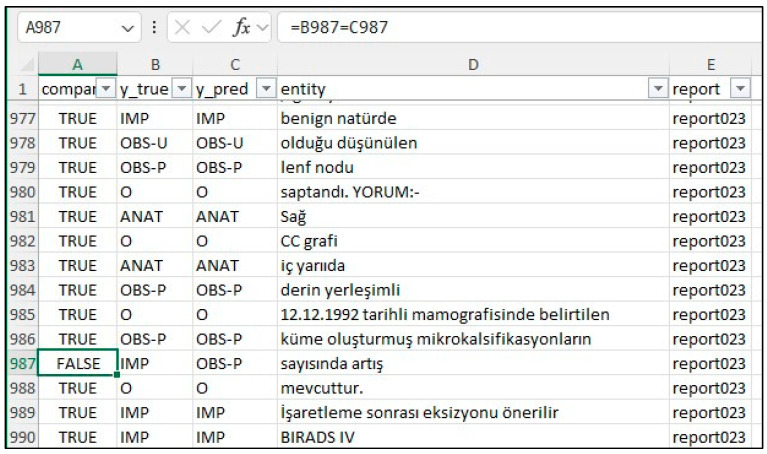
Materials and methods: This study investigated a prompt-based NER approach using Google's Gemini 1.5 Pro, a large language model (LLM) with a 1.5-million-token context window. We focused on extracting important clinical entities from Turkish mammography reports, a language with limited available natural language processing (NLP) tools. Our method employed many-shot learning, incorporating 165 examples within a 26,000-token prompt derived from 75 initial reports. We tested the model on a separate set of 85 unannotated reports, concentrating on five key entities: anatomy (ANAT), impression (IMP), observation presence (OBS-P), absence (OBS-A), and uncertainty (OBS-U).
Results: Our approach achieved high accuracy, with a macro-averaged F1 score of 0.99 for relaxed match and 0.84 for exact match. In relaxed matching, the model achieved F1 scores of 0.99 for ANAT, 0.99 for IMP, 1.00 for OBS-P, 1.00 for OBS-A, and 0.99 for OBS-U. For exact match, the F1 scores were 0.88 for ANAT, 0.79 for IMP, 0.78 for OBS-P, 0.94 for OBS-A, and 0.82 for OBS-U.
Discussion: These results indicate that a many-shot prompt engineering approach with large language models provides an effective way to automate clinical information extraction for languages where NLP resources are less developed, and as reported in the literature, generally outperforms zero-shot, five-shot, and other few-shot methods.
Conclusion: This approach has the potential to significantly improve clinical workflows and research efforts in multilingual healthcare environments.
期刊介绍:
Aims
Bioengineering (ISSN 2306-5354) provides an advanced forum for the science and technology of bioengineering. It publishes original research papers, comprehensive reviews, communications and case reports. Our aim is to encourage scientists to publish their experimental and theoretical results in as much detail as possible. All aspects of bioengineering are welcomed from theoretical concepts to education and applications. There is no restriction on the length of the papers. The full experimental details must be provided so that the results can be reproduced. There are, in addition, four key features of this Journal:
● We are introducing a new concept in scientific and technical publications “The Translational Case Report in Bioengineering”. It is a descriptive explanatory analysis of a transformative or translational event. Understanding that the goal of bioengineering scholarship is to advance towards a transformative or clinical solution to an identified transformative/clinical need, the translational case report is used to explore causation in order to find underlying principles that may guide other similar transformative/translational undertakings.
● Manuscripts regarding research proposals and research ideas will be particularly welcomed.
● Electronic files and software regarding the full details of the calculation and experimental procedure, if unable to be published in a normal way, can be deposited as supplementary material.
● We also accept manuscripts communicating to a broader audience with regard to research projects financed with public funds.
Scope
● Bionics and biological cybernetics: implantology; bio–abio interfaces
● Bioelectronics: wearable electronics; implantable electronics; “more than Moore” electronics; bioelectronics devices
● Bioprocess and biosystems engineering and applications: bioprocess design; biocatalysis; bioseparation and bioreactors; bioinformatics; bioenergy; etc.
● Biomolecular, cellular and tissue engineering and applications: tissue engineering; chromosome engineering; embryo engineering; cellular, molecular and synthetic biology; metabolic engineering; bio-nanotechnology; micro/nano technologies; genetic engineering; transgenic technology
● Biomedical engineering and applications: biomechatronics; biomedical electronics; biomechanics; biomaterials; biomimetics; biomedical diagnostics; biomedical therapy; biomedical devices; sensors and circuits; biomedical imaging and medical information systems; implants and regenerative medicine; neurotechnology; clinical engineering; rehabilitation engineering
● Biochemical engineering and applications: metabolic pathway engineering; modeling and simulation
● Translational bioengineering







 京公网安备 11010802042870号
京ICP备2023020795号-1
京公网安备 11010802042870号
京ICP备2023020795号-1

 分享
分享
 求助内容:
求助内容: 应助结果提醒方式:
 扫码关注我们
