Zhen Wang, Penghui Xiang, Zhe Xu, Meiqi Gu, Rui Zhang, Yifei Li, Hua Chen, Li He, Chengla Yi
{"title":"镁、锌和锶在骨质疏松性骨折修复中的作用。","authors":"Zhen Wang, Penghui Xiang, Zhe Xu, Meiqi Gu, Rui Zhang, Yifei Li, Hua Chen, Li He, Chengla Yi","doi":"10.3390/bioengineering12020201","DOIUrl":null,"url":null,"abstract":"<p><p>Osteoporotic fractures represent a significant public health challenge in the context of an aging global population, with the rising prevalence of osteoporosis intensifying the demand for effective fracture treatment. Restoring the structure and function of bone tissue damaged by osteoporosis-induced defects remains a critical issue in clinical practice. In recent years, bioactive metallic materials such as magnesium, zinc, and strontium have gained considerable attention due to their exceptional mechanical properties, biocompatibility, and biodegradability, positioning them as promising materials for osteoporotic fracture repair. This review systematically explored the biological mechanisms, application advancements, and associated challenges of magnesium, zinc, and strontium in fracture healing. Key topics included their roles in promoting osteoblast proliferation and differentiation, inhibiting osteoclast activity, and modulating the bone microenvironment. Additionally, this review examined the optimization strategies for their clinical application, such as their integration into bone scaffolds, the functionalization of conventional materials, and the synergistic effects between different metals. Finally, this review analyzed the current progress and unresolved issues in this field, offering a forward-looking perspective on the clinical potential of bioactive metallic materials in precision treatment of osteoporotic fractures.</p>","PeriodicalId":8874,"journal":{"name":"Bioengineering","volume":"12 2","pages":""},"PeriodicalIF":3.7000,"publicationDate":"2025-02-18","publicationTypes":"Journal Article","fieldsOfStudy":null,"isOpenAccess":false,"openAccessPdf":"https://www.ncbi.nlm.nih.gov/pmc/articles/PMC11851939/pdf/","citationCount":"0","resultStr":"{\"title\":\"The Role of Magnesium, Zinc, and Strontium in Osteoporotic Fracture Repair.\",\"authors\":\"Zhen Wang, Penghui Xiang, Zhe Xu, Meiqi Gu, Rui Zhang, Yifei Li, Hua Chen, Li He, Chengla Yi\",\"doi\":\"10.3390/bioengineering12020201\",\"DOIUrl\":null,\"url\":null,\"abstract\":\"<p><p>Osteoporotic fractures represent a significant public health challenge in the context of an aging global population, with the rising prevalence of osteoporosis intensifying the demand for effective fracture treatment. Restoring the structure and function of bone tissue damaged by osteoporosis-induced defects remains a critical issue in clinical practice. In recent years, bioactive metallic materials such as magnesium, zinc, and strontium have gained considerable attention due to their exceptional mechanical properties, biocompatibility, and biodegradability, positioning them as promising materials for osteoporotic fracture repair. This review systematically explored the biological mechanisms, application advancements, and associated challenges of magnesium, zinc, and strontium in fracture healing. Key topics included their roles in promoting osteoblast proliferation and differentiation, inhibiting osteoclast activity, and modulating the bone microenvironment. Additionally, this review examined the optimization strategies for their clinical application, such as their integration into bone scaffolds, the functionalization of conventional materials, and the synergistic effects between different metals. Finally, this review analyzed the current progress and unresolved issues in this field, offering a forward-looking perspective on the clinical potential of bioactive metallic materials in precision treatment of osteoporotic fractures.</p>\",\"PeriodicalId\":8874,\"journal\":{\"name\":\"Bioengineering\",\"volume\":\"12 2\",\"pages\":\"\"},\"PeriodicalIF\":3.7000,\"publicationDate\":\"2025-02-18\",\"publicationTypes\":\"Journal Article\",\"fieldsOfStudy\":null,\"isOpenAccess\":false,\"openAccessPdf\":\"https://www.ncbi.nlm.nih.gov/pmc/articles/PMC11851939/pdf/\",\"citationCount\":\"0\",\"resultStr\":null,\"platform\":\"Semanticscholar\",\"paperid\":null,\"PeriodicalName\":\"Bioengineering\",\"FirstCategoryId\":\"5\",\"ListUrlMain\":\"https://doi.org/10.3390/bioengineering12020201\",\"RegionNum\":3,\"RegionCategory\":\"医学\",\"ArticlePicture\":[],\"TitleCN\":null,\"AbstractTextCN\":null,\"PMCID\":null,\"EPubDate\":\"\",\"PubModel\":\"\",\"JCR\":\"Q2\",\"JCRName\":\"ENGINEERING, BIOMEDICAL\",\"Score\":null,\"Total\":0}","platform":"Semanticscholar","paperid":null,"PeriodicalName":"Bioengineering","FirstCategoryId":"5","ListUrlMain":"https://doi.org/10.3390/bioengineering12020201","RegionNum":3,"RegionCategory":"医学","ArticlePicture":[],"TitleCN":null,"AbstractTextCN":null,"PMCID":null,"EPubDate":"","PubModel":"","JCR":"Q2","JCRName":"ENGINEERING, BIOMEDICAL","Score":null,"Total":0}
The Role of Magnesium, Zinc, and Strontium in Osteoporotic Fracture Repair.
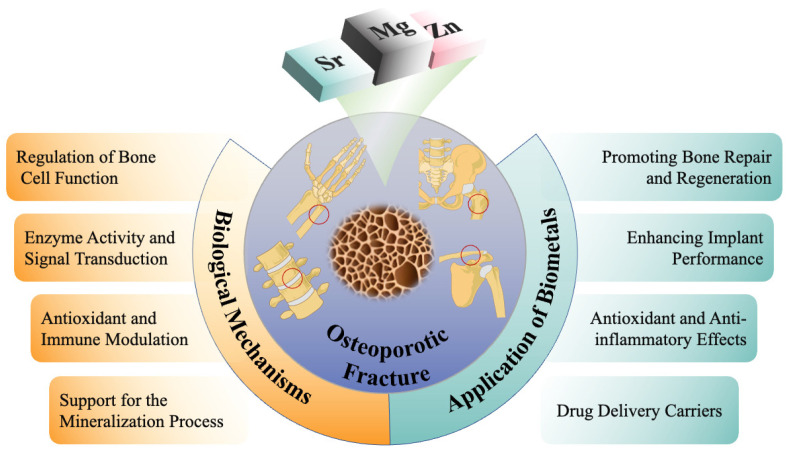
Osteoporotic fractures represent a significant public health challenge in the context of an aging global population, with the rising prevalence of osteoporosis intensifying the demand for effective fracture treatment. Restoring the structure and function of bone tissue damaged by osteoporosis-induced defects remains a critical issue in clinical practice. In recent years, bioactive metallic materials such as magnesium, zinc, and strontium have gained considerable attention due to their exceptional mechanical properties, biocompatibility, and biodegradability, positioning them as promising materials for osteoporotic fracture repair. This review systematically explored the biological mechanisms, application advancements, and associated challenges of magnesium, zinc, and strontium in fracture healing. Key topics included their roles in promoting osteoblast proliferation and differentiation, inhibiting osteoclast activity, and modulating the bone microenvironment. Additionally, this review examined the optimization strategies for their clinical application, such as their integration into bone scaffolds, the functionalization of conventional materials, and the synergistic effects between different metals. Finally, this review analyzed the current progress and unresolved issues in this field, offering a forward-looking perspective on the clinical potential of bioactive metallic materials in precision treatment of osteoporotic fractures.
期刊介绍:
Aims
Bioengineering (ISSN 2306-5354) provides an advanced forum for the science and technology of bioengineering. It publishes original research papers, comprehensive reviews, communications and case reports. Our aim is to encourage scientists to publish their experimental and theoretical results in as much detail as possible. All aspects of bioengineering are welcomed from theoretical concepts to education and applications. There is no restriction on the length of the papers. The full experimental details must be provided so that the results can be reproduced. There are, in addition, four key features of this Journal:
● We are introducing a new concept in scientific and technical publications “The Translational Case Report in Bioengineering”. It is a descriptive explanatory analysis of a transformative or translational event. Understanding that the goal of bioengineering scholarship is to advance towards a transformative or clinical solution to an identified transformative/clinical need, the translational case report is used to explore causation in order to find underlying principles that may guide other similar transformative/translational undertakings.
● Manuscripts regarding research proposals and research ideas will be particularly welcomed.
● Electronic files and software regarding the full details of the calculation and experimental procedure, if unable to be published in a normal way, can be deposited as supplementary material.
● We also accept manuscripts communicating to a broader audience with regard to research projects financed with public funds.
Scope
● Bionics and biological cybernetics: implantology; bio–abio interfaces
● Bioelectronics: wearable electronics; implantable electronics; “more than Moore” electronics; bioelectronics devices
● Bioprocess and biosystems engineering and applications: bioprocess design; biocatalysis; bioseparation and bioreactors; bioinformatics; bioenergy; etc.
● Biomolecular, cellular and tissue engineering and applications: tissue engineering; chromosome engineering; embryo engineering; cellular, molecular and synthetic biology; metabolic engineering; bio-nanotechnology; micro/nano technologies; genetic engineering; transgenic technology
● Biomedical engineering and applications: biomechatronics; biomedical electronics; biomechanics; biomaterials; biomimetics; biomedical diagnostics; biomedical therapy; biomedical devices; sensors and circuits; biomedical imaging and medical information systems; implants and regenerative medicine; neurotechnology; clinical engineering; rehabilitation engineering
● Biochemical engineering and applications: metabolic pathway engineering; modeling and simulation
● Translational bioengineering






 京公网安备 11010802042870号
京ICP备2023020795号-1
京公网安备 11010802042870号
京ICP备2023020795号-1

 分享
分享
 求助内容:
求助内容: 应助结果提醒方式:
 扫码关注我们
