Matthew Chung Yi Koh, Jinghao Nicholas Ngiam, Ka Lip Chew, Nares Smitasin, Lionel Hon-Wai Lum, David Michael Allen
{"title":"2012年至2024年新加坡抗碳青霉烯非发酵革兰氏阴性菌血液感染的临床表现和结果:嗜麦寡养单胞菌、伊丽莎白菌和金黄菌。","authors":"Matthew Chung Yi Koh, Jinghao Nicholas Ngiam, Ka Lip Chew, Nares Smitasin, Lionel Hon-Wai Lum, David Michael Allen","doi":"10.1186/s12879-025-10636-9","DOIUrl":null,"url":null,"abstract":"<p><strong>Background: </strong>Bloodstream infections with the non-fermenting Gram-negative organisms Stenotrophomonas maltophilia, Elizabethkingia spp. or Chryseobacterium spp. are observed in nosocomial settings. Comparative description of their clinical presentation, microbiological characteristics, treatment options and outcomes remain to be investigated.</p><p><strong>Methods: </strong>We performed a retrospective single-centre analysis of bloodstream infections with the abovementioned three organisms from 1 Jan 2012 to 30 Jun 2024.</p><p><strong>Results: </strong>A total of 349 distinct encounters (from 322 unique patients) were identified with bacteraemia. Stenotrophomonas maltophilia was the commonest (197/349, 56.4%), followed by Elizabethkingia spp. (127/349, 36.4%) and Chryseobacterium spp. (25/349, 7.2%). Prior carbapenem exposure was observed in 59.9% of cases. The majority were related to central lines (58.2%). Most cases were nosocomial in onset (82.5%), and a third were from the intensive care unit (32.1%). A significant proportion of our Stenotrophomonas maltophilia (32.8%) and Chryseobacterium spp. (22.7%) isolates were resistant to levofloxacin, while a majority of the organisms retained susceptibility to trimethoprim-sulfamethoxazole (TMP-SMX) and minocycline. Dual antibiotics were used in a minority of encounters (23/349, 6.6%). Mortality was high across infections with the three organisms, but highest amongst those with Stenotrophomonas maltophilia bacteraemia (41.6%), followed by Elizabethkingia spp. (29.9%) and Chryseobacterium spp. (20.0%).</p><p><strong>Conclusions: </strong>Stenotrophomonas, Elizabethkingia or Chryseobacterium spp bacteraemia was associated with significant mortality. Most cases were nosocomial in acquisition, with prior carbapenem exposure or indwelling central catheters. Fluoroquinolone resistance was common for Stenotrophomonas maltophilia and Chryseobacterium spp., but less prevalent in Elizabethkingia spp., while TMP-SMX and minocycline retained susceptibility. Monitoring these trends would be critical in guiding empiric therapy for these organisms.</p>","PeriodicalId":8981,"journal":{"name":"BMC Infectious Diseases","volume":"25 1","pages":"273"},"PeriodicalIF":3.0000,"publicationDate":"2025-02-25","publicationTypes":"Journal Article","fieldsOfStudy":null,"isOpenAccess":false,"openAccessPdf":"https://www.ncbi.nlm.nih.gov/pmc/articles/PMC11863829/pdf/","citationCount":"0","resultStr":"{\"title\":\"Clinical presentation and outcomes of bloodstream infection with intrinsically carbapenem-resistant non-fermenting gram-negative organisms: Stenotrophomonas maltophilia, Elizabethkingia spp. and Chryseobacterium spp. in Singapore, from 2012 to 2024.\",\"authors\":\"Matthew Chung Yi Koh, Jinghao Nicholas Ngiam, Ka Lip Chew, Nares Smitasin, Lionel Hon-Wai Lum, David Michael Allen\",\"doi\":\"10.1186/s12879-025-10636-9\",\"DOIUrl\":null,\"url\":null,\"abstract\":\"<p><strong>Background: </strong>Bloodstream infections with the non-fermenting Gram-negative organisms Stenotrophomonas maltophilia, Elizabethkingia spp. or Chryseobacterium spp. are observed in nosocomial settings. Comparative description of their clinical presentation, microbiological characteristics, treatment options and outcomes remain to be investigated.</p><p><strong>Methods: </strong>We performed a retrospective single-centre analysis of bloodstream infections with the abovementioned three organisms from 1 Jan 2012 to 30 Jun 2024.</p><p><strong>Results: </strong>A total of 349 distinct encounters (from 322 unique patients) were identified with bacteraemia. Stenotrophomonas maltophilia was the commonest (197/349, 56.4%), followed by Elizabethkingia spp. (127/349, 36.4%) and Chryseobacterium spp. (25/349, 7.2%). Prior carbapenem exposure was observed in 59.9% of cases. The majority were related to central lines (58.2%). Most cases were nosocomial in onset (82.5%), and a third were from the intensive care unit (32.1%). A significant proportion of our Stenotrophomonas maltophilia (32.8%) and Chryseobacterium spp. (22.7%) isolates were resistant to levofloxacin, while a majority of the organisms retained susceptibility to trimethoprim-sulfamethoxazole (TMP-SMX) and minocycline. Dual antibiotics were used in a minority of encounters (23/349, 6.6%). Mortality was high across infections with the three organisms, but highest amongst those with Stenotrophomonas maltophilia bacteraemia (41.6%), followed by Elizabethkingia spp. (29.9%) and Chryseobacterium spp. (20.0%).</p><p><strong>Conclusions: </strong>Stenotrophomonas, Elizabethkingia or Chryseobacterium spp bacteraemia was associated with significant mortality. Most cases were nosocomial in acquisition, with prior carbapenem exposure or indwelling central catheters. Fluoroquinolone resistance was common for Stenotrophomonas maltophilia and Chryseobacterium spp., but less prevalent in Elizabethkingia spp., while TMP-SMX and minocycline retained susceptibility. Monitoring these trends would be critical in guiding empiric therapy for these organisms.</p>\",\"PeriodicalId\":8981,\"journal\":{\"name\":\"BMC Infectious Diseases\",\"volume\":\"25 1\",\"pages\":\"273\"},\"PeriodicalIF\":3.0000,\"publicationDate\":\"2025-02-25\",\"publicationTypes\":\"Journal Article\",\"fieldsOfStudy\":null,\"isOpenAccess\":false,\"openAccessPdf\":\"https://www.ncbi.nlm.nih.gov/pmc/articles/PMC11863829/pdf/\",\"citationCount\":\"0\",\"resultStr\":null,\"platform\":\"Semanticscholar\",\"paperid\":null,\"PeriodicalName\":\"BMC Infectious Diseases\",\"FirstCategoryId\":\"3\",\"ListUrlMain\":\"https://doi.org/10.1186/s12879-025-10636-9\",\"RegionNum\":3,\"RegionCategory\":\"医学\",\"ArticlePicture\":[],\"TitleCN\":null,\"AbstractTextCN\":null,\"PMCID\":null,\"EPubDate\":\"\",\"PubModel\":\"\",\"JCR\":\"Q2\",\"JCRName\":\"INFECTIOUS DISEASES\",\"Score\":null,\"Total\":0}","platform":"Semanticscholar","paperid":null,"PeriodicalName":"BMC Infectious Diseases","FirstCategoryId":"3","ListUrlMain":"https://doi.org/10.1186/s12879-025-10636-9","RegionNum":3,"RegionCategory":"医学","ArticlePicture":[],"TitleCN":null,"AbstractTextCN":null,"PMCID":null,"EPubDate":"","PubModel":"","JCR":"Q2","JCRName":"INFECTIOUS DISEASES","Score":null,"Total":0}
Clinical presentation and outcomes of bloodstream infection with intrinsically carbapenem-resistant non-fermenting gram-negative organisms: Stenotrophomonas maltophilia, Elizabethkingia spp. and Chryseobacterium spp. in Singapore, from 2012 to 2024.
Background: Bloodstream infections with the non-fermenting Gram-negative organisms Stenotrophomonas maltophilia, Elizabethkingia spp. or Chryseobacterium spp. are observed in nosocomial settings. Comparative description of their clinical presentation, microbiological characteristics, treatment options and outcomes remain to be investigated.
Methods: We performed a retrospective single-centre analysis of bloodstream infections with the abovementioned three organisms from 1 Jan 2012 to 30 Jun 2024.
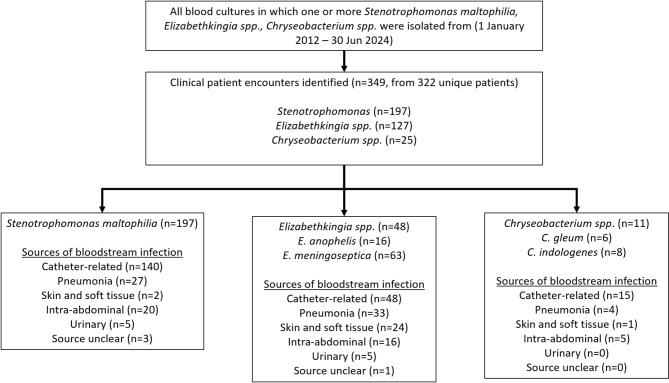
Results: A total of 349 distinct encounters (from 322 unique patients) were identified with bacteraemia. Stenotrophomonas maltophilia was the commonest (197/349, 56.4%), followed by Elizabethkingia spp. (127/349, 36.4%) and Chryseobacterium spp. (25/349, 7.2%). Prior carbapenem exposure was observed in 59.9% of cases. The majority were related to central lines (58.2%). Most cases were nosocomial in onset (82.5%), and a third were from the intensive care unit (32.1%). A significant proportion of our Stenotrophomonas maltophilia (32.8%) and Chryseobacterium spp. (22.7%) isolates were resistant to levofloxacin, while a majority of the organisms retained susceptibility to trimethoprim-sulfamethoxazole (TMP-SMX) and minocycline. Dual antibiotics were used in a minority of encounters (23/349, 6.6%). Mortality was high across infections with the three organisms, but highest amongst those with Stenotrophomonas maltophilia bacteraemia (41.6%), followed by Elizabethkingia spp. (29.9%) and Chryseobacterium spp. (20.0%).
Conclusions: Stenotrophomonas, Elizabethkingia or Chryseobacterium spp bacteraemia was associated with significant mortality. Most cases were nosocomial in acquisition, with prior carbapenem exposure or indwelling central catheters. Fluoroquinolone resistance was common for Stenotrophomonas maltophilia and Chryseobacterium spp., but less prevalent in Elizabethkingia spp., while TMP-SMX and minocycline retained susceptibility. Monitoring these trends would be critical in guiding empiric therapy for these organisms.
期刊介绍:
BMC Infectious Diseases is an open access, peer-reviewed journal that considers articles on all aspects of the prevention, diagnosis and management of infectious and sexually transmitted diseases in humans, as well as related molecular genetics, pathophysiology, and epidemiology.




 京公网安备 11010802042870号
京ICP备2023020795号-1
京公网安备 11010802042870号
京ICP备2023020795号-1

 分享
分享
 求助内容:
求助内容: 应助结果提醒方式:
 扫码关注我们
