Shahid Ishaq, Iqbal Ali Shah, Shin-Da Lee, Bor-Tsang Wu
{"title":"运动训练对帕金森病黑质纹状体谷氨酸能通路和受体相互作用的影响:系统综述","authors":"Shahid Ishaq, Iqbal Ali Shah, Shin-Da Lee, Bor-Tsang Wu","doi":"10.3389/fnagi.2025.1512278","DOIUrl":null,"url":null,"abstract":"<p><strong>Background: </strong>The excitatory imbalance of glutamatergic neurons, caused by insufficient input from dopaminergic neurons, contributes the pathogenesis of Parkinson's disease (PD). Exercise training is one of the non-pharmacological, non-invasive therapeutic approaches.</p><p><strong>Objective: </strong>This systematic review is the first to summarize the effects of exercise training on the regulation of protein and gene expressions within the nigrostriatal glutamatergic pathway and its receptor interactions in animal models of Parkinson's disease (PD).</p><p><strong>Methodology: </strong>The PubMed, Web of Science, and Embase electronic databases were searched, and 9 out of 96 studies that met the PRISMA guidelines were included. These studies received a CAMARADES score ranging from 4 to 6 out of 10. The included studies utilized pharmacologically induced PD models in mice or rats with 1-methyl-4-phenyl-1,2,3,6-tetrahydropyridine (MPTP) or 6-hydroxydopamine (6-OHDA). The majority of studies (89%) employed treadmill training, while 11% used voluntary wheel running, with training protocols consisting of 5 days per week for 4 weeks.</p><p><strong>Results: </strong>Exercise training reduced extracellular glutamate (Glu) and increased the expression of GLT-1, GS, Gln, and mGluR2/3 while down-regulating VGULT1 in the presynaptic terminal of the glutamatergic neurons within the nigrostriatal pathway in PD animal models. It also downregulated mGluR5 and modulated the <i>α</i>-amino-3-hydroxy-5-methyl-4-isoxazolepropionic acid (AMPA) receptor subunits: GluA1 was downregulated, inhibiting long-term potentiation, while GluA2 and GluA3 were upregulated in the nigrostriatal pathway in PD animal models. In addition, the exercise training downregulated the N-methyl-D-aspartate (NMDA) receptors, Arc, Cav1.3, CaMKII, and p-CaMKII in the nigrostriatal pathway in PD animal models.</p><p><strong>Conclusion: </strong>Exercise training exerted a neuroprotective effect on the glutamatergic pathway in Parkinson's disease (PD) animal models by limiting excess glutamate in the synaptic cleft. Exercise training modulated the ionotropic receptors and limited the glutamatergic excitatory imbalance within the nigrostriatal pathway in PD animal models. It also improved motor function, including balance, coordination, and gait parameters.</p><p><strong>Systematic review registration: </strong>https://www.crd.york.ac.uk/prospero/#recordDetails, identifier CRD42024564127.</p>","PeriodicalId":12450,"journal":{"name":"Frontiers in Aging Neuroscience","volume":"17 ","pages":"1512278"},"PeriodicalIF":4.5000,"publicationDate":"2025-02-11","publicationTypes":"Journal Article","fieldsOfStudy":null,"isOpenAccess":false,"openAccessPdf":"https://www.ncbi.nlm.nih.gov/pmc/articles/PMC11850376/pdf/","citationCount":"0","resultStr":"{\"title\":\"Effects of exercise training on the nigrostriatal glutamatergic pathway and receptor interactions in Parkinson's disease: a systematic review.\",\"authors\":\"Shahid Ishaq, Iqbal Ali Shah, Shin-Da Lee, Bor-Tsang Wu\",\"doi\":\"10.3389/fnagi.2025.1512278\",\"DOIUrl\":null,\"url\":null,\"abstract\":\"<p><strong>Background: </strong>The excitatory imbalance of glutamatergic neurons, caused by insufficient input from dopaminergic neurons, contributes the pathogenesis of Parkinson's disease (PD). Exercise training is one of the non-pharmacological, non-invasive therapeutic approaches.</p><p><strong>Objective: </strong>This systematic review is the first to summarize the effects of exercise training on the regulation of protein and gene expressions within the nigrostriatal glutamatergic pathway and its receptor interactions in animal models of Parkinson's disease (PD).</p><p><strong>Methodology: </strong>The PubMed, Web of Science, and Embase electronic databases were searched, and 9 out of 96 studies that met the PRISMA guidelines were included. These studies received a CAMARADES score ranging from 4 to 6 out of 10. The included studies utilized pharmacologically induced PD models in mice or rats with 1-methyl-4-phenyl-1,2,3,6-tetrahydropyridine (MPTP) or 6-hydroxydopamine (6-OHDA). The majority of studies (89%) employed treadmill training, while 11% used voluntary wheel running, with training protocols consisting of 5 days per week for 4 weeks.</p><p><strong>Results: </strong>Exercise training reduced extracellular glutamate (Glu) and increased the expression of GLT-1, GS, Gln, and mGluR2/3 while down-regulating VGULT1 in the presynaptic terminal of the glutamatergic neurons within the nigrostriatal pathway in PD animal models. It also downregulated mGluR5 and modulated the <i>α</i>-amino-3-hydroxy-5-methyl-4-isoxazolepropionic acid (AMPA) receptor subunits: GluA1 was downregulated, inhibiting long-term potentiation, while GluA2 and GluA3 were upregulated in the nigrostriatal pathway in PD animal models. In addition, the exercise training downregulated the N-methyl-D-aspartate (NMDA) receptors, Arc, Cav1.3, CaMKII, and p-CaMKII in the nigrostriatal pathway in PD animal models.</p><p><strong>Conclusion: </strong>Exercise training exerted a neuroprotective effect on the glutamatergic pathway in Parkinson's disease (PD) animal models by limiting excess glutamate in the synaptic cleft. Exercise training modulated the ionotropic receptors and limited the glutamatergic excitatory imbalance within the nigrostriatal pathway in PD animal models. It also improved motor function, including balance, coordination, and gait parameters.</p><p><strong>Systematic review registration: </strong>https://www.crd.york.ac.uk/prospero/#recordDetails, identifier CRD42024564127.</p>\",\"PeriodicalId\":12450,\"journal\":{\"name\":\"Frontiers in Aging Neuroscience\",\"volume\":\"17 \",\"pages\":\"1512278\"},\"PeriodicalIF\":4.5000,\"publicationDate\":\"2025-02-11\",\"publicationTypes\":\"Journal Article\",\"fieldsOfStudy\":null,\"isOpenAccess\":false,\"openAccessPdf\":\"https://www.ncbi.nlm.nih.gov/pmc/articles/PMC11850376/pdf/\",\"citationCount\":\"0\",\"resultStr\":null,\"platform\":\"Semanticscholar\",\"paperid\":null,\"PeriodicalName\":\"Frontiers in Aging Neuroscience\",\"FirstCategoryId\":\"3\",\"ListUrlMain\":\"https://doi.org/10.3389/fnagi.2025.1512278\",\"RegionNum\":2,\"RegionCategory\":\"医学\",\"ArticlePicture\":[],\"TitleCN\":null,\"AbstractTextCN\":null,\"PMCID\":null,\"EPubDate\":\"2025/1/1 0:00:00\",\"PubModel\":\"eCollection\",\"JCR\":\"Q2\",\"JCRName\":\"GERIATRICS & GERONTOLOGY\",\"Score\":null,\"Total\":0}","platform":"Semanticscholar","paperid":null,"PeriodicalName":"Frontiers in Aging Neuroscience","FirstCategoryId":"3","ListUrlMain":"https://doi.org/10.3389/fnagi.2025.1512278","RegionNum":2,"RegionCategory":"医学","ArticlePicture":[],"TitleCN":null,"AbstractTextCN":null,"PMCID":null,"EPubDate":"2025/1/1 0:00:00","PubModel":"eCollection","JCR":"Q2","JCRName":"GERIATRICS & GERONTOLOGY","Score":null,"Total":0}
引用次数: 0
摘要
背景:多巴胺能神经元输入不足导致的谷氨酸能神经元兴奋性失衡是帕金森病(PD)的发病机制之一。运动训练是一种非药物、非侵入性治疗方法。目的:本文首次综述了运动训练对帕金森病(PD)动物模型中黑质纹状体谷氨酸能通路蛋白和基因表达及其受体相互作用的调节作用。方法:检索PubMed、Web of Science和Embase电子数据库,并纳入96项符合PRISMA指南的研究中的9项。这些研究获得的CAMARADES评分从4到6分(满分10分)不等。所纳入的研究采用1-甲基-4-苯基-1,2,3,6-四氢吡啶(MPTP)或6-羟基多巴胺(6-OHDA)在小鼠或大鼠中药理学诱导的PD模型。大多数研究(89%)采用跑步机训练,而11%采用自愿轮跑,训练方案包括每周5 天,持续4 周。结果:运动训练在PD动物模型中降低细胞外谷氨酸(Glu),增加GLT-1、GS、Gln和mGluR2/3的表达,下调黑质纹状体通路谷氨酸能神经元突触前末端的VGULT1。同时下调mGluR5并调节α-氨基-3-羟基-5-甲基-4-异恶唑丙酸(AMPA)受体亚基:在PD动物模型中,GluA1下调,抑制长时程增强,而GluA2和GluA3上调黑质纹状体通路。此外,运动训练下调PD动物模型黑质纹状体通路中n -甲基- d -天冬氨酸(NMDA)受体、Arc、Cav1.3、CaMKII和p-CaMKII。结论:运动训练通过限制突触间隙中过量的谷氨酸,对帕金森病(PD)动物模型的谷氨酸能通路具有神经保护作用。运动训练可调节PD动物模型黑质纹状体通路内的嗜离子受体,限制谷氨酸能兴奋性失衡。它还改善了运动功能,包括平衡、协调和步态参数。系统综述注册:https://www.crd.york.ac.uk/prospero/#recordDetails,标识符CRD42024564127。
Effects of exercise training on the nigrostriatal glutamatergic pathway and receptor interactions in Parkinson's disease: a systematic review.
Background: The excitatory imbalance of glutamatergic neurons, caused by insufficient input from dopaminergic neurons, contributes the pathogenesis of Parkinson's disease (PD). Exercise training is one of the non-pharmacological, non-invasive therapeutic approaches.
Objective: This systematic review is the first to summarize the effects of exercise training on the regulation of protein and gene expressions within the nigrostriatal glutamatergic pathway and its receptor interactions in animal models of Parkinson's disease (PD).
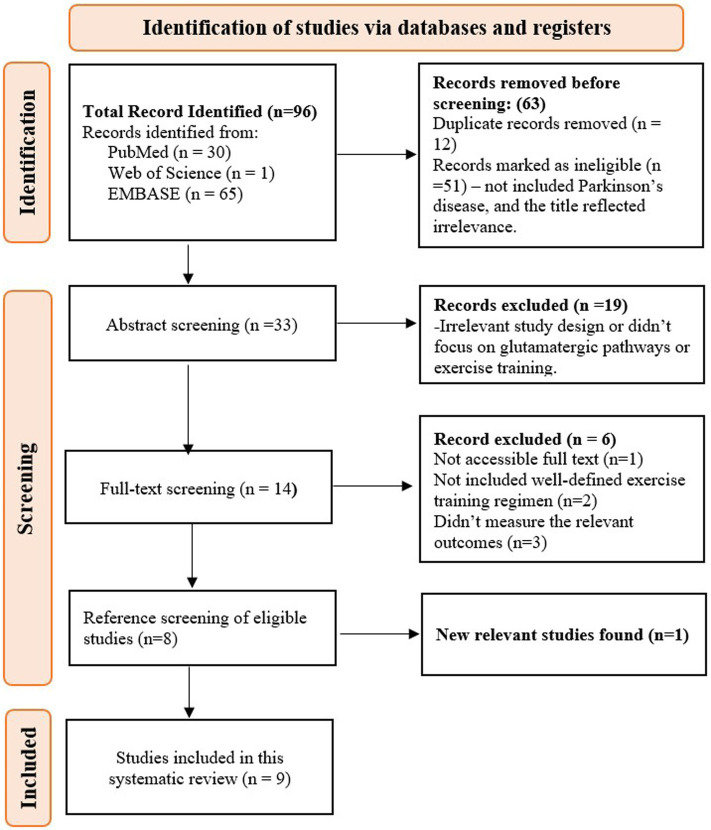
Methodology: The PubMed, Web of Science, and Embase electronic databases were searched, and 9 out of 96 studies that met the PRISMA guidelines were included. These studies received a CAMARADES score ranging from 4 to 6 out of 10. The included studies utilized pharmacologically induced PD models in mice or rats with 1-methyl-4-phenyl-1,2,3,6-tetrahydropyridine (MPTP) or 6-hydroxydopamine (6-OHDA). The majority of studies (89%) employed treadmill training, while 11% used voluntary wheel running, with training protocols consisting of 5 days per week for 4 weeks.
Results: Exercise training reduced extracellular glutamate (Glu) and increased the expression of GLT-1, GS, Gln, and mGluR2/3 while down-regulating VGULT1 in the presynaptic terminal of the glutamatergic neurons within the nigrostriatal pathway in PD animal models. It also downregulated mGluR5 and modulated the α-amino-3-hydroxy-5-methyl-4-isoxazolepropionic acid (AMPA) receptor subunits: GluA1 was downregulated, inhibiting long-term potentiation, while GluA2 and GluA3 were upregulated in the nigrostriatal pathway in PD animal models. In addition, the exercise training downregulated the N-methyl-D-aspartate (NMDA) receptors, Arc, Cav1.3, CaMKII, and p-CaMKII in the nigrostriatal pathway in PD animal models.
Conclusion: Exercise training exerted a neuroprotective effect on the glutamatergic pathway in Parkinson's disease (PD) animal models by limiting excess glutamate in the synaptic cleft. Exercise training modulated the ionotropic receptors and limited the glutamatergic excitatory imbalance within the nigrostriatal pathway in PD animal models. It also improved motor function, including balance, coordination, and gait parameters.
期刊介绍:
Frontiers in Aging Neuroscience is a leading journal in its field, publishing rigorously peer-reviewed research that advances our understanding of the mechanisms of Central Nervous System aging and age-related neural diseases. Specialty Chief Editor Thomas Wisniewski at the New York University School of Medicine is supported by an outstanding Editorial Board of international researchers. This multidisciplinary open-access journal is at the forefront of disseminating and communicating scientific knowledge and impactful discoveries to researchers, academics, clinicians and the public worldwide.





 京公网安备 11010802042870号
京ICP备2023020795号-1
京公网安备 11010802042870号
京ICP备2023020795号-1

 分享
分享
 求助内容:
求助内容: 应助结果提醒方式:
 扫码关注我们
