Jonas Kappen, Luay Rashan, Katrin Franke, Ludger A Wessjohann
{"title":"阿曼药用植物苦藤(Terminalia dhofarica)多酚类化合物的特征分析及生物活性研究。","authors":"Jonas Kappen, Luay Rashan, Katrin Franke, Ludger A Wessjohann","doi":"10.3390/molecules30040952","DOIUrl":null,"url":null,"abstract":"<p><p>Several polyphenol-rich <i>Terminalia</i> species (Combretaceae) are known to accelerate wound healing. Recently, the Omani medicinal plant <i>Anogeissus dhofarica</i> (now <i>Terminalia dhofarica</i>) was attributed to the genus <i>Terminalia</i> based on phylogenetic studies. Leaves, bark, and extracts of <i>T. dhofarica</i> are traditionally used for various medicinal purposes, including wound treatment and personal hygiene. In the present study, the phytochemical profile of leaves from <i>T. dhofarica</i> was evaluated by ultra-high-performance liquid chromatography coupled with electrospray ionization high-resolution mass spectrometry (UHPLC-ESI-HRMS) and nuclear magnetic resonance (NMR) spectroscopy. Simple phenolics, polyphenolics (e.g., flavonoids and tannins) and their glucosides were characterized as major metabolite classes. In addition, 20 phenolics were isolated and structurally identified. Nine of these compounds were never described before for <i>T. dhofarica</i>. For the first time, we provide complete NMR data for 1-<i>O</i>-galloyl-6-<i>O</i>-<i>p</i>-coumaroyl-d-glucose (<b>1</b>). Biological screening demonstrated moderate efficacy against the Gram-negative bacterium <i>Aliivibrio fischeri,</i> the phytopathogenic fungus <i>Septoria tritici,</i> and the oomycete <i>Phytophthora infestans</i>. In summary, the data expand the knowledge of the phytochemistry of the underexplored species <i>T. dhofarica</i> and underscore its potential for therapeutic applications, particularly in the context of traditional medicine.</p>","PeriodicalId":19041,"journal":{"name":"Molecules","volume":"30 4","pages":""},"PeriodicalIF":5.1000,"publicationDate":"2025-02-18","publicationTypes":"Journal Article","fieldsOfStudy":null,"isOpenAccess":false,"openAccessPdf":"https://www.ncbi.nlm.nih.gov/pmc/articles/PMC11858248/pdf/","citationCount":"0","resultStr":"{\"title\":\"Profiling and Bioactivity of Polyphenols from the Omani Medicinal Plant <i>Terminalia dhofarica</i> (syn. <i>Anogeissus dhofarica</i>).\",\"authors\":\"Jonas Kappen, Luay Rashan, Katrin Franke, Ludger A Wessjohann\",\"doi\":\"10.3390/molecules30040952\",\"DOIUrl\":null,\"url\":null,\"abstract\":\"<p><p>Several polyphenol-rich <i>Terminalia</i> species (Combretaceae) are known to accelerate wound healing. Recently, the Omani medicinal plant <i>Anogeissus dhofarica</i> (now <i>Terminalia dhofarica</i>) was attributed to the genus <i>Terminalia</i> based on phylogenetic studies. Leaves, bark, and extracts of <i>T. dhofarica</i> are traditionally used for various medicinal purposes, including wound treatment and personal hygiene. In the present study, the phytochemical profile of leaves from <i>T. dhofarica</i> was evaluated by ultra-high-performance liquid chromatography coupled with electrospray ionization high-resolution mass spectrometry (UHPLC-ESI-HRMS) and nuclear magnetic resonance (NMR) spectroscopy. Simple phenolics, polyphenolics (e.g., flavonoids and tannins) and their glucosides were characterized as major metabolite classes. In addition, 20 phenolics were isolated and structurally identified. Nine of these compounds were never described before for <i>T. dhofarica</i>. For the first time, we provide complete NMR data for 1-<i>O</i>-galloyl-6-<i>O</i>-<i>p</i>-coumaroyl-d-glucose (<b>1</b>). Biological screening demonstrated moderate efficacy against the Gram-negative bacterium <i>Aliivibrio fischeri,</i> the phytopathogenic fungus <i>Septoria tritici,</i> and the oomycete <i>Phytophthora infestans</i>. In summary, the data expand the knowledge of the phytochemistry of the underexplored species <i>T. dhofarica</i> and underscore its potential for therapeutic applications, particularly in the context of traditional medicine.</p>\",\"PeriodicalId\":19041,\"journal\":{\"name\":\"Molecules\",\"volume\":\"30 4\",\"pages\":\"\"},\"PeriodicalIF\":5.1000,\"publicationDate\":\"2025-02-18\",\"publicationTypes\":\"Journal Article\",\"fieldsOfStudy\":null,\"isOpenAccess\":false,\"openAccessPdf\":\"https://www.ncbi.nlm.nih.gov/pmc/articles/PMC11858248/pdf/\",\"citationCount\":\"0\",\"resultStr\":null,\"platform\":\"Semanticscholar\",\"paperid\":null,\"PeriodicalName\":\"Molecules\",\"FirstCategoryId\":\"92\",\"ListUrlMain\":\"https://doi.org/10.3390/molecules30040952\",\"RegionNum\":2,\"RegionCategory\":\"化学\",\"ArticlePicture\":[],\"TitleCN\":null,\"AbstractTextCN\":null,\"PMCID\":null,\"EPubDate\":\"\",\"PubModel\":\"\",\"JCR\":\"Q2\",\"JCRName\":\"BIOCHEMISTRY & MOLECULAR BIOLOGY\",\"Score\":null,\"Total\":0}","platform":"Semanticscholar","paperid":null,"PeriodicalName":"Molecules","FirstCategoryId":"92","ListUrlMain":"https://doi.org/10.3390/molecules30040952","RegionNum":2,"RegionCategory":"化学","ArticlePicture":[],"TitleCN":null,"AbstractTextCN":null,"PMCID":null,"EPubDate":"","PubModel":"","JCR":"Q2","JCRName":"BIOCHEMISTRY & MOLECULAR BIOLOGY","Score":null,"Total":0}
引用次数: 0
摘要
已知几种富含多酚的终属植物(combretacae)可加速伤口愈合。最近,阿曼药用植物Anogeissus dhofarica(现为Terminalia dhofarica)在系统发育研究的基础上被归属于Terminalia属。藤的叶子、树皮和提取物传统上用于各种医疗目的,包括伤口治疗和个人卫生。本研究采用超高效液相色谱-电喷雾高分辨率质谱联用技术(UHPLC-ESI-HRMS)和核磁共振(NMR)技术,对白桦叶片的化学成分进行了分析。简单酚类物质、多酚类物质(如黄酮类和单宁类)及其苷类物质被认为是主要的代谢产物。此外,还分离和鉴定了20种酚类物质。其中9种化合物以前从未在T. dhofarica中描述过。我们首次为1- o -没食子酰基-6- o -对-coumaroyl-d-葡萄糖提供了完整的核磁共振数据(1)。生物筛选显示,该化合物对革兰氏阴性菌费雪alivibrio fischeri、植物致病真菌小麦Septoria tritici和卵霉菌疫霉(Phytophthora infestans)有中等效果。总之,这些数据扩大了对未被充分开发的物种T. dhofarica的植物化学知识,并强调了其治疗应用的潜力,特别是在传统医学的背景下。
Profiling and Bioactivity of Polyphenols from the Omani Medicinal Plant Terminalia dhofarica (syn. Anogeissus dhofarica).
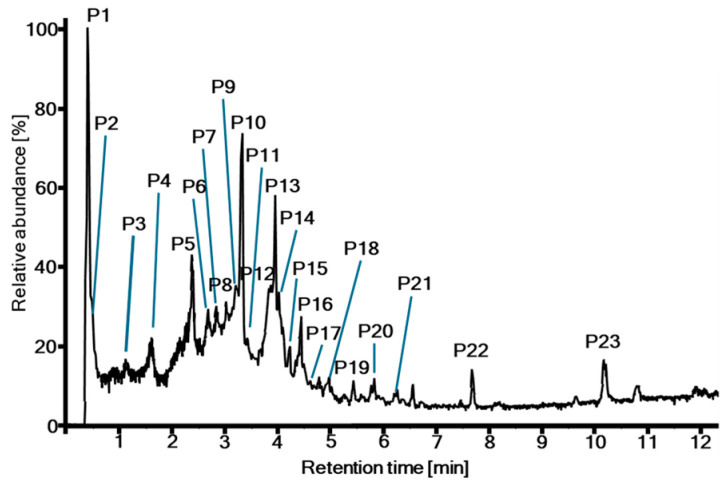
Several polyphenol-rich Terminalia species (Combretaceae) are known to accelerate wound healing. Recently, the Omani medicinal plant Anogeissus dhofarica (now Terminalia dhofarica) was attributed to the genus Terminalia based on phylogenetic studies. Leaves, bark, and extracts of T. dhofarica are traditionally used for various medicinal purposes, including wound treatment and personal hygiene. In the present study, the phytochemical profile of leaves from T. dhofarica was evaluated by ultra-high-performance liquid chromatography coupled with electrospray ionization high-resolution mass spectrometry (UHPLC-ESI-HRMS) and nuclear magnetic resonance (NMR) spectroscopy. Simple phenolics, polyphenolics (e.g., flavonoids and tannins) and their glucosides were characterized as major metabolite classes. In addition, 20 phenolics were isolated and structurally identified. Nine of these compounds were never described before for T. dhofarica. For the first time, we provide complete NMR data for 1-O-galloyl-6-O-p-coumaroyl-d-glucose (1). Biological screening demonstrated moderate efficacy against the Gram-negative bacterium Aliivibrio fischeri, the phytopathogenic fungus Septoria tritici, and the oomycete Phytophthora infestans. In summary, the data expand the knowledge of the phytochemistry of the underexplored species T. dhofarica and underscore its potential for therapeutic applications, particularly in the context of traditional medicine.
期刊介绍:
Molecules (ISSN 1420-3049, CODEN: MOLEFW) is an open access journal of synthetic organic chemistry and natural product chemistry. All articles are peer-reviewed and published continously upon acceptance. Molecules is published by MDPI, Basel, Switzerland. Our aim is to encourage chemists to publish as much as possible their experimental detail, particularly synthetic procedures and characterization information. There is no restriction on the length of the experimental section. In addition, availability of compound samples is published and considered as important information. Authors are encouraged to register or deposit their chemical samples through the non-profit international organization Molecular Diversity Preservation International (MDPI). Molecules has been launched in 1996 to preserve and exploit molecular diversity of both, chemical information and chemical substances.






 京公网安备 11010802042870号
京ICP备2023020795号-1
京公网安备 11010802042870号
京ICP备2023020795号-1

 分享
分享
 求助内容:
求助内容: 应助结果提醒方式:
 扫码关注我们
