{"title":"紫杉醇作为减肥的治疗潜力:一项回顾性纵向研究。","authors":"Yorito Hattori, Yuriko Nakaoku, Soshiro Ogata, Satoshi Saito, Kunihiro Nishimura, Masafumi Ihara","doi":"10.3390/nu17040706","DOIUrl":null,"url":null,"abstract":"<p><strong>Background/objectives: </strong>The current approach to obesity care, which primarily focuses on weight loss, is often insufficient because of the challenges in maintaining long-term results. Therefore, novel, safe, and sustainable medications for obesity are highly anticipated. Taxifolin, a natural bioactive flavonoid, was found to exert pleiotropic protective effects against various diseases. Our experimental <i>in vivo</i> and <i>in vitro</i> studies revealed that taxifolin administration contributes to weight loss. Accordingly, we hypothesized that long-term oral intake of taxifolin was clinically associated with weight loss.</p><p><strong>Methods: </strong>A retrospective longitudinal study was conducted on participants who consistently monitored their body weight during routine clinic visits between January 2021 and July 2021. Body weight changes of the patients who received 300 mg/day of taxifolin were compared with those of patients who did not receive taxifolin.</p><p><strong>Results: </strong>The study enrolled a total of 62 patients: 36 received taxifolin and 26 did not receive taxifolin. Long-term intake of taxifolin showed greater weight loss than those not receiving taxifolin over a mean follow-up of 176.1 and 177.7 days, respectively (-1.6 vs. -0.3 kg; <i>p</i> = 0.026). Furthermore, long-term taxifolin intake was an independent predictor of increased weight loss (adjusted β [mean difference] -0.14, 95% confidence interval [-2.69, -0.18], <i>p</i> = 0.026). No adverse events were observed.</p><p><strong>Conclusions: </strong>Long-term daily oral intake of taxifolin may safely and sustainably prevent or manage obesity.</p>","PeriodicalId":19486,"journal":{"name":"Nutrients","volume":"17 4","pages":""},"PeriodicalIF":5.8000,"publicationDate":"2025-02-16","publicationTypes":"Journal Article","fieldsOfStudy":null,"isOpenAccess":false,"openAccessPdf":"https://www.ncbi.nlm.nih.gov/pmc/articles/PMC11858263/pdf/","citationCount":"0","resultStr":"{\"title\":\"Taxifolin as a Therapeutic Potential for Weight Loss: A Retrospective Longitudinal Study.\",\"authors\":\"Yorito Hattori, Yuriko Nakaoku, Soshiro Ogata, Satoshi Saito, Kunihiro Nishimura, Masafumi Ihara\",\"doi\":\"10.3390/nu17040706\",\"DOIUrl\":null,\"url\":null,\"abstract\":\"<p><strong>Background/objectives: </strong>The current approach to obesity care, which primarily focuses on weight loss, is often insufficient because of the challenges in maintaining long-term results. Therefore, novel, safe, and sustainable medications for obesity are highly anticipated. Taxifolin, a natural bioactive flavonoid, was found to exert pleiotropic protective effects against various diseases. Our experimental <i>in vivo</i> and <i>in vitro</i> studies revealed that taxifolin administration contributes to weight loss. Accordingly, we hypothesized that long-term oral intake of taxifolin was clinically associated with weight loss.</p><p><strong>Methods: </strong>A retrospective longitudinal study was conducted on participants who consistently monitored their body weight during routine clinic visits between January 2021 and July 2021. Body weight changes of the patients who received 300 mg/day of taxifolin were compared with those of patients who did not receive taxifolin.</p><p><strong>Results: </strong>The study enrolled a total of 62 patients: 36 received taxifolin and 26 did not receive taxifolin. Long-term intake of taxifolin showed greater weight loss than those not receiving taxifolin over a mean follow-up of 176.1 and 177.7 days, respectively (-1.6 vs. -0.3 kg; <i>p</i> = 0.026). Furthermore, long-term taxifolin intake was an independent predictor of increased weight loss (adjusted β [mean difference] -0.14, 95% confidence interval [-2.69, -0.18], <i>p</i> = 0.026). No adverse events were observed.</p><p><strong>Conclusions: </strong>Long-term daily oral intake of taxifolin may safely and sustainably prevent or manage obesity.</p>\",\"PeriodicalId\":19486,\"journal\":{\"name\":\"Nutrients\",\"volume\":\"17 4\",\"pages\":\"\"},\"PeriodicalIF\":5.8000,\"publicationDate\":\"2025-02-16\",\"publicationTypes\":\"Journal Article\",\"fieldsOfStudy\":null,\"isOpenAccess\":false,\"openAccessPdf\":\"https://www.ncbi.nlm.nih.gov/pmc/articles/PMC11858263/pdf/\",\"citationCount\":\"0\",\"resultStr\":null,\"platform\":\"Semanticscholar\",\"paperid\":null,\"PeriodicalName\":\"Nutrients\",\"FirstCategoryId\":\"3\",\"ListUrlMain\":\"https://doi.org/10.3390/nu17040706\",\"RegionNum\":2,\"RegionCategory\":\"医学\",\"ArticlePicture\":[],\"TitleCN\":null,\"AbstractTextCN\":null,\"PMCID\":null,\"EPubDate\":\"\",\"PubModel\":\"\",\"JCR\":\"Q1\",\"JCRName\":\"NUTRITION & DIETETICS\",\"Score\":null,\"Total\":0}","platform":"Semanticscholar","paperid":null,"PeriodicalName":"Nutrients","FirstCategoryId":"3","ListUrlMain":"https://doi.org/10.3390/nu17040706","RegionNum":2,"RegionCategory":"医学","ArticlePicture":[],"TitleCN":null,"AbstractTextCN":null,"PMCID":null,"EPubDate":"","PubModel":"","JCR":"Q1","JCRName":"NUTRITION & DIETETICS","Score":null,"Total":0}
引用次数: 0
摘要
背景/目的:目前的肥胖治疗方法主要侧重于减肥,由于维持长期效果的挑战,往往是不够的。因此,新的、安全的、可持续的治疗肥胖的药物备受期待。杉木素是一种天然的生物活性类黄酮,对多种疾病具有多效保护作用。我们的体内和体外实验研究表明,给药紫杉醇有助于减肥。因此,我们假设长期口服噻虫啉在临床上与体重减轻有关。方法:对2021年1月至2021年7月期间在常规诊所就诊期间持续监测体重的参与者进行回顾性纵向研究。将接受300 mg/天的taxifolin治疗的患者的体重变化与未接受taxifolin治疗的患者进行比较。结果:该研究共纳入62例患者:36例接受了taxifolin治疗,26例未接受taxifolin治疗。在平均随访176.1天和177.7天期间,长期摄入taxifolin的患者体重减轻幅度大于未摄入taxifolin的患者(-1.6 vs -0.3 kg;P = 0.026)。此外,长期摄入taxifolin是体重减轻增加的独立预测因子(调整后的β[平均差值]-0.14,95%可信区间[-2.69,-0.18],p = 0.026)。未观察到不良事件。结论:长期每日口服紫杉醇可安全、可持续地预防或控制肥胖。
Taxifolin as a Therapeutic Potential for Weight Loss: A Retrospective Longitudinal Study.
Background/objectives: The current approach to obesity care, which primarily focuses on weight loss, is often insufficient because of the challenges in maintaining long-term results. Therefore, novel, safe, and sustainable medications for obesity are highly anticipated. Taxifolin, a natural bioactive flavonoid, was found to exert pleiotropic protective effects against various diseases. Our experimental in vivo and in vitro studies revealed that taxifolin administration contributes to weight loss. Accordingly, we hypothesized that long-term oral intake of taxifolin was clinically associated with weight loss.
Methods: A retrospective longitudinal study was conducted on participants who consistently monitored their body weight during routine clinic visits between January 2021 and July 2021. Body weight changes of the patients who received 300 mg/day of taxifolin were compared with those of patients who did not receive taxifolin.
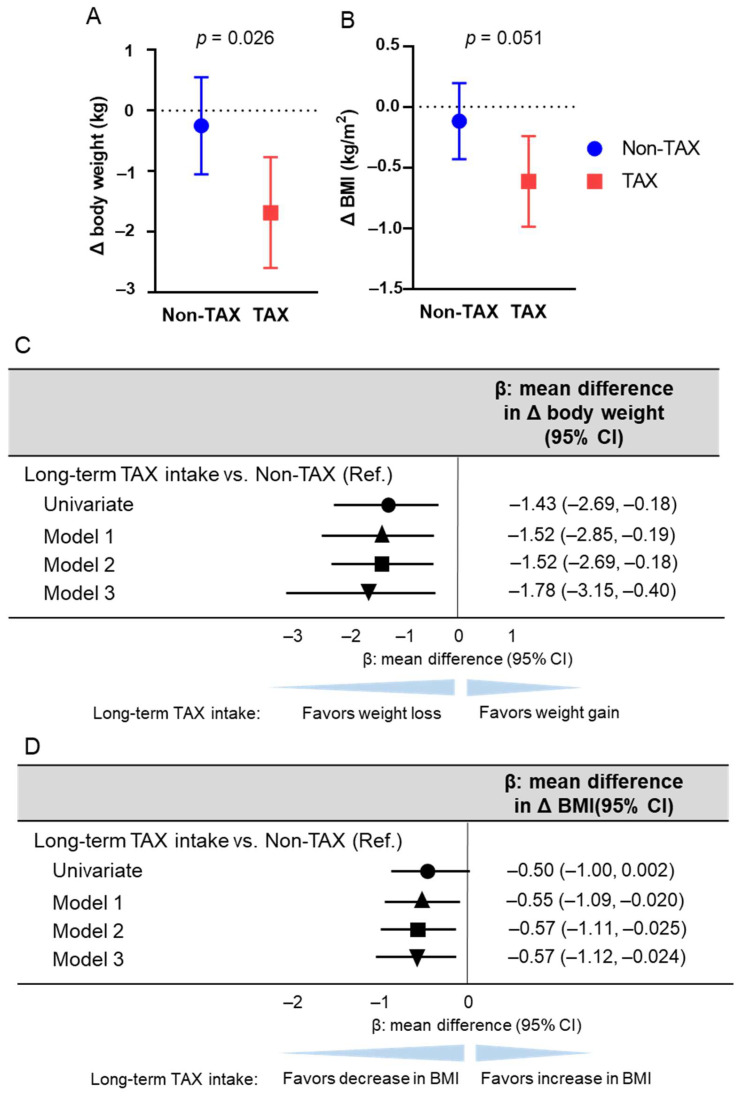
Results: The study enrolled a total of 62 patients: 36 received taxifolin and 26 did not receive taxifolin. Long-term intake of taxifolin showed greater weight loss than those not receiving taxifolin over a mean follow-up of 176.1 and 177.7 days, respectively (-1.6 vs. -0.3 kg; p = 0.026). Furthermore, long-term taxifolin intake was an independent predictor of increased weight loss (adjusted β [mean difference] -0.14, 95% confidence interval [-2.69, -0.18], p = 0.026). No adverse events were observed.
Conclusions: Long-term daily oral intake of taxifolin may safely and sustainably prevent or manage obesity.
期刊介绍:
Nutrients (ISSN 2072-6643) is an international, peer-reviewed open access advanced forum for studies related to Human Nutrition. It publishes reviews, regular research papers and short communications. Our aim is to encourage scientists to publish their experimental and theoretical results in as much detail as possible. There is no restriction on the length of the papers. The full experimental details must be provided so that the results can be reproduced.





 京公网安备 11010802042870号
京ICP备2023020795号-1
京公网安备 11010802042870号
京ICP备2023020795号-1

 分享
分享
 求助内容:
求助内容: 应助结果提醒方式:
 扫码关注我们
