Zuzana Knazicka, Branislav Galik, Ivana Novotna, Julius Arvay, Katarina Fatrcova-Sramkova, Miroslava Kacaniova, Jiri Mlcek, Eva Kovacikova, Eva Mixtajova, Tunde Jurikova, Eva Ivanisova, Adriana Kolesarova, Hana Duranova
{"title":"提高商业美食油的质量:干辣椒红(Capsicum annuum L. )作为天然添加剂的作用。","authors":"Zuzana Knazicka, Branislav Galik, Ivana Novotna, Julius Arvay, Katarina Fatrcova-Sramkova, Miroslava Kacaniova, Jiri Mlcek, Eva Kovacikova, Eva Mixtajova, Tunde Jurikova, Eva Ivanisova, Adriana Kolesarova, Hana Duranova","doi":"10.3390/molecules30040927","DOIUrl":null,"url":null,"abstract":"<p><p>This study assessed the potential of dried Cayenne pepper (CP; <i>Capsicum annuum</i> L.) as a natural additive to rice bran oil (RBO), grape seed oil (GSO), and virgin olive oil (OO). Key analyses included peroxide and acid values, oxidative stability (Rancimat method), the composition of fatty acids (FAs) (GC-FID method), antioxidant activity (AA; DPPH method), and antimicrobial properties (disc diffusion method). Capsaicin and the dihydrocapsaicin contents in CP were quantified (HPLC-DAD method) as 1499.37 ± 3.64 and 1449.04 ± 5.14 mg/kg DW, respectively. Oleic acid (C18:1cis n9) dominated in OO (69.70%), OO-CP (69.73%), and RBO-CP (38.97%), while linoleic acid (C18:2cis n6) prevailed in RBO (41.34%), GSO (57.93%), and GSO-CP (58.03%). The addition of CP influenced the FA profile, particularly linoleic acid in OO and RBO, and all FAs in GSO. Peroxide and acid values increased significantly in RBO and GSO upon CP addition, but induction times remained unaffected. The strongest AA (77.00 ± 0.13%) was observed in OO-CP. Cayenne pepper significantly enhanced the antioxidant profiles of all oils compared to the counterparts. However, the antimicrobial activity was weak (≤5.0 mm inhibition zones) against tested microorganisms. These findings support CP as a functional additive for enhancing the nutritional and functional properties of gourmet oils, while highlighting the need for further optimization to improve stability and bioactivity.</p>","PeriodicalId":19041,"journal":{"name":"Molecules","volume":"30 4","pages":""},"PeriodicalIF":5.1000,"publicationDate":"2025-02-17","publicationTypes":"Journal Article","fieldsOfStudy":null,"isOpenAccess":false,"openAccessPdf":"https://www.ncbi.nlm.nih.gov/pmc/articles/PMC11858105/pdf/","citationCount":"0","resultStr":"{\"title\":\"Enhancing Commercial Gourmet Oil Quality: The Role of Dried Cayenne Pepper Red (<i>Capsicum annuum</i> L.) as a Natural Additive.\",\"authors\":\"Zuzana Knazicka, Branislav Galik, Ivana Novotna, Julius Arvay, Katarina Fatrcova-Sramkova, Miroslava Kacaniova, Jiri Mlcek, Eva Kovacikova, Eva Mixtajova, Tunde Jurikova, Eva Ivanisova, Adriana Kolesarova, Hana Duranova\",\"doi\":\"10.3390/molecules30040927\",\"DOIUrl\":null,\"url\":null,\"abstract\":\"<p><p>This study assessed the potential of dried Cayenne pepper (CP; <i>Capsicum annuum</i> L.) as a natural additive to rice bran oil (RBO), grape seed oil (GSO), and virgin olive oil (OO). Key analyses included peroxide and acid values, oxidative stability (Rancimat method), the composition of fatty acids (FAs) (GC-FID method), antioxidant activity (AA; DPPH method), and antimicrobial properties (disc diffusion method). Capsaicin and the dihydrocapsaicin contents in CP were quantified (HPLC-DAD method) as 1499.37 ± 3.64 and 1449.04 ± 5.14 mg/kg DW, respectively. Oleic acid (C18:1cis n9) dominated in OO (69.70%), OO-CP (69.73%), and RBO-CP (38.97%), while linoleic acid (C18:2cis n6) prevailed in RBO (41.34%), GSO (57.93%), and GSO-CP (58.03%). The addition of CP influenced the FA profile, particularly linoleic acid in OO and RBO, and all FAs in GSO. Peroxide and acid values increased significantly in RBO and GSO upon CP addition, but induction times remained unaffected. The strongest AA (77.00 ± 0.13%) was observed in OO-CP. Cayenne pepper significantly enhanced the antioxidant profiles of all oils compared to the counterparts. However, the antimicrobial activity was weak (≤5.0 mm inhibition zones) against tested microorganisms. These findings support CP as a functional additive for enhancing the nutritional and functional properties of gourmet oils, while highlighting the need for further optimization to improve stability and bioactivity.</p>\",\"PeriodicalId\":19041,\"journal\":{\"name\":\"Molecules\",\"volume\":\"30 4\",\"pages\":\"\"},\"PeriodicalIF\":5.1000,\"publicationDate\":\"2025-02-17\",\"publicationTypes\":\"Journal Article\",\"fieldsOfStudy\":null,\"isOpenAccess\":false,\"openAccessPdf\":\"https://www.ncbi.nlm.nih.gov/pmc/articles/PMC11858105/pdf/\",\"citationCount\":\"0\",\"resultStr\":null,\"platform\":\"Semanticscholar\",\"paperid\":null,\"PeriodicalName\":\"Molecules\",\"FirstCategoryId\":\"92\",\"ListUrlMain\":\"https://doi.org/10.3390/molecules30040927\",\"RegionNum\":2,\"RegionCategory\":\"化学\",\"ArticlePicture\":[],\"TitleCN\":null,\"AbstractTextCN\":null,\"PMCID\":null,\"EPubDate\":\"\",\"PubModel\":\"\",\"JCR\":\"Q2\",\"JCRName\":\"BIOCHEMISTRY & MOLECULAR BIOLOGY\",\"Score\":null,\"Total\":0}","platform":"Semanticscholar","paperid":null,"PeriodicalName":"Molecules","FirstCategoryId":"92","ListUrlMain":"https://doi.org/10.3390/molecules30040927","RegionNum":2,"RegionCategory":"化学","ArticlePicture":[],"TitleCN":null,"AbstractTextCN":null,"PMCID":null,"EPubDate":"","PubModel":"","JCR":"Q2","JCRName":"BIOCHEMISTRY & MOLECULAR BIOLOGY","Score":null,"Total":0}
Enhancing Commercial Gourmet Oil Quality: The Role of Dried Cayenne Pepper Red (Capsicum annuum L.) as a Natural Additive.
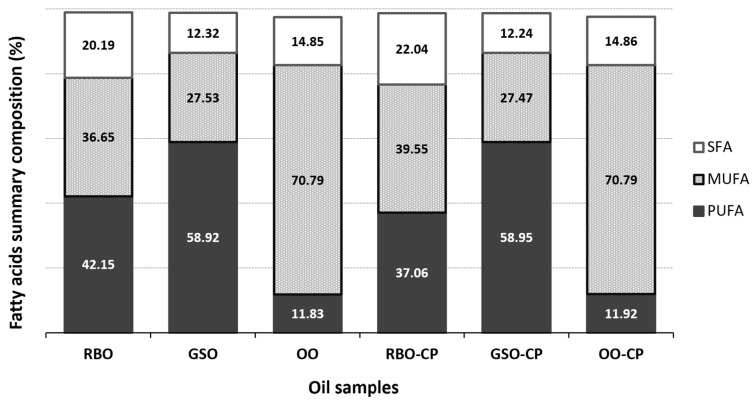
This study assessed the potential of dried Cayenne pepper (CP; Capsicum annuum L.) as a natural additive to rice bran oil (RBO), grape seed oil (GSO), and virgin olive oil (OO). Key analyses included peroxide and acid values, oxidative stability (Rancimat method), the composition of fatty acids (FAs) (GC-FID method), antioxidant activity (AA; DPPH method), and antimicrobial properties (disc diffusion method). Capsaicin and the dihydrocapsaicin contents in CP were quantified (HPLC-DAD method) as 1499.37 ± 3.64 and 1449.04 ± 5.14 mg/kg DW, respectively. Oleic acid (C18:1cis n9) dominated in OO (69.70%), OO-CP (69.73%), and RBO-CP (38.97%), while linoleic acid (C18:2cis n6) prevailed in RBO (41.34%), GSO (57.93%), and GSO-CP (58.03%). The addition of CP influenced the FA profile, particularly linoleic acid in OO and RBO, and all FAs in GSO. Peroxide and acid values increased significantly in RBO and GSO upon CP addition, but induction times remained unaffected. The strongest AA (77.00 ± 0.13%) was observed in OO-CP. Cayenne pepper significantly enhanced the antioxidant profiles of all oils compared to the counterparts. However, the antimicrobial activity was weak (≤5.0 mm inhibition zones) against tested microorganisms. These findings support CP as a functional additive for enhancing the nutritional and functional properties of gourmet oils, while highlighting the need for further optimization to improve stability and bioactivity.
期刊介绍:
Molecules (ISSN 1420-3049, CODEN: MOLEFW) is an open access journal of synthetic organic chemistry and natural product chemistry. All articles are peer-reviewed and published continously upon acceptance. Molecules is published by MDPI, Basel, Switzerland. Our aim is to encourage chemists to publish as much as possible their experimental detail, particularly synthetic procedures and characterization information. There is no restriction on the length of the experimental section. In addition, availability of compound samples is published and considered as important information. Authors are encouraged to register or deposit their chemical samples through the non-profit international organization Molecular Diversity Preservation International (MDPI). Molecules has been launched in 1996 to preserve and exploit molecular diversity of both, chemical information and chemical substances.






 京公网安备 11010802042870号
京ICP备2023020795号-1
京公网安备 11010802042870号
京ICP备2023020795号-1

 分享
分享
 求助内容:
求助内容: 应助结果提醒方式:
 扫码关注我们
