Xiaokun He, Nan Xu, Yuan Xue, Hong Zhang, Ran Zuo, Qian Xu
{"title":"通过 DFT 计算重新审视 InN MOVPE 中气相反应的机理途径。","authors":"Xiaokun He, Nan Xu, Yuan Xue, Hong Zhang, Ran Zuo, Qian Xu","doi":"10.3390/molecules30040971","DOIUrl":null,"url":null,"abstract":"<p><p>III-nitrides are crucial materials for solar flow batteries due to their versatile properties. In contrast to the well-studied MOVPE reaction mechanism for AlN and GaN, few works report gas-phase mechanistic studies on the growth of InN. To better understand the reaction thermodynamics, this work revisited the gas-phase reactions involved in metal-organic vapor-phase epitaxy (abbreviated as MOVPE) growth of InN. Utilizing the M06-2X function in conjunction with Pople's triple-ζ split-valence basis set with polarization functions, this work recharacterized all stationary points reported in previous literature and compared the differences between the structures and reaction energies. For the reaction pathways which do not include a transition state, rigorous constrained geometry optimizations were utilized to scan the PES connecting the reactants and products in adduct formation and XMIn (M, D, T) pyrolysis, confirming that there are no TSs in these pathways, which is in agreement with the previous findings. A comprehensive bonding analysis indicates that in TMIn:NH<sub>3</sub>, the In-N demonstrates strong coordinate bond characteristics, whereas in DMIn:NH<sub>3</sub> and MMIn:NH<sub>3</sub>, the interactions between the Lewis acid and base fragments lean toward electrostatic attraction. Additionally, the NBO computations show that the H radical can facilitate the migration of electrons that are originally distributed between the In-C bonds in XMIn. Based on this finding, novel reaction pathways were also investigated. When the H radical approaches MMInNH<sub>2</sub>, MMIn:NH<sub>3</sub> rather than MMInHNH<sub>2</sub> will generate and this is followed by the elimination of CH<sub>4</sub> via two parallel paths. Considering the abundance of H<sub>2</sub> in the environment, this work also examines the reactions between H<sub>2</sub> and XMIn. The Mulliken charge distributions indicated that intermolecular electron transfer mainly occurs between the In atom and N atom whiling forming (DMInNH<sub>2</sub>)<sub>2</sub>, whereas it predominately occurs between the In atom and the N atom intramolecularly when generating (DMInNH<sub>2</sub>)<sub>3</sub>.</p>","PeriodicalId":19041,"journal":{"name":"Molecules","volume":"30 4","pages":""},"PeriodicalIF":4.6000,"publicationDate":"2025-02-19","publicationTypes":"Journal Article","fieldsOfStudy":null,"isOpenAccess":false,"openAccessPdf":"https://www.ncbi.nlm.nih.gov/pmc/articles/PMC11857898/pdf/","citationCount":"0","resultStr":"{\"title\":\"Revisiting the Mechanistic Pathway of Gas-Phase Reactions in InN MOVPE Through DFT Calculations.\",\"authors\":\"Xiaokun He, Nan Xu, Yuan Xue, Hong Zhang, Ran Zuo, Qian Xu\",\"doi\":\"10.3390/molecules30040971\",\"DOIUrl\":null,\"url\":null,\"abstract\":\"<p><p>III-nitrides are crucial materials for solar flow batteries due to their versatile properties. In contrast to the well-studied MOVPE reaction mechanism for AlN and GaN, few works report gas-phase mechanistic studies on the growth of InN. To better understand the reaction thermodynamics, this work revisited the gas-phase reactions involved in metal-organic vapor-phase epitaxy (abbreviated as MOVPE) growth of InN. Utilizing the M06-2X function in conjunction with Pople's triple-ζ split-valence basis set with polarization functions, this work recharacterized all stationary points reported in previous literature and compared the differences between the structures and reaction energies. For the reaction pathways which do not include a transition state, rigorous constrained geometry optimizations were utilized to scan the PES connecting the reactants and products in adduct formation and XMIn (M, D, T) pyrolysis, confirming that there are no TSs in these pathways, which is in agreement with the previous findings. A comprehensive bonding analysis indicates that in TMIn:NH<sub>3</sub>, the In-N demonstrates strong coordinate bond characteristics, whereas in DMIn:NH<sub>3</sub> and MMIn:NH<sub>3</sub>, the interactions between the Lewis acid and base fragments lean toward electrostatic attraction. Additionally, the NBO computations show that the H radical can facilitate the migration of electrons that are originally distributed between the In-C bonds in XMIn. Based on this finding, novel reaction pathways were also investigated. When the H radical approaches MMInNH<sub>2</sub>, MMIn:NH<sub>3</sub> rather than MMInHNH<sub>2</sub> will generate and this is followed by the elimination of CH<sub>4</sub> via two parallel paths. Considering the abundance of H<sub>2</sub> in the environment, this work also examines the reactions between H<sub>2</sub> and XMIn. The Mulliken charge distributions indicated that intermolecular electron transfer mainly occurs between the In atom and N atom whiling forming (DMInNH<sub>2</sub>)<sub>2</sub>, whereas it predominately occurs between the In atom and the N atom intramolecularly when generating (DMInNH<sub>2</sub>)<sub>3</sub>.</p>\",\"PeriodicalId\":19041,\"journal\":{\"name\":\"Molecules\",\"volume\":\"30 4\",\"pages\":\"\"},\"PeriodicalIF\":4.6000,\"publicationDate\":\"2025-02-19\",\"publicationTypes\":\"Journal Article\",\"fieldsOfStudy\":null,\"isOpenAccess\":false,\"openAccessPdf\":\"https://www.ncbi.nlm.nih.gov/pmc/articles/PMC11857898/pdf/\",\"citationCount\":\"0\",\"resultStr\":null,\"platform\":\"Semanticscholar\",\"paperid\":null,\"PeriodicalName\":\"Molecules\",\"FirstCategoryId\":\"92\",\"ListUrlMain\":\"https://doi.org/10.3390/molecules30040971\",\"RegionNum\":2,\"RegionCategory\":\"化学\",\"ArticlePicture\":[],\"TitleCN\":null,\"AbstractTextCN\":null,\"PMCID\":null,\"EPubDate\":\"\",\"PubModel\":\"\",\"JCR\":\"Q2\",\"JCRName\":\"BIOCHEMISTRY & MOLECULAR BIOLOGY\",\"Score\":null,\"Total\":0}","platform":"Semanticscholar","paperid":null,"PeriodicalName":"Molecules","FirstCategoryId":"92","ListUrlMain":"https://doi.org/10.3390/molecules30040971","RegionNum":2,"RegionCategory":"化学","ArticlePicture":[],"TitleCN":null,"AbstractTextCN":null,"PMCID":null,"EPubDate":"","PubModel":"","JCR":"Q2","JCRName":"BIOCHEMISTRY & MOLECULAR BIOLOGY","Score":null,"Total":0}
引用次数: 0
摘要
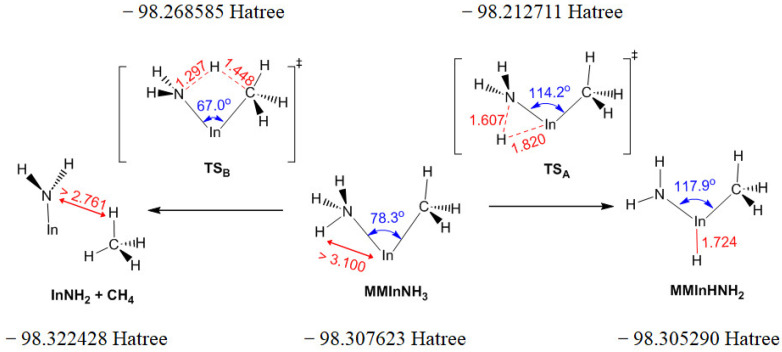
iii -氮化物是太阳能液流电池的关键材料,因为它们具有多种特性。与已被充分研究的AlN和GaN的MOVPE反应机理相反,很少有研究报道InN的气相生长机理。为了更好地理解反应热力学,本工作重新考察了金属-有机气相外延(简称MOVPE)生长中涉及的气相反应。利用M06-2X函数,结合people的三重-ζ分裂价基集和极化函数,重新表征了以往文献中报道的所有平稳点,并比较了结构和反应能之间的差异。对于不包含过渡态的反应路径,采用严格的约束几何优化方法扫描了连接反应物和产物在加合物形成和XMIn (M, D, T)热解的PES,证实了这些路径中不存在TSs,这与之前的研究结果一致。综合成键分析表明,在TMIn:NH3中,in - n表现出较强的配位键特征,而在DMIn:NH3和MMIn:NH3中,Lewis酸和碱片段之间的相互作用倾向于静电吸引。此外,NBO计算表明,H自由基可以促进XMIn中原本分布在in - c键之间的电子的迁移。基于这一发现,新的反应途径也被研究。当H自由基接近MMInNH2时,生成MMIn:NH3而不是MMInHNH2,随后CH4通过两条平行路径消除。考虑到环境中H2的丰度,本工作还研究了H2和XMIn之间的反应。Mulliken电荷分布表明,形成(DMInNH2)2时分子间电子转移主要发生在In原子和N原子之间,而形成(DMInNH2)3时分子内电子转移主要发生在In原子和N原子之间。
Revisiting the Mechanistic Pathway of Gas-Phase Reactions in InN MOVPE Through DFT Calculations.
III-nitrides are crucial materials for solar flow batteries due to their versatile properties. In contrast to the well-studied MOVPE reaction mechanism for AlN and GaN, few works report gas-phase mechanistic studies on the growth of InN. To better understand the reaction thermodynamics, this work revisited the gas-phase reactions involved in metal-organic vapor-phase epitaxy (abbreviated as MOVPE) growth of InN. Utilizing the M06-2X function in conjunction with Pople's triple-ζ split-valence basis set with polarization functions, this work recharacterized all stationary points reported in previous literature and compared the differences between the structures and reaction energies. For the reaction pathways which do not include a transition state, rigorous constrained geometry optimizations were utilized to scan the PES connecting the reactants and products in adduct formation and XMIn (M, D, T) pyrolysis, confirming that there are no TSs in these pathways, which is in agreement with the previous findings. A comprehensive bonding analysis indicates that in TMIn:NH3, the In-N demonstrates strong coordinate bond characteristics, whereas in DMIn:NH3 and MMIn:NH3, the interactions between the Lewis acid and base fragments lean toward electrostatic attraction. Additionally, the NBO computations show that the H radical can facilitate the migration of electrons that are originally distributed between the In-C bonds in XMIn. Based on this finding, novel reaction pathways were also investigated. When the H radical approaches MMInNH2, MMIn:NH3 rather than MMInHNH2 will generate and this is followed by the elimination of CH4 via two parallel paths. Considering the abundance of H2 in the environment, this work also examines the reactions between H2 and XMIn. The Mulliken charge distributions indicated that intermolecular electron transfer mainly occurs between the In atom and N atom whiling forming (DMInNH2)2, whereas it predominately occurs between the In atom and the N atom intramolecularly when generating (DMInNH2)3.
期刊介绍:
Molecules (ISSN 1420-3049, CODEN: MOLEFW) is an open access journal of synthetic organic chemistry and natural product chemistry. All articles are peer-reviewed and published continously upon acceptance. Molecules is published by MDPI, Basel, Switzerland. Our aim is to encourage chemists to publish as much as possible their experimental detail, particularly synthetic procedures and characterization information. There is no restriction on the length of the experimental section. In addition, availability of compound samples is published and considered as important information. Authors are encouraged to register or deposit their chemical samples through the non-profit international organization Molecular Diversity Preservation International (MDPI). Molecules has been launched in 1996 to preserve and exploit molecular diversity of both, chemical information and chemical substances.






 京公网安备 11010802042870号
京ICP备2023020795号-1
京公网安备 11010802042870号
京ICP备2023020795号-1

 分享
分享
 求助内容:
求助内容: 应助结果提醒方式:
 扫码关注我们
