Donna Cooper, Claire Stevens, Conor Jamieson, Ming Xuan Lee, Ruth Riley, Bharat Patel, Jade Meadows, Parmjit Kaur, Obiageli Okolie, Kieran Hand, Donna M Lecky
{"title":"国家抗菌剂管理培训计划的实施:一个案例研究。","authors":"Donna Cooper, Claire Stevens, Conor Jamieson, Ming Xuan Lee, Ruth Riley, Bharat Patel, Jade Meadows, Parmjit Kaur, Obiageli Okolie, Kieran Hand, Donna M Lecky","doi":"10.3390/antibiotics14020148","DOIUrl":null,"url":null,"abstract":"<p><strong>Background: </strong>Approximately 71% of antibiotics in England are prescribed in general practice settings. Whilst there are various impactful training resources available to support clinicians in antimicrobial stewardship (AMS) activities, implementation, reach, and uptake affect how successful they are nationally. This case study explores the feasibility, acceptability, and usefulness of embedding the TARGET (Treat Antibiotics Responsibly, Guidance, Education and Tools) AMS training into a local incentive scheme.</p><p><strong>Method: </strong>Black Country Integrated Care Board (ICB) invited a representative from all associated general practises to a TARGET AMS training event; attendance was linked to a local incentive scheme. Data were collected via a pre- and post-workshop survey capturing TARGET toolkit knowledge, AMS attitudes and behaviours, training feedback, and intention to implement AMS behaviours. Descriptive analyses were conducted.</p><p><strong>Results: </strong>157 and 101 attendees completed the pre- and post-session surveys, respectively. In total, 89% agreed that attending the session was a good use of their time. The proportions of attendees stating an intention to use the TARGET toolkit and implement a range of AMS strategies following the session were high (TARGET Toolkit: >82%, AMS strategies: >90%). Most attendees planned to implement these actions within 3 months (47%) or within 3-6 months (30%).</p><p><strong>Conclusion: </strong>Results suggest that embedding the training into a local incentive scheme is a viable implementation approach in extending training reach. Although the impact on prescribing rates is not yet available, the high engagement and intention to implement AMS strategies observed should inspire confidence in this approach to training implementation.</p>","PeriodicalId":54246,"journal":{"name":"Antibiotics-Basel","volume":"14 2","pages":""},"PeriodicalIF":4.6000,"publicationDate":"2025-02-03","publicationTypes":"Journal Article","fieldsOfStudy":null,"isOpenAccess":false,"openAccessPdf":"https://www.ncbi.nlm.nih.gov/pmc/articles/PMC11851554/pdf/","citationCount":"0","resultStr":"{\"title\":\"Implementation of a National Antimicrobial Stewardship Training Programme for General Practice: A Case Study.\",\"authors\":\"Donna Cooper, Claire Stevens, Conor Jamieson, Ming Xuan Lee, Ruth Riley, Bharat Patel, Jade Meadows, Parmjit Kaur, Obiageli Okolie, Kieran Hand, Donna M Lecky\",\"doi\":\"10.3390/antibiotics14020148\",\"DOIUrl\":null,\"url\":null,\"abstract\":\"<p><strong>Background: </strong>Approximately 71% of antibiotics in England are prescribed in general practice settings. Whilst there are various impactful training resources available to support clinicians in antimicrobial stewardship (AMS) activities, implementation, reach, and uptake affect how successful they are nationally. This case study explores the feasibility, acceptability, and usefulness of embedding the TARGET (Treat Antibiotics Responsibly, Guidance, Education and Tools) AMS training into a local incentive scheme.</p><p><strong>Method: </strong>Black Country Integrated Care Board (ICB) invited a representative from all associated general practises to a TARGET AMS training event; attendance was linked to a local incentive scheme. Data were collected via a pre- and post-workshop survey capturing TARGET toolkit knowledge, AMS attitudes and behaviours, training feedback, and intention to implement AMS behaviours. Descriptive analyses were conducted.</p><p><strong>Results: </strong>157 and 101 attendees completed the pre- and post-session surveys, respectively. In total, 89% agreed that attending the session was a good use of their time. The proportions of attendees stating an intention to use the TARGET toolkit and implement a range of AMS strategies following the session were high (TARGET Toolkit: >82%, AMS strategies: >90%). Most attendees planned to implement these actions within 3 months (47%) or within 3-6 months (30%).</p><p><strong>Conclusion: </strong>Results suggest that embedding the training into a local incentive scheme is a viable implementation approach in extending training reach. Although the impact on prescribing rates is not yet available, the high engagement and intention to implement AMS strategies observed should inspire confidence in this approach to training implementation.</p>\",\"PeriodicalId\":54246,\"journal\":{\"name\":\"Antibiotics-Basel\",\"volume\":\"14 2\",\"pages\":\"\"},\"PeriodicalIF\":4.6000,\"publicationDate\":\"2025-02-03\",\"publicationTypes\":\"Journal Article\",\"fieldsOfStudy\":null,\"isOpenAccess\":false,\"openAccessPdf\":\"https://www.ncbi.nlm.nih.gov/pmc/articles/PMC11851554/pdf/\",\"citationCount\":\"0\",\"resultStr\":null,\"platform\":\"Semanticscholar\",\"paperid\":null,\"PeriodicalName\":\"Antibiotics-Basel\",\"FirstCategoryId\":\"3\",\"ListUrlMain\":\"https://doi.org/10.3390/antibiotics14020148\",\"RegionNum\":2,\"RegionCategory\":\"医学\",\"ArticlePicture\":[],\"TitleCN\":null,\"AbstractTextCN\":null,\"PMCID\":null,\"EPubDate\":\"\",\"PubModel\":\"\",\"JCR\":\"Q1\",\"JCRName\":\"INFECTIOUS DISEASES\",\"Score\":null,\"Total\":0}","platform":"Semanticscholar","paperid":null,"PeriodicalName":"Antibiotics-Basel","FirstCategoryId":"3","ListUrlMain":"https://doi.org/10.3390/antibiotics14020148","RegionNum":2,"RegionCategory":"医学","ArticlePicture":[],"TitleCN":null,"AbstractTextCN":null,"PMCID":null,"EPubDate":"","PubModel":"","JCR":"Q1","JCRName":"INFECTIOUS DISEASES","Score":null,"Total":0}
引用次数: 0
摘要
背景:在英格兰,大约71%的抗生素是在普通诊所开的。虽然有各种有效的培训资源可用于支持临床医生开展抗微生物药物管理(AMS)活动,但实施、覆盖和吸收会影响它们在全国的成功程度。本案例研究探讨了将TARGET(负责任地对待抗生素,指导,教育和工具)AMS培训纳入当地激励计划的可行性,可接受性和有效性。方法:Black Country Integrated Care Board (ICB)邀请所有相关全科医生的代表参加TARGET AMS培训活动;出勤率与当地的奖励计划挂钩。通过研讨会前和研讨会后的调查收集数据,包括TARGET工具包知识、AMS态度和行为、培训反馈和实施AMS行为的意图。进行描述性分析。结果:157名和101名与会者分别完成了会议前和会议后的调查。总的来说,89%的人认为参加会议是对时间的有效利用。在会议结束后,表示有意使用TARGET工具包并实施一系列AMS策略的与会者比例很高(TARGET工具包:>82%,AMS策略:>90%)。大多数与会者计划在3个月内(47%)或3-6个月内(30%)实施这些行动。结论:将培训纳入地方激励方案是扩大培训覆盖面的可行实施途径。虽然对处方率的影响尚不清楚,但观察到的高参与度和实施辅助医疗服务战略的意图应该激发对这种培训实施方法的信心。
Implementation of a National Antimicrobial Stewardship Training Programme for General Practice: A Case Study.
Background: Approximately 71% of antibiotics in England are prescribed in general practice settings. Whilst there are various impactful training resources available to support clinicians in antimicrobial stewardship (AMS) activities, implementation, reach, and uptake affect how successful they are nationally. This case study explores the feasibility, acceptability, and usefulness of embedding the TARGET (Treat Antibiotics Responsibly, Guidance, Education and Tools) AMS training into a local incentive scheme.
Method: Black Country Integrated Care Board (ICB) invited a representative from all associated general practises to a TARGET AMS training event; attendance was linked to a local incentive scheme. Data were collected via a pre- and post-workshop survey capturing TARGET toolkit knowledge, AMS attitudes and behaviours, training feedback, and intention to implement AMS behaviours. Descriptive analyses were conducted.
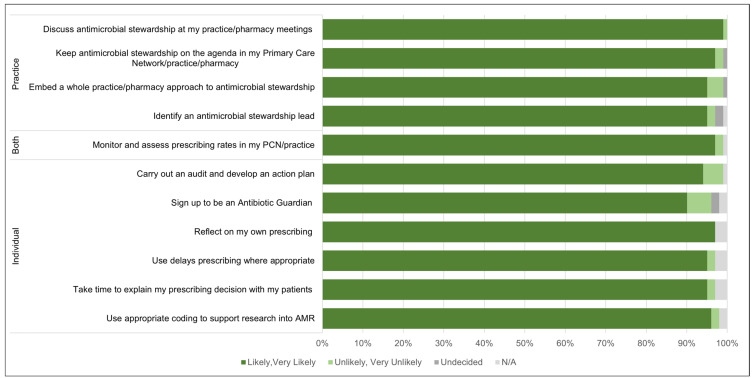
Results: 157 and 101 attendees completed the pre- and post-session surveys, respectively. In total, 89% agreed that attending the session was a good use of their time. The proportions of attendees stating an intention to use the TARGET toolkit and implement a range of AMS strategies following the session were high (TARGET Toolkit: >82%, AMS strategies: >90%). Most attendees planned to implement these actions within 3 months (47%) or within 3-6 months (30%).
Conclusion: Results suggest that embedding the training into a local incentive scheme is a viable implementation approach in extending training reach. Although the impact on prescribing rates is not yet available, the high engagement and intention to implement AMS strategies observed should inspire confidence in this approach to training implementation.
Antibiotics-BaselPharmacology, Toxicology and Pharmaceutics-General Pharmacology, Toxicology and Pharmaceutics
CiteScore
7.30
自引率
14.60%
发文量
1547
审稿时长
11 weeks
期刊介绍:
Antibiotics (ISSN 2079-6382) is an open access, peer reviewed journal on all aspects of antibiotics. Antibiotics is a multi-disciplinary journal encompassing the general fields of biochemistry, chemistry, genetics, microbiology and pharmacology. Our aim is to encourage scientists to publish their experimental and theoretical results in as much detail as possible. Therefore, there is no restriction on the length of papers.






 京公网安备 11010802042870号
京ICP备2023020795号-1
京公网安备 11010802042870号
京ICP备2023020795号-1

 分享
分享
 求助内容:
求助内容: 应助结果提醒方式:
 扫码关注我们
