Zhipeng Li, Huimin Mao, Xiaobin Liu, Jun Wan, Jingqi Chi, Shaobo Huang, Qingliang Lv, Zexing Wu, Lei Wang
{"title":"阻断效应延缓非对称活性单元的选择性海水氧化电子释放","authors":"Zhipeng Li, Huimin Mao, Xiaobin Liu, Jun Wan, Jingqi Chi, Shaobo Huang, Qingliang Lv, Zexing Wu, Lei Wang","doi":"10.1021/acsnano.4c17958","DOIUrl":null,"url":null,"abstract":"During seawater electrolysis, chloride ion (Cl<sup>–</sup>) adsorption at the anode leads to an inevitable competitive chloride oxidation reaction (ClOR) with the oxygen evolution reaction (OER), compromising the long-term stability of the electrolysis process. Furthermore, Ni-based OER electrocatalysts are challenged by activity degradation due to the overoxidation of Ni<sup>3+</sup>. In response, we present a design of oxygen-vacancy-regulated asymmetric Nb–O–Ni bonds aimed at selective seawater oxidation. The experimental and in situ characterization results indicate that the blocking effect of oxygen vacancies effectively alleviates the electron release of Ni<sup>3+</sup> and the electron enrichment of Nb<sup>5+</sup> on asymmetric Nb–O–Ni bonds, achieving a stable and selective OER in alkaline seawater. Density functional theory (DFT) calculations reveal that oxygen vacancies in Nb–O–Ni bonds optimize the adsorption strength of reaction intermediates and break up the scaling relationship between *OH and *OOH intermediates. The constructed anion exchange membrane electrolysis cell achieves a cost efficiency of $1.07 per GGE (gasoline gallon equivalent) for H<sub>2</sub> production at a current density of 1000 mA cm<sup>–2</sup>, maintaining operational stability for 100 h at 500 mA cm<sup>–2</sup>.","PeriodicalId":21,"journal":{"name":"ACS Nano","volume":"51 1","pages":""},"PeriodicalIF":16.0000,"publicationDate":"2025-02-26","publicationTypes":"Journal Article","fieldsOfStudy":null,"isOpenAccess":false,"openAccessPdf":"","citationCount":"0","resultStr":"{\"title\":\"Blocking Effect Retards Electron Release from Asymmetric Active Units for Selective Seawater Oxidation\",\"authors\":\"Zhipeng Li, Huimin Mao, Xiaobin Liu, Jun Wan, Jingqi Chi, Shaobo Huang, Qingliang Lv, Zexing Wu, Lei Wang\",\"doi\":\"10.1021/acsnano.4c17958\",\"DOIUrl\":null,\"url\":null,\"abstract\":\"During seawater electrolysis, chloride ion (Cl<sup>–</sup>) adsorption at the anode leads to an inevitable competitive chloride oxidation reaction (ClOR) with the oxygen evolution reaction (OER), compromising the long-term stability of the electrolysis process. Furthermore, Ni-based OER electrocatalysts are challenged by activity degradation due to the overoxidation of Ni<sup>3+</sup>. In response, we present a design of oxygen-vacancy-regulated asymmetric Nb–O–Ni bonds aimed at selective seawater oxidation. The experimental and in situ characterization results indicate that the blocking effect of oxygen vacancies effectively alleviates the electron release of Ni<sup>3+</sup> and the electron enrichment of Nb<sup>5+</sup> on asymmetric Nb–O–Ni bonds, achieving a stable and selective OER in alkaline seawater. Density functional theory (DFT) calculations reveal that oxygen vacancies in Nb–O–Ni bonds optimize the adsorption strength of reaction intermediates and break up the scaling relationship between *OH and *OOH intermediates. The constructed anion exchange membrane electrolysis cell achieves a cost efficiency of $1.07 per GGE (gasoline gallon equivalent) for H<sub>2</sub> production at a current density of 1000 mA cm<sup>–2</sup>, maintaining operational stability for 100 h at 500 mA cm<sup>–2</sup>.\",\"PeriodicalId\":21,\"journal\":{\"name\":\"ACS Nano\",\"volume\":\"51 1\",\"pages\":\"\"},\"PeriodicalIF\":16.0000,\"publicationDate\":\"2025-02-26\",\"publicationTypes\":\"Journal Article\",\"fieldsOfStudy\":null,\"isOpenAccess\":false,\"openAccessPdf\":\"\",\"citationCount\":\"0\",\"resultStr\":null,\"platform\":\"Semanticscholar\",\"paperid\":null,\"PeriodicalName\":\"ACS Nano\",\"FirstCategoryId\":\"88\",\"ListUrlMain\":\"https://doi.org/10.1021/acsnano.4c17958\",\"RegionNum\":1,\"RegionCategory\":\"材料科学\",\"ArticlePicture\":[],\"TitleCN\":null,\"AbstractTextCN\":null,\"PMCID\":null,\"EPubDate\":\"\",\"PubModel\":\"\",\"JCR\":\"Q1\",\"JCRName\":\"CHEMISTRY, MULTIDISCIPLINARY\",\"Score\":null,\"Total\":0}","platform":"Semanticscholar","paperid":null,"PeriodicalName":"ACS Nano","FirstCategoryId":"88","ListUrlMain":"https://doi.org/10.1021/acsnano.4c17958","RegionNum":1,"RegionCategory":"材料科学","ArticlePicture":[],"TitleCN":null,"AbstractTextCN":null,"PMCID":null,"EPubDate":"","PubModel":"","JCR":"Q1","JCRName":"CHEMISTRY, MULTIDISCIPLINARY","Score":null,"Total":0}
引用次数: 0
摘要
在海水电解过程中,氯离子(Cl -)在阳极的吸附不可避免地导致氯离子氧化反应(ClOR)与析氧反应(OER)发生竞争性反应,影响了电解过程的长期稳定性。此外,ni基OER电催化剂由于Ni3+的过度氧化而受到活性降低的挑战。作为回应,我们提出了一种设计氧空位调节的不对称Nb-O-Ni键,旨在选择性海水氧化。实验和原位表征结果表明,氧空位的阻断作用有效缓解了Ni3+的电子释放和Nb5+在不对称Nb-O-Ni键上的电子富集,在碱性海水中实现了稳定的选择性OER。密度泛函理论(DFT)计算表明,Nb-O-Ni键上的氧空位优化了反应中间体的吸附强度,打破了*OH和*OOH中间体之间的结垢关系。所构建的阴离子交换膜电解电池在1000 mA cm-2电流密度下生产氢气的成本效率为1.07美元/ GGE(汽油加仑当量),在500 mA cm-2电流密度下保持100小时的运行稳定性。
Blocking Effect Retards Electron Release from Asymmetric Active Units for Selective Seawater Oxidation
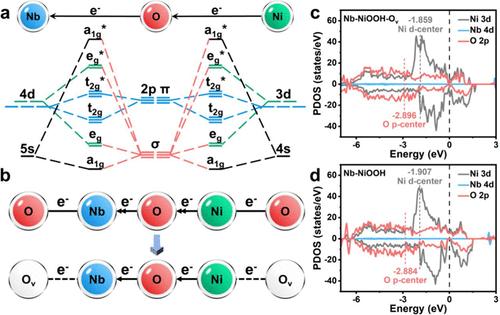
During seawater electrolysis, chloride ion (Cl–) adsorption at the anode leads to an inevitable competitive chloride oxidation reaction (ClOR) with the oxygen evolution reaction (OER), compromising the long-term stability of the electrolysis process. Furthermore, Ni-based OER electrocatalysts are challenged by activity degradation due to the overoxidation of Ni3+. In response, we present a design of oxygen-vacancy-regulated asymmetric Nb–O–Ni bonds aimed at selective seawater oxidation. The experimental and in situ characterization results indicate that the blocking effect of oxygen vacancies effectively alleviates the electron release of Ni3+ and the electron enrichment of Nb5+ on asymmetric Nb–O–Ni bonds, achieving a stable and selective OER in alkaline seawater. Density functional theory (DFT) calculations reveal that oxygen vacancies in Nb–O–Ni bonds optimize the adsorption strength of reaction intermediates and break up the scaling relationship between *OH and *OOH intermediates. The constructed anion exchange membrane electrolysis cell achieves a cost efficiency of $1.07 per GGE (gasoline gallon equivalent) for H2 production at a current density of 1000 mA cm–2, maintaining operational stability for 100 h at 500 mA cm–2.
期刊介绍:
ACS Nano, published monthly, serves as an international forum for comprehensive articles on nanoscience and nanotechnology research at the intersections of chemistry, biology, materials science, physics, and engineering. The journal fosters communication among scientists in these communities, facilitating collaboration, new research opportunities, and advancements through discoveries. ACS Nano covers synthesis, assembly, characterization, theory, and simulation of nanostructures, nanobiotechnology, nanofabrication, methods and tools for nanoscience and nanotechnology, and self- and directed-assembly. Alongside original research articles, it offers thorough reviews, perspectives on cutting-edge research, and discussions envisioning the future of nanoscience and nanotechnology.




 京公网安备 11010802042870号
京ICP备2023020795号-1
京公网安备 11010802042870号
京ICP备2023020795号-1

 分享
分享
 求助内容:
求助内容: 应助结果提醒方式:
 扫码关注我们
