{"title":"PAR6-aPKC-LGL结构揭示了LGL如何拮抗aPKC","authors":"Daniel St Johnston","doi":"10.1038/s41594-025-01506-8","DOIUrl":null,"url":null,"abstract":"The apical–basal polarity of epithelial cells depends on mutual antagonism between the apical aPKC and lateral LGL proteins. Until now, it has been unclear how LGL can be both a substrate and inhibitor of aPKC. Now, a cryo-electron microscopy (cryo-EM) structure of a stalled PAR6–aPKC–LGL complex addresses this conundrum.","PeriodicalId":49141,"journal":{"name":"Nature Structural & Molecular Biology","volume":"32 4","pages":"588-590"},"PeriodicalIF":10.1000,"publicationDate":"2025-02-27","publicationTypes":"Journal Article","fieldsOfStudy":null,"isOpenAccess":false,"openAccessPdf":"","citationCount":"0","resultStr":"{\"title\":\"A PAR6–aPKC–LGL structure reveals how LGL antagonizes aPKC\",\"authors\":\"Daniel St Johnston\",\"doi\":\"10.1038/s41594-025-01506-8\",\"DOIUrl\":null,\"url\":null,\"abstract\":\"The apical–basal polarity of epithelial cells depends on mutual antagonism between the apical aPKC and lateral LGL proteins. Until now, it has been unclear how LGL can be both a substrate and inhibitor of aPKC. Now, a cryo-electron microscopy (cryo-EM) structure of a stalled PAR6–aPKC–LGL complex addresses this conundrum.\",\"PeriodicalId\":49141,\"journal\":{\"name\":\"Nature Structural & Molecular Biology\",\"volume\":\"32 4\",\"pages\":\"588-590\"},\"PeriodicalIF\":10.1000,\"publicationDate\":\"2025-02-27\",\"publicationTypes\":\"Journal Article\",\"fieldsOfStudy\":null,\"isOpenAccess\":false,\"openAccessPdf\":\"\",\"citationCount\":\"0\",\"resultStr\":null,\"platform\":\"Semanticscholar\",\"paperid\":null,\"PeriodicalName\":\"Nature Structural & Molecular Biology\",\"FirstCategoryId\":\"99\",\"ListUrlMain\":\"https://www.nature.com/articles/s41594-025-01506-8\",\"RegionNum\":1,\"RegionCategory\":\"生物学\",\"ArticlePicture\":[],\"TitleCN\":null,\"AbstractTextCN\":null,\"PMCID\":null,\"EPubDate\":\"\",\"PubModel\":\"\",\"JCR\":\"Q1\",\"JCRName\":\"BIOCHEMISTRY & MOLECULAR BIOLOGY\",\"Score\":null,\"Total\":0}","platform":"Semanticscholar","paperid":null,"PeriodicalName":"Nature Structural & Molecular Biology","FirstCategoryId":"99","ListUrlMain":"https://www.nature.com/articles/s41594-025-01506-8","RegionNum":1,"RegionCategory":"生物学","ArticlePicture":[],"TitleCN":null,"AbstractTextCN":null,"PMCID":null,"EPubDate":"","PubModel":"","JCR":"Q1","JCRName":"BIOCHEMISTRY & MOLECULAR BIOLOGY","Score":null,"Total":0}
A PAR6–aPKC–LGL structure reveals how LGL antagonizes aPKC
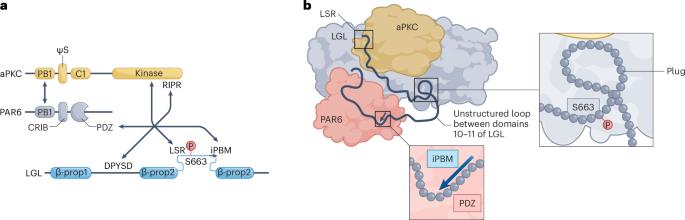
The apical–basal polarity of epithelial cells depends on mutual antagonism between the apical aPKC and lateral LGL proteins. Until now, it has been unclear how LGL can be both a substrate and inhibitor of aPKC. Now, a cryo-electron microscopy (cryo-EM) structure of a stalled PAR6–aPKC–LGL complex addresses this conundrum.
期刊介绍:
Nature Structural & Molecular Biology is a comprehensive platform that combines structural and molecular research. Our journal focuses on exploring the functional and mechanistic aspects of biological processes, emphasizing how molecular components collaborate to achieve a particular function. While structural data can shed light on these insights, our publication does not require them as a prerequisite.




 京公网安备 11010802042870号
京ICP备2023020795号-1
京公网安备 11010802042870号
京ICP备2023020795号-1

 分享
分享
 求助内容:
求助内容: 应助结果提醒方式:
 扫码关注我们
