{"title":"基于瓜枝的超分子光收集系统:SS-FRET和TS-FRET机制及其功能应用","authors":"Wei Zhang , Mao-Qin Liu , Yang Luo","doi":"10.1016/j.ccr.2025.216555","DOIUrl":null,"url":null,"abstract":"<div><div>Supramolecular light-harvesting systems constructed based on SS-FRET and TS-FRET are promising for chemical sensing leadership, information encryption, biomedical imaging, etc. These systems typically exhibit extremely large Stokes shifts, high quantum yields, and long-wavelength-emitting fluorescence (especially in the near-infrared) with tunable colors. This review summarizes cucurbit[n]urils-based supramolecular light-harvesting systems that restrict the rotation and vibration of organic fluorescent/phosphorescent molecules, and briefly discusses ALHSs based on other macrocyclic compounds and their functional applications. A wide range of cucurbit[n]urils are encompassed for practical reading value, including single-cavity Q[n]s, (<em>n</em> = 5–8, 10) and double-cavity <em>t</em>Q[13–15]) and <em>ns</em>-Q[10]). The rigid cavity structure and high affinity of Q[n]s could induce spatial confinement effects, which effectively limit or reduce the decay of radiative/non-radiative transitions, promote inter-system crossing, reduce the distance between donor-acceptor pairs, and effectively improve energy transfer efficiency. We contribute to the promotion of the further development of Q[n]s-based FRET systems by discussing and summarizing the advantages, importance, and functional applications of Q[n]s in the construction of FRET systems, e.g., tunable multicolor luminescent materials, information encryption/anti-counterfeiting, photocatalysis, and biologically targeted therapeutics/imaging.</div></div>","PeriodicalId":289,"journal":{"name":"Coordination Chemistry Reviews","volume":"533 ","pages":"Article 216555"},"PeriodicalIF":25.6000,"publicationDate":"2025-06-15","publicationTypes":"Journal Article","fieldsOfStudy":null,"isOpenAccess":false,"openAccessPdf":"","citationCount":"0","resultStr":"{\"title\":\"Supramolecular light-harvesting systems based on cucurbit[n]urils: SS-FRET and TS-FRET mechanisms and functional applications\",\"authors\":\"Wei Zhang , Mao-Qin Liu , Yang Luo\",\"doi\":\"10.1016/j.ccr.2025.216555\",\"DOIUrl\":null,\"url\":null,\"abstract\":\"<div><div>Supramolecular light-harvesting systems constructed based on SS-FRET and TS-FRET are promising for chemical sensing leadership, information encryption, biomedical imaging, etc. These systems typically exhibit extremely large Stokes shifts, high quantum yields, and long-wavelength-emitting fluorescence (especially in the near-infrared) with tunable colors. This review summarizes cucurbit[n]urils-based supramolecular light-harvesting systems that restrict the rotation and vibration of organic fluorescent/phosphorescent molecules, and briefly discusses ALHSs based on other macrocyclic compounds and their functional applications. A wide range of cucurbit[n]urils are encompassed for practical reading value, including single-cavity Q[n]s, (<em>n</em> = 5–8, 10) and double-cavity <em>t</em>Q[13–15]) and <em>ns</em>-Q[10]). The rigid cavity structure and high affinity of Q[n]s could induce spatial confinement effects, which effectively limit or reduce the decay of radiative/non-radiative transitions, promote inter-system crossing, reduce the distance between donor-acceptor pairs, and effectively improve energy transfer efficiency. We contribute to the promotion of the further development of Q[n]s-based FRET systems by discussing and summarizing the advantages, importance, and functional applications of Q[n]s in the construction of FRET systems, e.g., tunable multicolor luminescent materials, information encryption/anti-counterfeiting, photocatalysis, and biologically targeted therapeutics/imaging.</div></div>\",\"PeriodicalId\":289,\"journal\":{\"name\":\"Coordination Chemistry Reviews\",\"volume\":\"533 \",\"pages\":\"Article 216555\"},\"PeriodicalIF\":25.6000,\"publicationDate\":\"2025-06-15\",\"publicationTypes\":\"Journal Article\",\"fieldsOfStudy\":null,\"isOpenAccess\":false,\"openAccessPdf\":\"\",\"citationCount\":\"0\",\"resultStr\":null,\"platform\":\"Semanticscholar\",\"paperid\":null,\"PeriodicalName\":\"Coordination Chemistry Reviews\",\"FirstCategoryId\":\"92\",\"ListUrlMain\":\"https://www.sciencedirect.com/science/article/pii/S0010854525001250\",\"RegionNum\":1,\"RegionCategory\":\"化学\",\"ArticlePicture\":[],\"TitleCN\":null,\"AbstractTextCN\":null,\"PMCID\":null,\"EPubDate\":\"2025/2/27 0:00:00\",\"PubModel\":\"Epub\",\"JCR\":\"Q1\",\"JCRName\":\"CHEMISTRY, INORGANIC & NUCLEAR\",\"Score\":null,\"Total\":0}","platform":"Semanticscholar","paperid":null,"PeriodicalName":"Coordination Chemistry Reviews","FirstCategoryId":"92","ListUrlMain":"https://www.sciencedirect.com/science/article/pii/S0010854525001250","RegionNum":1,"RegionCategory":"化学","ArticlePicture":[],"TitleCN":null,"AbstractTextCN":null,"PMCID":null,"EPubDate":"2025/2/27 0:00:00","PubModel":"Epub","JCR":"Q1","JCRName":"CHEMISTRY, INORGANIC & NUCLEAR","Score":null,"Total":0}
Supramolecular light-harvesting systems based on cucurbit[n]urils: SS-FRET and TS-FRET mechanisms and functional applications
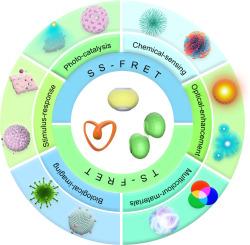
Supramolecular light-harvesting systems constructed based on SS-FRET and TS-FRET are promising for chemical sensing leadership, information encryption, biomedical imaging, etc. These systems typically exhibit extremely large Stokes shifts, high quantum yields, and long-wavelength-emitting fluorescence (especially in the near-infrared) with tunable colors. This review summarizes cucurbit[n]urils-based supramolecular light-harvesting systems that restrict the rotation and vibration of organic fluorescent/phosphorescent molecules, and briefly discusses ALHSs based on other macrocyclic compounds and their functional applications. A wide range of cucurbit[n]urils are encompassed for practical reading value, including single-cavity Q[n]s, (n = 5–8, 10) and double-cavity tQ[13–15]) and ns-Q[10]). The rigid cavity structure and high affinity of Q[n]s could induce spatial confinement effects, which effectively limit or reduce the decay of radiative/non-radiative transitions, promote inter-system crossing, reduce the distance between donor-acceptor pairs, and effectively improve energy transfer efficiency. We contribute to the promotion of the further development of Q[n]s-based FRET systems by discussing and summarizing the advantages, importance, and functional applications of Q[n]s in the construction of FRET systems, e.g., tunable multicolor luminescent materials, information encryption/anti-counterfeiting, photocatalysis, and biologically targeted therapeutics/imaging.
期刊介绍:
Coordination Chemistry Reviews offers rapid publication of review articles on current and significant topics in coordination chemistry, encompassing organometallic, supramolecular, theoretical, and bioinorganic chemistry. It also covers catalysis, materials chemistry, and metal-organic frameworks from a coordination chemistry perspective. Reviews summarize recent developments or discuss specific techniques, welcoming contributions from both established and emerging researchers.
The journal releases special issues on timely subjects, including those featuring contributions from specific regions or conferences. Occasional full-length book articles are also featured. Additionally, special volumes cover annual reviews of main group chemistry, transition metal group chemistry, and organometallic chemistry. These comprehensive reviews are vital resources for those engaged in coordination chemistry, further establishing Coordination Chemistry Reviews as a hub for insightful surveys in inorganic and physical inorganic chemistry.





 京公网安备 11010802042870号
京ICP备2023020795号-1
京公网安备 11010802042870号
京ICP备2023020795号-1

 分享
分享
 求助内容:
求助内容: 应助结果提醒方式:
 扫码关注我们
