Jian Liu, William L. Kubic, Jr., Eric C. D. Tan, Jacob W. Dempsey, Pahola Thathiana Benavides, Sweta Balchandani, Hakan Olcay, Dupeng Liu, Ning Sun, Shailesh Dangwal, Blake N. Trusty, Syed Z. Islam, Ramesh R. Bhave
{"title":"液-液萃取法分离发酵液中2,3-丁二醇的技术经济分析及生命周期评价","authors":"Jian Liu, William L. Kubic, Jr., Eric C. D. Tan, Jacob W. Dempsey, Pahola Thathiana Benavides, Sweta Balchandani, Hakan Olcay, Dupeng Liu, Ning Sun, Shailesh Dangwal, Blake N. Trusty, Syed Z. Islam, Ramesh R. Bhave","doi":"10.1021/acs.iecr.4c03056","DOIUrl":null,"url":null,"abstract":"It is energy-intensive to separate dilute 2,3-butanediol (2,3-BDO) (<10 wt %) from the aqueous phase of fermentation broth for sustainable aviation fuel (SAF) using conventional distillation. Liquid–liquid extraction (LLE) using oleyl alcohol as a solvent in a membrane extractor to extract BDO from water can significantly reduce the energy cost and minimize the potential emulsion. In an Aspen Plus model simulation, 95.2% BDO recovery and 97.1% BDO purity have been achieved using this LLE method with solvent recovery and heat integration. The thermal energy cost was estimated to be 4.57 MJ/kg BDO, which is only about 16.8% of the lower heating value (LHV) of the BDO. This method consumes 81% less energy than the cascade distillation and reduces about $0.46/GGE (gasoline gallon equivalent) to the minimal fuel selling price. Meanwhile, the greenhouse gas (GHG) emission is 62% lower than petroleum-based jet fuel production and 34% less than using the cascade distillation.","PeriodicalId":39,"journal":{"name":"Industrial & Engineering Chemistry Research","volume":"15 1","pages":""},"PeriodicalIF":3.9000,"publicationDate":"2025-02-26","publicationTypes":"Journal Article","fieldsOfStudy":null,"isOpenAccess":false,"openAccessPdf":"","citationCount":"0","resultStr":"{\"title\":\"Techno-Economic Analysis and Life Cycle Assessment for the Separation of 2,3-Butanediol from Fermentation Broth Using Liquid–Liquid Extraction\",\"authors\":\"Jian Liu, William L. Kubic, Jr., Eric C. D. Tan, Jacob W. Dempsey, Pahola Thathiana Benavides, Sweta Balchandani, Hakan Olcay, Dupeng Liu, Ning Sun, Shailesh Dangwal, Blake N. Trusty, Syed Z. Islam, Ramesh R. Bhave\",\"doi\":\"10.1021/acs.iecr.4c03056\",\"DOIUrl\":null,\"url\":null,\"abstract\":\"It is energy-intensive to separate dilute 2,3-butanediol (2,3-BDO) (<10 wt %) from the aqueous phase of fermentation broth for sustainable aviation fuel (SAF) using conventional distillation. Liquid–liquid extraction (LLE) using oleyl alcohol as a solvent in a membrane extractor to extract BDO from water can significantly reduce the energy cost and minimize the potential emulsion. In an Aspen Plus model simulation, 95.2% BDO recovery and 97.1% BDO purity have been achieved using this LLE method with solvent recovery and heat integration. The thermal energy cost was estimated to be 4.57 MJ/kg BDO, which is only about 16.8% of the lower heating value (LHV) of the BDO. This method consumes 81% less energy than the cascade distillation and reduces about $0.46/GGE (gasoline gallon equivalent) to the minimal fuel selling price. Meanwhile, the greenhouse gas (GHG) emission is 62% lower than petroleum-based jet fuel production and 34% less than using the cascade distillation.\",\"PeriodicalId\":39,\"journal\":{\"name\":\"Industrial & Engineering Chemistry Research\",\"volume\":\"15 1\",\"pages\":\"\"},\"PeriodicalIF\":3.9000,\"publicationDate\":\"2025-02-26\",\"publicationTypes\":\"Journal Article\",\"fieldsOfStudy\":null,\"isOpenAccess\":false,\"openAccessPdf\":\"\",\"citationCount\":\"0\",\"resultStr\":null,\"platform\":\"Semanticscholar\",\"paperid\":null,\"PeriodicalName\":\"Industrial & Engineering Chemistry Research\",\"FirstCategoryId\":\"5\",\"ListUrlMain\":\"https://doi.org/10.1021/acs.iecr.4c03056\",\"RegionNum\":3,\"RegionCategory\":\"工程技术\",\"ArticlePicture\":[],\"TitleCN\":null,\"AbstractTextCN\":null,\"PMCID\":null,\"EPubDate\":\"\",\"PubModel\":\"\",\"JCR\":\"Q2\",\"JCRName\":\"ENGINEERING, CHEMICAL\",\"Score\":null,\"Total\":0}","platform":"Semanticscholar","paperid":null,"PeriodicalName":"Industrial & Engineering Chemistry Research","FirstCategoryId":"5","ListUrlMain":"https://doi.org/10.1021/acs.iecr.4c03056","RegionNum":3,"RegionCategory":"工程技术","ArticlePicture":[],"TitleCN":null,"AbstractTextCN":null,"PMCID":null,"EPubDate":"","PubModel":"","JCR":"Q2","JCRName":"ENGINEERING, CHEMICAL","Score":null,"Total":0}
Techno-Economic Analysis and Life Cycle Assessment for the Separation of 2,3-Butanediol from Fermentation Broth Using Liquid–Liquid Extraction
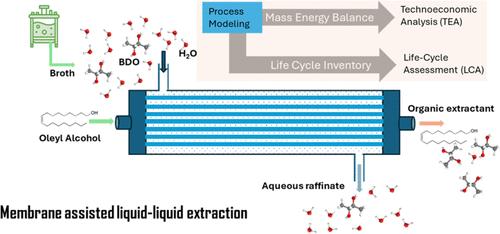
It is energy-intensive to separate dilute 2,3-butanediol (2,3-BDO) (<10 wt %) from the aqueous phase of fermentation broth for sustainable aviation fuel (SAF) using conventional distillation. Liquid–liquid extraction (LLE) using oleyl alcohol as a solvent in a membrane extractor to extract BDO from water can significantly reduce the energy cost and minimize the potential emulsion. In an Aspen Plus model simulation, 95.2% BDO recovery and 97.1% BDO purity have been achieved using this LLE method with solvent recovery and heat integration. The thermal energy cost was estimated to be 4.57 MJ/kg BDO, which is only about 16.8% of the lower heating value (LHV) of the BDO. This method consumes 81% less energy than the cascade distillation and reduces about $0.46/GGE (gasoline gallon equivalent) to the minimal fuel selling price. Meanwhile, the greenhouse gas (GHG) emission is 62% lower than petroleum-based jet fuel production and 34% less than using the cascade distillation.
期刊介绍:
ndustrial & Engineering Chemistry, with variations in title and format, has been published since 1909 by the American Chemical Society. Industrial & Engineering Chemistry Research is a weekly publication that reports industrial and academic research in the broad fields of applied chemistry and chemical engineering with special focus on fundamentals, processes, and products.




 京公网安备 11010802042870号
京ICP备2023020795号-1
京公网安备 11010802042870号
京ICP备2023020795号-1

 分享
分享
 求助内容:
求助内容: 应助结果提醒方式:
 扫码关注我们
