Kangmin Ju , Hanul Song , Youngkwon Kim , Jungsoo Park
{"title":"基于数值分析的混合动力汽车汽油机LP-EGR冷凝现象半经验研究","authors":"Kangmin Ju , Hanul Song , Youngkwon Kim , Jungsoo Park","doi":"10.1016/j.applthermaleng.2025.126022","DOIUrl":null,"url":null,"abstract":"<div><div>This study focuses on condensation phenomena within a critical component, the low-pressure exhaust gas recirculation (LP-EGR) cooler. By combining experimental and computational techniques, we aimed to understand and predict condensation behavior under various operating conditions. A dynamometer test was conducted to identify the condensation issue and its location. Computational Fluid Dynamics (CFD) analysis was employed to visualize flow patterns and temperature distributions within the cooler. Coolant temperature was selected as the primary variable influencing condensation. Our findings revealed an inverse relationship between the LP-EGR rate and the amount of condensation. A lower LP-EGR rate led to increased condensation. At 2000 rpm and an EGR rate of 4.7 %, approximately 16.4 g of condensation was observed. Furthermore, CFD simulations predicted that at a coolant temperature of −17 °C, condensation could reach up to 55 g. Tube 4 in the cooler was identified as the most susceptible area due to prolonged residence time of low-temperature flow. Based on these results, we recommend implementing a flexible LP-EGR rate strategy to mitigate condensation issues, especially under cold operating conditions. This approach can help optimize engine performance and reduce emissions while minimizing the negative impacts of condensation.</div></div>","PeriodicalId":8201,"journal":{"name":"Applied Thermal Engineering","volume":"269 ","pages":"Article 126022"},"PeriodicalIF":7.5000,"publicationDate":"2025-06-15","publicationTypes":"Journal Article","fieldsOfStudy":null,"isOpenAccess":false,"openAccessPdf":"","citationCount":"0","resultStr":"{\"title\":\"Semi-empirical study based on numerical analysis for analyzing LP-EGR condensation phenomenon in the gasoline engine of a hybrid electric vehicle\",\"authors\":\"Kangmin Ju , Hanul Song , Youngkwon Kim , Jungsoo Park\",\"doi\":\"10.1016/j.applthermaleng.2025.126022\",\"DOIUrl\":null,\"url\":null,\"abstract\":\"<div><div>This study focuses on condensation phenomena within a critical component, the low-pressure exhaust gas recirculation (LP-EGR) cooler. By combining experimental and computational techniques, we aimed to understand and predict condensation behavior under various operating conditions. A dynamometer test was conducted to identify the condensation issue and its location. Computational Fluid Dynamics (CFD) analysis was employed to visualize flow patterns and temperature distributions within the cooler. Coolant temperature was selected as the primary variable influencing condensation. Our findings revealed an inverse relationship between the LP-EGR rate and the amount of condensation. A lower LP-EGR rate led to increased condensation. At 2000 rpm and an EGR rate of 4.7 %, approximately 16.4 g of condensation was observed. Furthermore, CFD simulations predicted that at a coolant temperature of −17 °C, condensation could reach up to 55 g. Tube 4 in the cooler was identified as the most susceptible area due to prolonged residence time of low-temperature flow. Based on these results, we recommend implementing a flexible LP-EGR rate strategy to mitigate condensation issues, especially under cold operating conditions. This approach can help optimize engine performance and reduce emissions while minimizing the negative impacts of condensation.</div></div>\",\"PeriodicalId\":8201,\"journal\":{\"name\":\"Applied Thermal Engineering\",\"volume\":\"269 \",\"pages\":\"Article 126022\"},\"PeriodicalIF\":7.5000,\"publicationDate\":\"2025-06-15\",\"publicationTypes\":\"Journal Article\",\"fieldsOfStudy\":null,\"isOpenAccess\":false,\"openAccessPdf\":\"\",\"citationCount\":\"0\",\"resultStr\":null,\"platform\":\"Semanticscholar\",\"paperid\":null,\"PeriodicalName\":\"Applied Thermal Engineering\",\"FirstCategoryId\":\"5\",\"ListUrlMain\":\"https://www.sciencedirect.com/science/article/pii/S1359431125006131\",\"RegionNum\":2,\"RegionCategory\":\"工程技术\",\"ArticlePicture\":[],\"TitleCN\":null,\"AbstractTextCN\":null,\"PMCID\":null,\"EPubDate\":\"2025/2/20 0:00:00\",\"PubModel\":\"Epub\",\"JCR\":\"Q2\",\"JCRName\":\"ENERGY & FUELS\",\"Score\":null,\"Total\":0}","platform":"Semanticscholar","paperid":null,"PeriodicalName":"Applied Thermal Engineering","FirstCategoryId":"5","ListUrlMain":"https://www.sciencedirect.com/science/article/pii/S1359431125006131","RegionNum":2,"RegionCategory":"工程技术","ArticlePicture":[],"TitleCN":null,"AbstractTextCN":null,"PMCID":null,"EPubDate":"2025/2/20 0:00:00","PubModel":"Epub","JCR":"Q2","JCRName":"ENERGY & FUELS","Score":null,"Total":0}
Semi-empirical study based on numerical analysis for analyzing LP-EGR condensation phenomenon in the gasoline engine of a hybrid electric vehicle
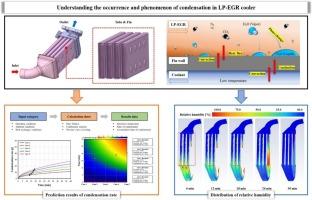
This study focuses on condensation phenomena within a critical component, the low-pressure exhaust gas recirculation (LP-EGR) cooler. By combining experimental and computational techniques, we aimed to understand and predict condensation behavior under various operating conditions. A dynamometer test was conducted to identify the condensation issue and its location. Computational Fluid Dynamics (CFD) analysis was employed to visualize flow patterns and temperature distributions within the cooler. Coolant temperature was selected as the primary variable influencing condensation. Our findings revealed an inverse relationship between the LP-EGR rate and the amount of condensation. A lower LP-EGR rate led to increased condensation. At 2000 rpm and an EGR rate of 4.7 %, approximately 16.4 g of condensation was observed. Furthermore, CFD simulations predicted that at a coolant temperature of −17 °C, condensation could reach up to 55 g. Tube 4 in the cooler was identified as the most susceptible area due to prolonged residence time of low-temperature flow. Based on these results, we recommend implementing a flexible LP-EGR rate strategy to mitigate condensation issues, especially under cold operating conditions. This approach can help optimize engine performance and reduce emissions while minimizing the negative impacts of condensation.
期刊介绍:
Applied Thermal Engineering disseminates novel research related to the design, development and demonstration of components, devices, equipment, technologies and systems involving thermal processes for the production, storage, utilization and conservation of energy, with a focus on engineering application.
The journal publishes high-quality and high-impact Original Research Articles, Review Articles, Short Communications and Letters to the Editor on cutting-edge innovations in research, and recent advances or issues of interest to the thermal engineering community.




 京公网安备 11010802042870号
京ICP备2023020795号-1
京公网安备 11010802042870号
京ICP备2023020795号-1

 分享
分享
 求助内容:
求助内容: 应助结果提醒方式:
 扫码关注我们
