Chenlei Ye , Weihong Liao , Zongxue Xu , Xinyi Shu
{"title":"城市中尺度复杂雨洪系统中人水关系评价的创新框架","authors":"Chenlei Ye , Weihong Liao , Zongxue Xu , Xinyi Shu","doi":"10.1016/j.jhydrol.2025.132876","DOIUrl":null,"url":null,"abstract":"<div><div>Urban pluvial flooding, exacerbated by intense rainstorms, has emerged as a growing risk to urban safety in the face of climate change and accelerated urban development. Integrated hydrological and hydrodynamic models have become widely adopted for simulating urban floods, enhancing the accuracy of pluvial flood prediction. However, existing research has primarily focused on modeling flooding, while always overlooking the modeling of social systems directly impacted by floods. Moreover, various flood control measures under human influence can partially reduce peak discharge and surface runoff, making it crucial to deeply analyze the human-water relationship. This involves coupling the surface inundation process with social systems under flood control, which is a crucial issue in flood management. This research proposes an innovative framework to assess the human-water relationship in complex pluvial flooding systems. Specifically, HWI-CEM (Human-water interaction, crowd evacuation model) was developed to simulate social behavior during crowd evacuation. The framework consists of three main components: (1) Based on hydrological and hydrodynamic models, a heuristic algorithm is used to optimize the composition and location of flood control infrastructure; (2) HWI-CEM adopts a bottom-up modeling approach, simulates the crowd evacuation process in urban floods, focusing on heterogeneous individual features and behavior rules, and analyzes the impacts of rainfall, development modes, and evacuation strategies; and (3) An uncertainty analysis of HWI-CEM is implemented using multithreaded parallel computing. The framework was applied in Jincheng, the results reveal: First, the multi-objective optimization of adaptive flood control measures (FCMs) effectively reduces flood impacts under various return periods, while the global evacuation mode (GEM) and zonal evacuation mode (ZEM) strategies significantly influence both evacuation efficiency and balance. FCMs, as decentralized flood control measures, enhance evacuation efficiency by regulating runoff and improving the balance of the evacuation process, although extreme events may require additional drainage capacity enhancement measures. Second, HWI-CEM successfully couples urban flooding processes with complex social systems. It effectively captures individual heterogeneity and interaction mechanisms in urban flooding scenarios. HWI-CEM demonstrates robustness and stability, with minor variations having minimal impact on its overall performance. The integrated framework proposed in this study for assessing the human-water relationship shows strong versatility and interpretability at urban meso-scales.</div></div>","PeriodicalId":362,"journal":{"name":"Journal of Hydrology","volume":"655 ","pages":"Article 132876"},"PeriodicalIF":7.3000,"publicationDate":"2025-07-01","publicationTypes":"Journal Article","fieldsOfStudy":null,"isOpenAccess":false,"openAccessPdf":"","citationCount":"0","resultStr":"{\"title\":\"An innovative framework to assess the human-water relationship in complex pluvial flooding system at urban meso-scales\",\"authors\":\"Chenlei Ye , Weihong Liao , Zongxue Xu , Xinyi Shu\",\"doi\":\"10.1016/j.jhydrol.2025.132876\",\"DOIUrl\":null,\"url\":null,\"abstract\":\"<div><div>Urban pluvial flooding, exacerbated by intense rainstorms, has emerged as a growing risk to urban safety in the face of climate change and accelerated urban development. Integrated hydrological and hydrodynamic models have become widely adopted for simulating urban floods, enhancing the accuracy of pluvial flood prediction. However, existing research has primarily focused on modeling flooding, while always overlooking the modeling of social systems directly impacted by floods. Moreover, various flood control measures under human influence can partially reduce peak discharge and surface runoff, making it crucial to deeply analyze the human-water relationship. This involves coupling the surface inundation process with social systems under flood control, which is a crucial issue in flood management. This research proposes an innovative framework to assess the human-water relationship in complex pluvial flooding systems. Specifically, HWI-CEM (Human-water interaction, crowd evacuation model) was developed to simulate social behavior during crowd evacuation. The framework consists of three main components: (1) Based on hydrological and hydrodynamic models, a heuristic algorithm is used to optimize the composition and location of flood control infrastructure; (2) HWI-CEM adopts a bottom-up modeling approach, simulates the crowd evacuation process in urban floods, focusing on heterogeneous individual features and behavior rules, and analyzes the impacts of rainfall, development modes, and evacuation strategies; and (3) An uncertainty analysis of HWI-CEM is implemented using multithreaded parallel computing. The framework was applied in Jincheng, the results reveal: First, the multi-objective optimization of adaptive flood control measures (FCMs) effectively reduces flood impacts under various return periods, while the global evacuation mode (GEM) and zonal evacuation mode (ZEM) strategies significantly influence both evacuation efficiency and balance. FCMs, as decentralized flood control measures, enhance evacuation efficiency by regulating runoff and improving the balance of the evacuation process, although extreme events may require additional drainage capacity enhancement measures. Second, HWI-CEM successfully couples urban flooding processes with complex social systems. It effectively captures individual heterogeneity and interaction mechanisms in urban flooding scenarios. HWI-CEM demonstrates robustness and stability, with minor variations having minimal impact on its overall performance. The integrated framework proposed in this study for assessing the human-water relationship shows strong versatility and interpretability at urban meso-scales.</div></div>\",\"PeriodicalId\":362,\"journal\":{\"name\":\"Journal of Hydrology\",\"volume\":\"655 \",\"pages\":\"Article 132876\"},\"PeriodicalIF\":7.3000,\"publicationDate\":\"2025-07-01\",\"publicationTypes\":\"Journal Article\",\"fieldsOfStudy\":null,\"isOpenAccess\":false,\"openAccessPdf\":\"\",\"citationCount\":\"0\",\"resultStr\":null,\"platform\":\"Semanticscholar\",\"paperid\":null,\"PeriodicalName\":\"Journal of Hydrology\",\"FirstCategoryId\":\"89\",\"ListUrlMain\":\"https://www.sciencedirect.com/science/article/pii/S0022169425002148\",\"RegionNum\":1,\"RegionCategory\":\"地球科学\",\"ArticlePicture\":[],\"TitleCN\":null,\"AbstractTextCN\":null,\"PMCID\":null,\"EPubDate\":\"2025/2/19 0:00:00\",\"PubModel\":\"Epub\",\"JCR\":\"Q1\",\"JCRName\":\"ENGINEERING, CIVIL\",\"Score\":null,\"Total\":0}","platform":"Semanticscholar","paperid":null,"PeriodicalName":"Journal of Hydrology","FirstCategoryId":"89","ListUrlMain":"https://www.sciencedirect.com/science/article/pii/S0022169425002148","RegionNum":1,"RegionCategory":"地球科学","ArticlePicture":[],"TitleCN":null,"AbstractTextCN":null,"PMCID":null,"EPubDate":"2025/2/19 0:00:00","PubModel":"Epub","JCR":"Q1","JCRName":"ENGINEERING, CIVIL","Score":null,"Total":0}
An innovative framework to assess the human-water relationship in complex pluvial flooding system at urban meso-scales
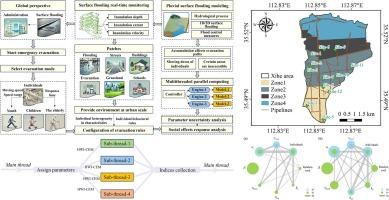
Urban pluvial flooding, exacerbated by intense rainstorms, has emerged as a growing risk to urban safety in the face of climate change and accelerated urban development. Integrated hydrological and hydrodynamic models have become widely adopted for simulating urban floods, enhancing the accuracy of pluvial flood prediction. However, existing research has primarily focused on modeling flooding, while always overlooking the modeling of social systems directly impacted by floods. Moreover, various flood control measures under human influence can partially reduce peak discharge and surface runoff, making it crucial to deeply analyze the human-water relationship. This involves coupling the surface inundation process with social systems under flood control, which is a crucial issue in flood management. This research proposes an innovative framework to assess the human-water relationship in complex pluvial flooding systems. Specifically, HWI-CEM (Human-water interaction, crowd evacuation model) was developed to simulate social behavior during crowd evacuation. The framework consists of three main components: (1) Based on hydrological and hydrodynamic models, a heuristic algorithm is used to optimize the composition and location of flood control infrastructure; (2) HWI-CEM adopts a bottom-up modeling approach, simulates the crowd evacuation process in urban floods, focusing on heterogeneous individual features and behavior rules, and analyzes the impacts of rainfall, development modes, and evacuation strategies; and (3) An uncertainty analysis of HWI-CEM is implemented using multithreaded parallel computing. The framework was applied in Jincheng, the results reveal: First, the multi-objective optimization of adaptive flood control measures (FCMs) effectively reduces flood impacts under various return periods, while the global evacuation mode (GEM) and zonal evacuation mode (ZEM) strategies significantly influence both evacuation efficiency and balance. FCMs, as decentralized flood control measures, enhance evacuation efficiency by regulating runoff and improving the balance of the evacuation process, although extreme events may require additional drainage capacity enhancement measures. Second, HWI-CEM successfully couples urban flooding processes with complex social systems. It effectively captures individual heterogeneity and interaction mechanisms in urban flooding scenarios. HWI-CEM demonstrates robustness and stability, with minor variations having minimal impact on its overall performance. The integrated framework proposed in this study for assessing the human-water relationship shows strong versatility and interpretability at urban meso-scales.
期刊介绍:
The Journal of Hydrology publishes original research papers and comprehensive reviews in all the subfields of the hydrological sciences including water based management and policy issues that impact on economics and society. These comprise, but are not limited to the physical, chemical, biogeochemical, stochastic and systems aspects of surface and groundwater hydrology, hydrometeorology and hydrogeology. Relevant topics incorporating the insights and methodologies of disciplines such as climatology, water resource systems, hydraulics, agrohydrology, geomorphology, soil science, instrumentation and remote sensing, civil and environmental engineering are included. Social science perspectives on hydrological problems such as resource and ecological economics, environmental sociology, psychology and behavioural science, management and policy analysis are also invited. Multi-and interdisciplinary analyses of hydrological problems are within scope. The science published in the Journal of Hydrology is relevant to catchment scales rather than exclusively to a local scale or site.




 京公网安备 11010802042870号
京ICP备2023020795号-1
京公网安备 11010802042870号
京ICP备2023020795号-1

 分享
分享
 求助内容:
求助内容: 应助结果提醒方式:
 扫码关注我们
