Jian Xu , Zhiqi Lin , Min Chen , Junmei Yang , Delu Zeng , John Paisley
{"title":"完全贝叶斯微分高斯过程通过随机微分方程","authors":"Jian Xu , Zhiqi Lin , Min Chen , Junmei Yang , Delu Zeng , John Paisley","doi":"10.1016/j.knosys.2025.113187","DOIUrl":null,"url":null,"abstract":"<div><div>Deep Gaussian process models typically employ discrete hierarchies, but recent advancements in differential Gaussian processes (DiffGPs) have extended these models to infinite depths. However, existing DiffGP approaches often overlook the uncertainty in kernel hyperparameters by treating them as fixed and time-invariant, which degrades the model’s predictive performance and neglects the posterior distribution. In this work, we introduce a fully Bayesian framework that models kernel hyperparameters as random variables and utilizes coupled stochastic differential equations (SDEs) to jointly learn their posterior distributions alongside those of inducing points. By incorporating the estimation uncertainty of hyperparameters, our method significantly enhances model flexibility and adaptability to complex dynamic systems. Furthermore, we employ a black-box adaptive SDE solver with a neural network to achieve realistic, time-varying posterior approximations, thereby improving the expressiveness of the variational posterior. Comprehensive experimental evaluations demonstrate that our approach outperforms traditional methods in terms of flexibility, accuracy, and other key performance metrics. This work not only provides a robust Bayesian extension to DiffGP models but also validates its effectiveness in handling intricate dynamic behaviors, thereby advancing the applicability of Gaussian process models in diverse real-world scenarios.</div></div>","PeriodicalId":49939,"journal":{"name":"Knowledge-Based Systems","volume":"314 ","pages":"Article 113187"},"PeriodicalIF":7.6000,"publicationDate":"2025-04-08","publicationTypes":"Journal Article","fieldsOfStudy":null,"isOpenAccess":false,"openAccessPdf":"","citationCount":"0","resultStr":"{\"title\":\"Fully Bayesian differential Gaussian processes through stochastic differential equations\",\"authors\":\"Jian Xu , Zhiqi Lin , Min Chen , Junmei Yang , Delu Zeng , John Paisley\",\"doi\":\"10.1016/j.knosys.2025.113187\",\"DOIUrl\":null,\"url\":null,\"abstract\":\"<div><div>Deep Gaussian process models typically employ discrete hierarchies, but recent advancements in differential Gaussian processes (DiffGPs) have extended these models to infinite depths. However, existing DiffGP approaches often overlook the uncertainty in kernel hyperparameters by treating them as fixed and time-invariant, which degrades the model’s predictive performance and neglects the posterior distribution. In this work, we introduce a fully Bayesian framework that models kernel hyperparameters as random variables and utilizes coupled stochastic differential equations (SDEs) to jointly learn their posterior distributions alongside those of inducing points. By incorporating the estimation uncertainty of hyperparameters, our method significantly enhances model flexibility and adaptability to complex dynamic systems. Furthermore, we employ a black-box adaptive SDE solver with a neural network to achieve realistic, time-varying posterior approximations, thereby improving the expressiveness of the variational posterior. Comprehensive experimental evaluations demonstrate that our approach outperforms traditional methods in terms of flexibility, accuracy, and other key performance metrics. This work not only provides a robust Bayesian extension to DiffGP models but also validates its effectiveness in handling intricate dynamic behaviors, thereby advancing the applicability of Gaussian process models in diverse real-world scenarios.</div></div>\",\"PeriodicalId\":49939,\"journal\":{\"name\":\"Knowledge-Based Systems\",\"volume\":\"314 \",\"pages\":\"Article 113187\"},\"PeriodicalIF\":7.6000,\"publicationDate\":\"2025-04-08\",\"publicationTypes\":\"Journal Article\",\"fieldsOfStudy\":null,\"isOpenAccess\":false,\"openAccessPdf\":\"\",\"citationCount\":\"0\",\"resultStr\":null,\"platform\":\"Semanticscholar\",\"paperid\":null,\"PeriodicalName\":\"Knowledge-Based Systems\",\"FirstCategoryId\":\"94\",\"ListUrlMain\":\"https://www.sciencedirect.com/science/article/pii/S0950705125002345\",\"RegionNum\":1,\"RegionCategory\":\"计算机科学\",\"ArticlePicture\":[],\"TitleCN\":null,\"AbstractTextCN\":null,\"PMCID\":null,\"EPubDate\":\"2025/2/25 0:00:00\",\"PubModel\":\"Epub\",\"JCR\":\"Q1\",\"JCRName\":\"COMPUTER SCIENCE, ARTIFICIAL INTELLIGENCE\",\"Score\":null,\"Total\":0}","platform":"Semanticscholar","paperid":null,"PeriodicalName":"Knowledge-Based Systems","FirstCategoryId":"94","ListUrlMain":"https://www.sciencedirect.com/science/article/pii/S0950705125002345","RegionNum":1,"RegionCategory":"计算机科学","ArticlePicture":[],"TitleCN":null,"AbstractTextCN":null,"PMCID":null,"EPubDate":"2025/2/25 0:00:00","PubModel":"Epub","JCR":"Q1","JCRName":"COMPUTER SCIENCE, ARTIFICIAL INTELLIGENCE","Score":null,"Total":0}
Fully Bayesian differential Gaussian processes through stochastic differential equations
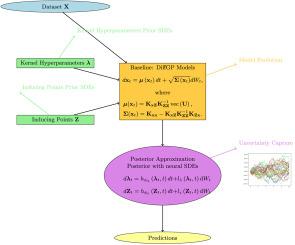
Deep Gaussian process models typically employ discrete hierarchies, but recent advancements in differential Gaussian processes (DiffGPs) have extended these models to infinite depths. However, existing DiffGP approaches often overlook the uncertainty in kernel hyperparameters by treating them as fixed and time-invariant, which degrades the model’s predictive performance and neglects the posterior distribution. In this work, we introduce a fully Bayesian framework that models kernel hyperparameters as random variables and utilizes coupled stochastic differential equations (SDEs) to jointly learn their posterior distributions alongside those of inducing points. By incorporating the estimation uncertainty of hyperparameters, our method significantly enhances model flexibility and adaptability to complex dynamic systems. Furthermore, we employ a black-box adaptive SDE solver with a neural network to achieve realistic, time-varying posterior approximations, thereby improving the expressiveness of the variational posterior. Comprehensive experimental evaluations demonstrate that our approach outperforms traditional methods in terms of flexibility, accuracy, and other key performance metrics. This work not only provides a robust Bayesian extension to DiffGP models but also validates its effectiveness in handling intricate dynamic behaviors, thereby advancing the applicability of Gaussian process models in diverse real-world scenarios.
期刊介绍:
Knowledge-Based Systems, an international and interdisciplinary journal in artificial intelligence, publishes original, innovative, and creative research results in the field. It focuses on knowledge-based and other artificial intelligence techniques-based systems. The journal aims to support human prediction and decision-making through data science and computation techniques, provide a balanced coverage of theory and practical study, and encourage the development and implementation of knowledge-based intelligence models, methods, systems, and software tools. Applications in business, government, education, engineering, and healthcare are emphasized.




 京公网安备 11010802042870号
京ICP备2023020795号-1
京公网安备 11010802042870号
京ICP备2023020795号-1

 分享
分享
 求助内容:
求助内容: 应助结果提醒方式:
 扫码关注我们
