Li Deng , Chenlin Hu , Xin Li , Hongmei Su , Jonathan Atuquaye Quaye , Qiuxia Yuan
{"title":"基于典型案例的海相碳酸盐岩成岩演化:综述与展望","authors":"Li Deng , Chenlin Hu , Xin Li , Hongmei Su , Jonathan Atuquaye Quaye , Qiuxia Yuan","doi":"10.1016/j.marpetgeo.2025.107352","DOIUrl":null,"url":null,"abstract":"<div><div>Oil and gas derived from marine carbonate rocks are critical energy resources worldwide. The diagenetic process plays a pivotal role in controlling reservoirs, which is essential for understanding reservoir genesis and enhancing oil and gas exploration. Considering the complexity of carbonate rock diagenesis, this review examines the diagenetic mechanisms and stages of marine carbonate rock reservoirs for the first time, with the aim of enhancing the understanding of reservoir evolution and improving oil and gas exploration. This review elucidates the significance of carbonate diagenesis, summarizes the stages of diagenesis, delineates the diagenetic evolution of various types of carbonate rocks, describes the technical methods employed to investigate diagenetic evolution, examines the factors affecting the reservoir, and discusses potential future developments. These findings indicate that compaction, cementation, dissolution, neomorphism, and metasomatism are the primary diagenesis of carbonate rocks. Diagenetic evolution is typically divided into syngenetic, early, intermediate, late, and epigenetic stages. This study employed a basin dynamics perspective to examine the fluid-rock interactions that drive diagenesis. Furthermore, it provided a summary of the diagenesis of microbial and cool-water carbonate rocks. The control of reservoirs through karstification, hydrothermal dissolution, dolomitization, and cementation is dual. In the future, artificial intelligence and artificial neural networks will play significant roles in identifying thin sections and diagenesis. The integration of micro-elements, micro-isotopes, and various techniques is highly significant for studying the diagenetic evolution of carbonate rocks. The storage of CO<sub>2</sub> in marine carbonates is considered a future development trend. This study offers a theoretical basis for the exploration and development of marine carbonates by examining advancements in the diagenetic evolution of marine carbonates, as well as the theoretical and technological aspects.</div></div>","PeriodicalId":18189,"journal":{"name":"Marine and Petroleum Geology","volume":"176 ","pages":"Article 107352"},"PeriodicalIF":3.6000,"publicationDate":"2025-06-01","publicationTypes":"Journal Article","fieldsOfStudy":null,"isOpenAccess":false,"openAccessPdf":"","citationCount":"0","resultStr":"{\"title\":\"Diagenetic evolution in marine carbonate rocks based on the typical case studies: Review and perspectives\",\"authors\":\"Li Deng , Chenlin Hu , Xin Li , Hongmei Su , Jonathan Atuquaye Quaye , Qiuxia Yuan\",\"doi\":\"10.1016/j.marpetgeo.2025.107352\",\"DOIUrl\":null,\"url\":null,\"abstract\":\"<div><div>Oil and gas derived from marine carbonate rocks are critical energy resources worldwide. The diagenetic process plays a pivotal role in controlling reservoirs, which is essential for understanding reservoir genesis and enhancing oil and gas exploration. Considering the complexity of carbonate rock diagenesis, this review examines the diagenetic mechanisms and stages of marine carbonate rock reservoirs for the first time, with the aim of enhancing the understanding of reservoir evolution and improving oil and gas exploration. This review elucidates the significance of carbonate diagenesis, summarizes the stages of diagenesis, delineates the diagenetic evolution of various types of carbonate rocks, describes the technical methods employed to investigate diagenetic evolution, examines the factors affecting the reservoir, and discusses potential future developments. These findings indicate that compaction, cementation, dissolution, neomorphism, and metasomatism are the primary diagenesis of carbonate rocks. Diagenetic evolution is typically divided into syngenetic, early, intermediate, late, and epigenetic stages. This study employed a basin dynamics perspective to examine the fluid-rock interactions that drive diagenesis. Furthermore, it provided a summary of the diagenesis of microbial and cool-water carbonate rocks. The control of reservoirs through karstification, hydrothermal dissolution, dolomitization, and cementation is dual. In the future, artificial intelligence and artificial neural networks will play significant roles in identifying thin sections and diagenesis. The integration of micro-elements, micro-isotopes, and various techniques is highly significant for studying the diagenetic evolution of carbonate rocks. The storage of CO<sub>2</sub> in marine carbonates is considered a future development trend. This study offers a theoretical basis for the exploration and development of marine carbonates by examining advancements in the diagenetic evolution of marine carbonates, as well as the theoretical and technological aspects.</div></div>\",\"PeriodicalId\":18189,\"journal\":{\"name\":\"Marine and Petroleum Geology\",\"volume\":\"176 \",\"pages\":\"Article 107352\"},\"PeriodicalIF\":3.6000,\"publicationDate\":\"2025-06-01\",\"publicationTypes\":\"Journal Article\",\"fieldsOfStudy\":null,\"isOpenAccess\":false,\"openAccessPdf\":\"\",\"citationCount\":\"0\",\"resultStr\":null,\"platform\":\"Semanticscholar\",\"paperid\":null,\"PeriodicalName\":\"Marine and Petroleum Geology\",\"FirstCategoryId\":\"89\",\"ListUrlMain\":\"https://www.sciencedirect.com/science/article/pii/S0264817225000698\",\"RegionNum\":2,\"RegionCategory\":\"地球科学\",\"ArticlePicture\":[],\"TitleCN\":null,\"AbstractTextCN\":null,\"PMCID\":null,\"EPubDate\":\"2025/2/25 0:00:00\",\"PubModel\":\"Epub\",\"JCR\":\"Q1\",\"JCRName\":\"GEOSCIENCES, MULTIDISCIPLINARY\",\"Score\":null,\"Total\":0}","platform":"Semanticscholar","paperid":null,"PeriodicalName":"Marine and Petroleum Geology","FirstCategoryId":"89","ListUrlMain":"https://www.sciencedirect.com/science/article/pii/S0264817225000698","RegionNum":2,"RegionCategory":"地球科学","ArticlePicture":[],"TitleCN":null,"AbstractTextCN":null,"PMCID":null,"EPubDate":"2025/2/25 0:00:00","PubModel":"Epub","JCR":"Q1","JCRName":"GEOSCIENCES, MULTIDISCIPLINARY","Score":null,"Total":0}
Diagenetic evolution in marine carbonate rocks based on the typical case studies: Review and perspectives
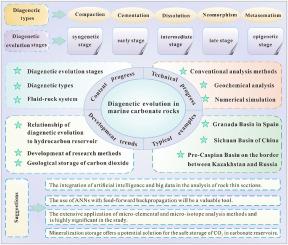
Oil and gas derived from marine carbonate rocks are critical energy resources worldwide. The diagenetic process plays a pivotal role in controlling reservoirs, which is essential for understanding reservoir genesis and enhancing oil and gas exploration. Considering the complexity of carbonate rock diagenesis, this review examines the diagenetic mechanisms and stages of marine carbonate rock reservoirs for the first time, with the aim of enhancing the understanding of reservoir evolution and improving oil and gas exploration. This review elucidates the significance of carbonate diagenesis, summarizes the stages of diagenesis, delineates the diagenetic evolution of various types of carbonate rocks, describes the technical methods employed to investigate diagenetic evolution, examines the factors affecting the reservoir, and discusses potential future developments. These findings indicate that compaction, cementation, dissolution, neomorphism, and metasomatism are the primary diagenesis of carbonate rocks. Diagenetic evolution is typically divided into syngenetic, early, intermediate, late, and epigenetic stages. This study employed a basin dynamics perspective to examine the fluid-rock interactions that drive diagenesis. Furthermore, it provided a summary of the diagenesis of microbial and cool-water carbonate rocks. The control of reservoirs through karstification, hydrothermal dissolution, dolomitization, and cementation is dual. In the future, artificial intelligence and artificial neural networks will play significant roles in identifying thin sections and diagenesis. The integration of micro-elements, micro-isotopes, and various techniques is highly significant for studying the diagenetic evolution of carbonate rocks. The storage of CO2 in marine carbonates is considered a future development trend. This study offers a theoretical basis for the exploration and development of marine carbonates by examining advancements in the diagenetic evolution of marine carbonates, as well as the theoretical and technological aspects.
期刊介绍:
Marine and Petroleum Geology is the pre-eminent international forum for the exchange of multidisciplinary concepts, interpretations and techniques for all concerned with marine and petroleum geology in industry, government and academia. Rapid bimonthly publication allows early communications of papers or short communications to the geoscience community.
Marine and Petroleum Geology is essential reading for geologists, geophysicists and explorationists in industry, government and academia working in the following areas: marine geology; basin analysis and evaluation; organic geochemistry; reserve/resource estimation; seismic stratigraphy; thermal models of basic evolution; sedimentary geology; continental margins; geophysical interpretation; structural geology/tectonics; formation evaluation techniques; well logging.




 京公网安备 11010802042870号
京ICP备2023020795号-1
京公网安备 11010802042870号
京ICP备2023020795号-1

 分享
分享
 求助内容:
求助内容: 应助结果提醒方式:
 扫码关注我们
