Martin van der Plas , Krijn B. Trimbos , Thijs Bosker , Martina G. Vijver
{"title":"基于eDNA的方法推进生态毒理学:eDNA元条形码研究在评估压力诱导的水生(宏观)无脊椎动物群落组成方面的见解和最佳实践","authors":"Martin van der Plas , Krijn B. Trimbos , Thijs Bosker , Martina G. Vijver","doi":"10.1016/j.ecolind.2025.113269","DOIUrl":null,"url":null,"abstract":"<div><div>Aquatic ecosystems are confronted with increasing levels of anthropogenic stress, prompting the need for rapid and reliable biomonitoring methods to allow ecological risk assessment and start science-based mitigation activities. Morphology-based sampling techniques have been the cornerstone of such evaluations and can be utilized to assess the impacts of anthropogenic stress on aquatic systems. However, environmental DNA (eDNA) has emerged as a promising alternative tool for biomonitoring. Macroinvertebrate species observations are pivotal in ecotoxicological studies and water quality assessment, nonetheless, few studies have implemented eDNA methods for stress-induced macroinvertebrate community composition assessment. To this end, we performed a systematic literature review, focusing on studies that analyzed the effects of anthropogenic stressors on macroinvertebrate community composition through eDNA metabarcoding. Our study aimed to 1) assess the relation between eDNA and morphology-based data for the assessment of stress-induced macroinvertebrate community composition; 2) evaluate the current quality of stress-induced macroinvertebrate community composition eDNA studies, and 3) formulate a minimum reporting and best practices guide for future studies. Our findings reveal that eDNA-derived beta diversity serves as a robust and sensitive indicator, outperforming morphology-based observations for determining beta diversity, making it a strong tool for invertebrate community assessment within ecotoxicology. However, we observed little consistency in applied methodology and reporting among the included studies, even though standardization is desired to increase the reproducibility and reliability of scientific research. To this end, we propose minimum reporting standards and a best practice guide for future studies, which will allow a wider and more systematic integration of eDNA metabarcoding to assess stress-induced (macro-) invertebrate community composition.</div></div>","PeriodicalId":11459,"journal":{"name":"Ecological Indicators","volume":"172 ","pages":"Article 113269"},"PeriodicalIF":7.0000,"publicationDate":"2025-03-01","publicationTypes":"Journal Article","fieldsOfStudy":null,"isOpenAccess":false,"openAccessPdf":"","citationCount":"0","resultStr":"{\"title\":\"eDNA-based approaches advance ecotoxicology: Insights and best practices from eDNA metabarcoding studies in evaluating stress-induced aquatic (macro-) invertebrate community composition\",\"authors\":\"Martin van der Plas , Krijn B. Trimbos , Thijs Bosker , Martina G. Vijver\",\"doi\":\"10.1016/j.ecolind.2025.113269\",\"DOIUrl\":null,\"url\":null,\"abstract\":\"<div><div>Aquatic ecosystems are confronted with increasing levels of anthropogenic stress, prompting the need for rapid and reliable biomonitoring methods to allow ecological risk assessment and start science-based mitigation activities. Morphology-based sampling techniques have been the cornerstone of such evaluations and can be utilized to assess the impacts of anthropogenic stress on aquatic systems. However, environmental DNA (eDNA) has emerged as a promising alternative tool for biomonitoring. Macroinvertebrate species observations are pivotal in ecotoxicological studies and water quality assessment, nonetheless, few studies have implemented eDNA methods for stress-induced macroinvertebrate community composition assessment. To this end, we performed a systematic literature review, focusing on studies that analyzed the effects of anthropogenic stressors on macroinvertebrate community composition through eDNA metabarcoding. Our study aimed to 1) assess the relation between eDNA and morphology-based data for the assessment of stress-induced macroinvertebrate community composition; 2) evaluate the current quality of stress-induced macroinvertebrate community composition eDNA studies, and 3) formulate a minimum reporting and best practices guide for future studies. Our findings reveal that eDNA-derived beta diversity serves as a robust and sensitive indicator, outperforming morphology-based observations for determining beta diversity, making it a strong tool for invertebrate community assessment within ecotoxicology. However, we observed little consistency in applied methodology and reporting among the included studies, even though standardization is desired to increase the reproducibility and reliability of scientific research. To this end, we propose minimum reporting standards and a best practice guide for future studies, which will allow a wider and more systematic integration of eDNA metabarcoding to assess stress-induced (macro-) invertebrate community composition.</div></div>\",\"PeriodicalId\":11459,\"journal\":{\"name\":\"Ecological Indicators\",\"volume\":\"172 \",\"pages\":\"Article 113269\"},\"PeriodicalIF\":7.0000,\"publicationDate\":\"2025-03-01\",\"publicationTypes\":\"Journal Article\",\"fieldsOfStudy\":null,\"isOpenAccess\":false,\"openAccessPdf\":\"\",\"citationCount\":\"0\",\"resultStr\":null,\"platform\":\"Semanticscholar\",\"paperid\":null,\"PeriodicalName\":\"Ecological Indicators\",\"FirstCategoryId\":\"93\",\"ListUrlMain\":\"https://www.sciencedirect.com/science/article/pii/S1470160X25001980\",\"RegionNum\":2,\"RegionCategory\":\"环境科学与生态学\",\"ArticlePicture\":[],\"TitleCN\":null,\"AbstractTextCN\":null,\"PMCID\":null,\"EPubDate\":\"2025/2/28 0:00:00\",\"PubModel\":\"Epub\",\"JCR\":\"Q1\",\"JCRName\":\"ENVIRONMENTAL SCIENCES\",\"Score\":null,\"Total\":0}","platform":"Semanticscholar","paperid":null,"PeriodicalName":"Ecological Indicators","FirstCategoryId":"93","ListUrlMain":"https://www.sciencedirect.com/science/article/pii/S1470160X25001980","RegionNum":2,"RegionCategory":"环境科学与生态学","ArticlePicture":[],"TitleCN":null,"AbstractTextCN":null,"PMCID":null,"EPubDate":"2025/2/28 0:00:00","PubModel":"Epub","JCR":"Q1","JCRName":"ENVIRONMENTAL SCIENCES","Score":null,"Total":0}
eDNA-based approaches advance ecotoxicology: Insights and best practices from eDNA metabarcoding studies in evaluating stress-induced aquatic (macro-) invertebrate community composition
Aquatic ecosystems are confronted with increasing levels of anthropogenic stress, prompting the need for rapid and reliable biomonitoring methods to allow ecological risk assessment and start science-based mitigation activities. Morphology-based sampling techniques have been the cornerstone of such evaluations and can be utilized to assess the impacts of anthropogenic stress on aquatic systems. However, environmental DNA (eDNA) has emerged as a promising alternative tool for biomonitoring. Macroinvertebrate species observations are pivotal in ecotoxicological studies and water quality assessment, nonetheless, few studies have implemented eDNA methods for stress-induced macroinvertebrate community composition assessment. To this end, we performed a systematic literature review, focusing on studies that analyzed the effects of anthropogenic stressors on macroinvertebrate community composition through eDNA metabarcoding. Our study aimed to 1) assess the relation between eDNA and morphology-based data for the assessment of stress-induced macroinvertebrate community composition; 2) evaluate the current quality of stress-induced macroinvertebrate community composition eDNA studies, and 3) formulate a minimum reporting and best practices guide for future studies. Our findings reveal that eDNA-derived beta diversity serves as a robust and sensitive indicator, outperforming morphology-based observations for determining beta diversity, making it a strong tool for invertebrate community assessment within ecotoxicology. However, we observed little consistency in applied methodology and reporting among the included studies, even though standardization is desired to increase the reproducibility and reliability of scientific research. To this end, we propose minimum reporting standards and a best practice guide for future studies, which will allow a wider and more systematic integration of eDNA metabarcoding to assess stress-induced (macro-) invertebrate community composition.
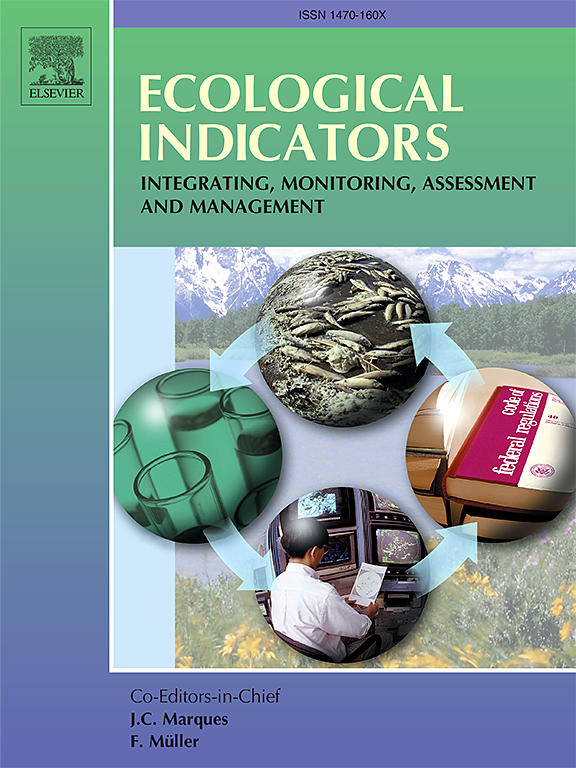
期刊介绍:
The ultimate aim of Ecological Indicators is to integrate the monitoring and assessment of ecological and environmental indicators with management practices. The journal provides a forum for the discussion of the applied scientific development and review of traditional indicator approaches as well as for theoretical, modelling and quantitative applications such as index development. Research into the following areas will be published.
• All aspects of ecological and environmental indicators and indices.
• New indicators, and new approaches and methods for indicator development, testing and use.
• Development and modelling of indices, e.g. application of indicator suites across multiple scales and resources.
• Analysis and research of resource, system- and scale-specific indicators.
• Methods for integration of social and other valuation metrics for the production of scientifically rigorous and politically-relevant assessments using indicator-based monitoring and assessment programs.
• How research indicators can be transformed into direct application for management purposes.
• Broader assessment objectives and methods, e.g. biodiversity, biological integrity, and sustainability, through the use of indicators.
• Resource-specific indicators such as landscape, agroecosystems, forests, wetlands, etc.





 京公网安备 11010802042870号
京ICP备2023020795号-1
京公网安备 11010802042870号
京ICP备2023020795号-1

 分享
分享
 求助内容:
求助内容: 应助结果提醒方式:
 扫码关注我们
