{"title":"大麻衍生的分层多孔碳阴极为先进的锌离子混合电容器提供了高能量存储","authors":"Quanxing Liao, Shenteng Wan, Yongdong Liu, Xiaohui Niu, Deyi Zhang, Hongxia Li, Kunjie Wang","doi":"10.1016/j.est.2025.115975","DOIUrl":null,"url":null,"abstract":"<div><div>Zinc-ion hybrid capacitors (ZIHCs) combining the advantages of secondary metal-ion batteries and supercapacitors, show promising application prospects in energy storage realm due to its intrinsic low cost, safety and scalable production. However, the low charge storage capability of carbon cathode does not match the high capacity of zinc anode, resulting in unsatisfied energy supply and poor cycling durability. The designing and tuning of carbon materials microstructure is one of the key breakthroughs for achieving high performance ZIHCs. Herein, a biomass porous carbon rich in oxygen functional groups (HRPC-X) was controllably prepared by pyrolysis of HEMP assisted with high temperature chemical activation. The features of high specific surface area, hierarchically porous structure and abundant oxygen-containing functional groups of HRPC-4 can not only provide abundant active sites and shorten ion/electron transfer distance but also improve the surface wettability and pseudocapacitance contribution. Hence, the as-prepared HRPC-4 demonstrates a superior capacitance performance in both KOH and Zn(CF<sub>3</sub>SO<sub>3</sub>)<sub>2</sub> aqueous electrolyte. Specifically, the as-assembled Zn//2 M Zn(CF<sub>3</sub>SO<sub>3</sub>)<sub>2</sub>//HRPC-4 ZIHC device delivers a high energy density of 168.8 W h kg<sup>−1</sup>, a power output of 45 kW kg<sup>−1</sup> and an excellent cycling stability with as high as 95.2 % of capacity retention after 10,000 cycles at 5 A g<sup>−1</sup>.</div></div>","PeriodicalId":15942,"journal":{"name":"Journal of energy storage","volume":"115 ","pages":"Article 115975"},"PeriodicalIF":8.9000,"publicationDate":"2025-04-15","publicationTypes":"Journal Article","fieldsOfStudy":null,"isOpenAccess":false,"openAccessPdf":"","citationCount":"0","resultStr":"{\"title\":\"Hemp-derived hierarchically porous carbon cathode enabling high energy storage for advanced zinc-ion hybrid capacitor\",\"authors\":\"Quanxing Liao, Shenteng Wan, Yongdong Liu, Xiaohui Niu, Deyi Zhang, Hongxia Li, Kunjie Wang\",\"doi\":\"10.1016/j.est.2025.115975\",\"DOIUrl\":null,\"url\":null,\"abstract\":\"<div><div>Zinc-ion hybrid capacitors (ZIHCs) combining the advantages of secondary metal-ion batteries and supercapacitors, show promising application prospects in energy storage realm due to its intrinsic low cost, safety and scalable production. However, the low charge storage capability of carbon cathode does not match the high capacity of zinc anode, resulting in unsatisfied energy supply and poor cycling durability. The designing and tuning of carbon materials microstructure is one of the key breakthroughs for achieving high performance ZIHCs. Herein, a biomass porous carbon rich in oxygen functional groups (HRPC-X) was controllably prepared by pyrolysis of HEMP assisted with high temperature chemical activation. The features of high specific surface area, hierarchically porous structure and abundant oxygen-containing functional groups of HRPC-4 can not only provide abundant active sites and shorten ion/electron transfer distance but also improve the surface wettability and pseudocapacitance contribution. Hence, the as-prepared HRPC-4 demonstrates a superior capacitance performance in both KOH and Zn(CF<sub>3</sub>SO<sub>3</sub>)<sub>2</sub> aqueous electrolyte. Specifically, the as-assembled Zn//2 M Zn(CF<sub>3</sub>SO<sub>3</sub>)<sub>2</sub>//HRPC-4 ZIHC device delivers a high energy density of 168.8 W h kg<sup>−1</sup>, a power output of 45 kW kg<sup>−1</sup> and an excellent cycling stability with as high as 95.2 % of capacity retention after 10,000 cycles at 5 A g<sup>−1</sup>.</div></div>\",\"PeriodicalId\":15942,\"journal\":{\"name\":\"Journal of energy storage\",\"volume\":\"115 \",\"pages\":\"Article 115975\"},\"PeriodicalIF\":8.9000,\"publicationDate\":\"2025-04-15\",\"publicationTypes\":\"Journal Article\",\"fieldsOfStudy\":null,\"isOpenAccess\":false,\"openAccessPdf\":\"\",\"citationCount\":\"0\",\"resultStr\":null,\"platform\":\"Semanticscholar\",\"paperid\":null,\"PeriodicalName\":\"Journal of energy storage\",\"FirstCategoryId\":\"5\",\"ListUrlMain\":\"https://www.sciencedirect.com/science/article/pii/S2352152X25006887\",\"RegionNum\":2,\"RegionCategory\":\"工程技术\",\"ArticlePicture\":[],\"TitleCN\":null,\"AbstractTextCN\":null,\"PMCID\":null,\"EPubDate\":\"2025/2/27 0:00:00\",\"PubModel\":\"Epub\",\"JCR\":\"Q1\",\"JCRName\":\"ENERGY & FUELS\",\"Score\":null,\"Total\":0}","platform":"Semanticscholar","paperid":null,"PeriodicalName":"Journal of energy storage","FirstCategoryId":"5","ListUrlMain":"https://www.sciencedirect.com/science/article/pii/S2352152X25006887","RegionNum":2,"RegionCategory":"工程技术","ArticlePicture":[],"TitleCN":null,"AbstractTextCN":null,"PMCID":null,"EPubDate":"2025/2/27 0:00:00","PubModel":"Epub","JCR":"Q1","JCRName":"ENERGY & FUELS","Score":null,"Total":0}
引用次数: 0
摘要
锌离子混合电容器结合了二次金属离子电池和超级电容器的优点,具有成本低、安全、可规模化生产等优点,在储能领域具有广阔的应用前景。然而,碳阴极的低电荷存储能力与锌阳极的高容量不匹配,导致能量供应不满意,循环耐久性差。碳材料微观结构的设计和调整是实现高性能zihc的关键突破之一。在高温化学活化的辅助下,通过HEMP热解可控制备了一种富氧官能团生物质多孔碳(HRPC-X)。HRPC-4具有高比表面积、分层多孔结构和丰富的含氧官能团等特点,不仅可以提供丰富的活性位点,缩短离子/电子转移距离,还可以提高表面润湿性和赝电容贡献。因此,制备的HRPC-4在KOH和Zn(CF3SO3)2水溶液中均表现出优异的电容性能。具体而言,组装后的Zn//2 M Zn(CF3SO3)2//HRPC-4 ZIHC器件具有168.8 W h kg−1的高能量密度,45 kW kg−1的输出功率和出色的循环稳定性,在5 a g−1下循环10,000次后容量保持率高达95.2%。
Hemp-derived hierarchically porous carbon cathode enabling high energy storage for advanced zinc-ion hybrid capacitor
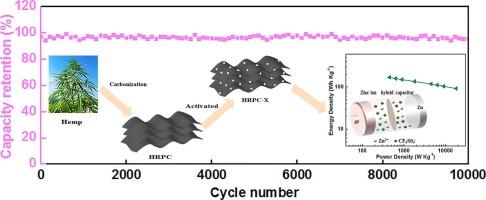
Zinc-ion hybrid capacitors (ZIHCs) combining the advantages of secondary metal-ion batteries and supercapacitors, show promising application prospects in energy storage realm due to its intrinsic low cost, safety and scalable production. However, the low charge storage capability of carbon cathode does not match the high capacity of zinc anode, resulting in unsatisfied energy supply and poor cycling durability. The designing and tuning of carbon materials microstructure is one of the key breakthroughs for achieving high performance ZIHCs. Herein, a biomass porous carbon rich in oxygen functional groups (HRPC-X) was controllably prepared by pyrolysis of HEMP assisted with high temperature chemical activation. The features of high specific surface area, hierarchically porous structure and abundant oxygen-containing functional groups of HRPC-4 can not only provide abundant active sites and shorten ion/electron transfer distance but also improve the surface wettability and pseudocapacitance contribution. Hence, the as-prepared HRPC-4 demonstrates a superior capacitance performance in both KOH and Zn(CF3SO3)2 aqueous electrolyte. Specifically, the as-assembled Zn//2 M Zn(CF3SO3)2//HRPC-4 ZIHC device delivers a high energy density of 168.8 W h kg−1, a power output of 45 kW kg−1 and an excellent cycling stability with as high as 95.2 % of capacity retention after 10,000 cycles at 5 A g−1.
期刊介绍:
Journal of energy storage focusses on all aspects of energy storage, in particular systems integration, electric grid integration, modelling and analysis, novel energy storage technologies, sizing and management strategies, business models for operation of storage systems and energy storage developments worldwide.




 京公网安备 11010802042870号
京ICP备2023020795号-1
京公网安备 11010802042870号
京ICP备2023020795号-1

 分享
分享
 求助内容:
求助内容: 应助结果提醒方式:
 扫码关注我们
