Zhengduo Zhao , Peng Liu , Quangui Li , Baisheng Nie , Yulong Zhao , Jibin Song , Guangjie Bao , Hengyi He , Wei Liu , Liang Sun
{"title":"利用高功率超声激励提高煤层气采收率:纳米-微-工程尺度研究","authors":"Zhengduo Zhao , Peng Liu , Quangui Li , Baisheng Nie , Yulong Zhao , Jibin Song , Guangjie Bao , Hengyi He , Wei Liu , Liang Sun","doi":"10.1016/j.energy.2025.135274","DOIUrl":null,"url":null,"abstract":"<div><div>High-power ultrasonic excitation can dilate sorptive/diffusive pores in coal, and promote coalbed methane (CBM) deliverability and recoverable reserves. This paper conducted multi-scale research, including nano/micro-scale pore alteration detection, gas permeability evolution tests and engineering-scale ultrasonic-excited CBM extraction. The results show that the maximum nitrogen sorption capacity increased from 2.3140 cm<sup>3</sup>/g and 8.6910 cm<sup>3</sup>/g to 3.5424 cm<sup>3</sup>/g and 12.3527 cm<sup>3</sup>/g, marking improvements of 53.09% and 42.13% for the two tested coals respectively after ultrasonic excitation. The specific surface area and pore volume within the mesopore size range (2–50 nm) significantly increased, benefiting gas desorption and diffusion. Gas permeability improved by 3.58–7.50 times, enhancing gas transport in fractures and the coal matrix. A miniaturized 18 kW ultrasonic transducer was developed and used for segmented stimulation in long water-filled boreholes. The borehole gas drainage data were monitored to evaluate coalseam remodeling, and it demonstrates that the gas concentration increased by 101.82%–119.90%, and the gas flowrate increased by 89.25%–331.32% in boreholes within 30 days after ultrasonic operation. This work marks the first successful field-scale implementation of ultrasonic technology for CBM recovery, revealing its transformative potential for CBM reservoir stimulation and establishing a foundational framework for advancing this innovative methodology.</div></div>","PeriodicalId":11647,"journal":{"name":"Energy","volume":"320 ","pages":"Article 135274"},"PeriodicalIF":10.1000,"publicationDate":"2025-04-01","publicationTypes":"Journal Article","fieldsOfStudy":null,"isOpenAccess":false,"openAccessPdf":"","citationCount":"0","resultStr":"{\"title\":\"Enhancing coalbed methane recovery using high power ultrasonic excitation: A nano-micro -to-engineering scale study\",\"authors\":\"Zhengduo Zhao , Peng Liu , Quangui Li , Baisheng Nie , Yulong Zhao , Jibin Song , Guangjie Bao , Hengyi He , Wei Liu , Liang Sun\",\"doi\":\"10.1016/j.energy.2025.135274\",\"DOIUrl\":null,\"url\":null,\"abstract\":\"<div><div>High-power ultrasonic excitation can dilate sorptive/diffusive pores in coal, and promote coalbed methane (CBM) deliverability and recoverable reserves. This paper conducted multi-scale research, including nano/micro-scale pore alteration detection, gas permeability evolution tests and engineering-scale ultrasonic-excited CBM extraction. The results show that the maximum nitrogen sorption capacity increased from 2.3140 cm<sup>3</sup>/g and 8.6910 cm<sup>3</sup>/g to 3.5424 cm<sup>3</sup>/g and 12.3527 cm<sup>3</sup>/g, marking improvements of 53.09% and 42.13% for the two tested coals respectively after ultrasonic excitation. The specific surface area and pore volume within the mesopore size range (2–50 nm) significantly increased, benefiting gas desorption and diffusion. Gas permeability improved by 3.58–7.50 times, enhancing gas transport in fractures and the coal matrix. A miniaturized 18 kW ultrasonic transducer was developed and used for segmented stimulation in long water-filled boreholes. The borehole gas drainage data were monitored to evaluate coalseam remodeling, and it demonstrates that the gas concentration increased by 101.82%–119.90%, and the gas flowrate increased by 89.25%–331.32% in boreholes within 30 days after ultrasonic operation. This work marks the first successful field-scale implementation of ultrasonic technology for CBM recovery, revealing its transformative potential for CBM reservoir stimulation and establishing a foundational framework for advancing this innovative methodology.</div></div>\",\"PeriodicalId\":11647,\"journal\":{\"name\":\"Energy\",\"volume\":\"320 \",\"pages\":\"Article 135274\"},\"PeriodicalIF\":10.1000,\"publicationDate\":\"2025-04-01\",\"publicationTypes\":\"Journal Article\",\"fieldsOfStudy\":null,\"isOpenAccess\":false,\"openAccessPdf\":\"\",\"citationCount\":\"0\",\"resultStr\":null,\"platform\":\"Semanticscholar\",\"paperid\":null,\"PeriodicalName\":\"Energy\",\"FirstCategoryId\":\"5\",\"ListUrlMain\":\"https://www.sciencedirect.com/science/article/pii/S0360544225009168\",\"RegionNum\":1,\"RegionCategory\":\"工程技术\",\"ArticlePicture\":[],\"TitleCN\":null,\"AbstractTextCN\":null,\"PMCID\":null,\"EPubDate\":\"2025/2/25 0:00:00\",\"PubModel\":\"Epub\",\"JCR\":\"Q1\",\"JCRName\":\"ENERGY & FUELS\",\"Score\":null,\"Total\":0}","platform":"Semanticscholar","paperid":null,"PeriodicalName":"Energy","FirstCategoryId":"5","ListUrlMain":"https://www.sciencedirect.com/science/article/pii/S0360544225009168","RegionNum":1,"RegionCategory":"工程技术","ArticlePicture":[],"TitleCN":null,"AbstractTextCN":null,"PMCID":null,"EPubDate":"2025/2/25 0:00:00","PubModel":"Epub","JCR":"Q1","JCRName":"ENERGY & FUELS","Score":null,"Total":0}
Enhancing coalbed methane recovery using high power ultrasonic excitation: A nano-micro -to-engineering scale study
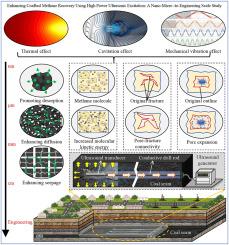
High-power ultrasonic excitation can dilate sorptive/diffusive pores in coal, and promote coalbed methane (CBM) deliverability and recoverable reserves. This paper conducted multi-scale research, including nano/micro-scale pore alteration detection, gas permeability evolution tests and engineering-scale ultrasonic-excited CBM extraction. The results show that the maximum nitrogen sorption capacity increased from 2.3140 cm3/g and 8.6910 cm3/g to 3.5424 cm3/g and 12.3527 cm3/g, marking improvements of 53.09% and 42.13% for the two tested coals respectively after ultrasonic excitation. The specific surface area and pore volume within the mesopore size range (2–50 nm) significantly increased, benefiting gas desorption and diffusion. Gas permeability improved by 3.58–7.50 times, enhancing gas transport in fractures and the coal matrix. A miniaturized 18 kW ultrasonic transducer was developed and used for segmented stimulation in long water-filled boreholes. The borehole gas drainage data were monitored to evaluate coalseam remodeling, and it demonstrates that the gas concentration increased by 101.82%–119.90%, and the gas flowrate increased by 89.25%–331.32% in boreholes within 30 days after ultrasonic operation. This work marks the first successful field-scale implementation of ultrasonic technology for CBM recovery, revealing its transformative potential for CBM reservoir stimulation and establishing a foundational framework for advancing this innovative methodology.
期刊介绍:
Energy is a multidisciplinary, international journal that publishes research and analysis in the field of energy engineering. Our aim is to become a leading peer-reviewed platform and a trusted source of information for energy-related topics.
The journal covers a range of areas including mechanical engineering, thermal sciences, and energy analysis. We are particularly interested in research on energy modelling, prediction, integrated energy systems, planning, and management.
Additionally, we welcome papers on energy conservation, efficiency, biomass and bioenergy, renewable energy, electricity supply and demand, energy storage, buildings, and economic and policy issues. These topics should align with our broader multidisciplinary focus.




 京公网安备 11010802042870号
京ICP备2023020795号-1
京公网安备 11010802042870号
京ICP备2023020795号-1

 分享
分享
 求助内容:
求助内容: 应助结果提醒方式:
 扫码关注我们
