Dr. Elmehdi Fraj, Dr. Maryam Hassiba, Dr. Haytham Bouammali, Dr. Mohammed Merzouki, Dr. Chaymae Bourhou, Prof. Susu M. Zughaier, Prof. Dr. Allal Challioui, Prof. Dr. Rachid Touzani, Prof. Dr. Abderrahim Bouali, Prof. Dr. Boufelja Bouammali
{"title":"新型黄酮衍生物的设计、合成及体外和硅内抗炎评价","authors":"Dr. Elmehdi Fraj, Dr. Maryam Hassiba, Dr. Haytham Bouammali, Dr. Mohammed Merzouki, Dr. Chaymae Bourhou, Prof. Susu M. Zughaier, Prof. Dr. Allal Challioui, Prof. Dr. Rachid Touzani, Prof. Dr. Abderrahim Bouali, Prof. Dr. Boufelja Bouammali","doi":"10.1002/slct.202405663","DOIUrl":null,"url":null,"abstract":"<p>A series of flavone derivatives (4–6) were synthesized via cyclization of 2′ hydroxychalcones 3 into flavonols 4 using the Algar–Flynn–Oyamada reaction. Flavonols 4 were then <i>O</i>-cyanomethylated to flavones 5, followed by click coupling to obtain flavone-tetrazole derivatives 6. The inhibitory ability of synthesized compounds on the production of pro-inflammatory mediators (nitric oxide and interleukin-1β) was also investigated. From the obtained results, it appears that only products <b>3b</b>, <b>5c</b>, <b>6a</b>, and <b>6b</b> at concentrations lower than 56.8 µg/mL have inhibitory ability on the production of NO from lipopolysaccharide-activated RAW 264.7 cells. In contrast, the other compounds, particularly derivatives <b>3c</b>, <b>4b-c</b>, and <b>5a-b</b>, exhibit pro-inflammatory activity even at low concentrations. For IL-1α release from THP-1 cells induced with LPS, flavones bearing the <i>O</i>-cyanopropyl group (5a-c) significantly lowered the production of this pro inflammatory mediator with the concentration lower than 32 µg/mL. The significant interactions of compound <b>5a-c</b> with the caspase-1 protein shown by the molecular docking consolidated the inhibitory activity of these <i>O</i>-cyanopropyl flavones. Therefore, these results suggest that compounds 5a-c can represent a useful starting point for the development of new treatments of the inflammatory disease.</p>","PeriodicalId":146,"journal":{"name":"ChemistrySelect","volume":"10 9","pages":""},"PeriodicalIF":2.0000,"publicationDate":"2025-02-27","publicationTypes":"Journal Article","fieldsOfStudy":null,"isOpenAccess":false,"openAccessPdf":"","citationCount":"0","resultStr":"{\"title\":\"Design, Synthesis, and Anti-Inflammatory Evaluation In Vitro and In Silico of Novel Flavone Derivatives\",\"authors\":\"Dr. Elmehdi Fraj, Dr. Maryam Hassiba, Dr. Haytham Bouammali, Dr. Mohammed Merzouki, Dr. Chaymae Bourhou, Prof. Susu M. Zughaier, Prof. Dr. Allal Challioui, Prof. Dr. Rachid Touzani, Prof. Dr. Abderrahim Bouali, Prof. Dr. Boufelja Bouammali\",\"doi\":\"10.1002/slct.202405663\",\"DOIUrl\":null,\"url\":null,\"abstract\":\"<p>A series of flavone derivatives (4–6) were synthesized via cyclization of 2′ hydroxychalcones 3 into flavonols 4 using the Algar–Flynn–Oyamada reaction. Flavonols 4 were then <i>O</i>-cyanomethylated to flavones 5, followed by click coupling to obtain flavone-tetrazole derivatives 6. The inhibitory ability of synthesized compounds on the production of pro-inflammatory mediators (nitric oxide and interleukin-1β) was also investigated. From the obtained results, it appears that only products <b>3b</b>, <b>5c</b>, <b>6a</b>, and <b>6b</b> at concentrations lower than 56.8 µg/mL have inhibitory ability on the production of NO from lipopolysaccharide-activated RAW 264.7 cells. In contrast, the other compounds, particularly derivatives <b>3c</b>, <b>4b-c</b>, and <b>5a-b</b>, exhibit pro-inflammatory activity even at low concentrations. For IL-1α release from THP-1 cells induced with LPS, flavones bearing the <i>O</i>-cyanopropyl group (5a-c) significantly lowered the production of this pro inflammatory mediator with the concentration lower than 32 µg/mL. The significant interactions of compound <b>5a-c</b> with the caspase-1 protein shown by the molecular docking consolidated the inhibitory activity of these <i>O</i>-cyanopropyl flavones. Therefore, these results suggest that compounds 5a-c can represent a useful starting point for the development of new treatments of the inflammatory disease.</p>\",\"PeriodicalId\":146,\"journal\":{\"name\":\"ChemistrySelect\",\"volume\":\"10 9\",\"pages\":\"\"},\"PeriodicalIF\":2.0000,\"publicationDate\":\"2025-02-27\",\"publicationTypes\":\"Journal Article\",\"fieldsOfStudy\":null,\"isOpenAccess\":false,\"openAccessPdf\":\"\",\"citationCount\":\"0\",\"resultStr\":null,\"platform\":\"Semanticscholar\",\"paperid\":null,\"PeriodicalName\":\"ChemistrySelect\",\"FirstCategoryId\":\"92\",\"ListUrlMain\":\"https://chemistry-europe.onlinelibrary.wiley.com/doi/10.1002/slct.202405663\",\"RegionNum\":4,\"RegionCategory\":\"化学\",\"ArticlePicture\":[],\"TitleCN\":null,\"AbstractTextCN\":null,\"PMCID\":null,\"EPubDate\":\"\",\"PubModel\":\"\",\"JCR\":\"Q3\",\"JCRName\":\"CHEMISTRY, MULTIDISCIPLINARY\",\"Score\":null,\"Total\":0}","platform":"Semanticscholar","paperid":null,"PeriodicalName":"ChemistrySelect","FirstCategoryId":"92","ListUrlMain":"https://chemistry-europe.onlinelibrary.wiley.com/doi/10.1002/slct.202405663","RegionNum":4,"RegionCategory":"化学","ArticlePicture":[],"TitleCN":null,"AbstractTextCN":null,"PMCID":null,"EPubDate":"","PubModel":"","JCR":"Q3","JCRName":"CHEMISTRY, MULTIDISCIPLINARY","Score":null,"Total":0}
Design, Synthesis, and Anti-Inflammatory Evaluation In Vitro and In Silico of Novel Flavone Derivatives
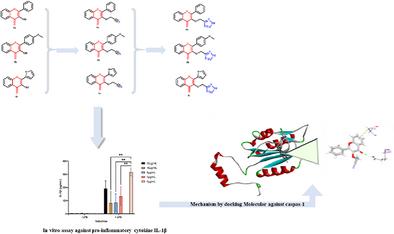
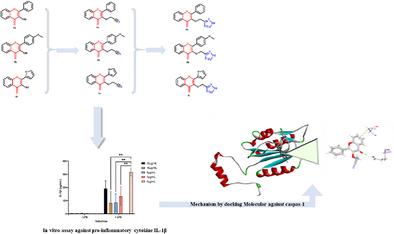
A series of flavone derivatives (4–6) were synthesized via cyclization of 2′ hydroxychalcones 3 into flavonols 4 using the Algar–Flynn–Oyamada reaction. Flavonols 4 were then O-cyanomethylated to flavones 5, followed by click coupling to obtain flavone-tetrazole derivatives 6. The inhibitory ability of synthesized compounds on the production of pro-inflammatory mediators (nitric oxide and interleukin-1β) was also investigated. From the obtained results, it appears that only products 3b, 5c, 6a, and 6b at concentrations lower than 56.8 µg/mL have inhibitory ability on the production of NO from lipopolysaccharide-activated RAW 264.7 cells. In contrast, the other compounds, particularly derivatives 3c, 4b-c, and 5a-b, exhibit pro-inflammatory activity even at low concentrations. For IL-1α release from THP-1 cells induced with LPS, flavones bearing the O-cyanopropyl group (5a-c) significantly lowered the production of this pro inflammatory mediator with the concentration lower than 32 µg/mL. The significant interactions of compound 5a-c with the caspase-1 protein shown by the molecular docking consolidated the inhibitory activity of these O-cyanopropyl flavones. Therefore, these results suggest that compounds 5a-c can represent a useful starting point for the development of new treatments of the inflammatory disease.
期刊介绍:
ChemistrySelect is the latest journal from ChemPubSoc Europe and Wiley-VCH. It offers researchers a quality society-owned journal in which to publish their work in all areas of chemistry. Manuscripts are evaluated by active researchers to ensure they add meaningfully to the scientific literature, and those accepted are processed quickly to ensure rapid online publication.






 京公网安备 11010802042870号
京ICP备2023020795号-1
京公网安备 11010802042870号
京ICP备2023020795号-1

 分享
分享
 求助内容:
求助内容: 应助结果提醒方式:
 扫码关注我们
