Brian R. Greene, Leia M. Otterstatter, Scott T. Salesky
{"title":"无人飞机系统对对流边界层的测量有多大的代表性?","authors":"Brian R. Greene, Leia M. Otterstatter, Scott T. Salesky","doi":"10.1029/2024GL114291","DOIUrl":null,"url":null,"abstract":"<p>Uncrewed aircraft systems (UAS) demonstrate significant potential for filling data gaps in the atmospheric boundary layer. However, the extent to which UAS observations—typically vertical profiles taken over 15 min—are representative of the boundary layer as a whole remains poorly characterized. Using large eddy simulations (LES) of the daytime convective boundary layer (CBL), we quantify random errors in UAS measurements that occur due to insufficient statistical convergence of the time average to the true ensemble mean. Random errors in first-order moments increase as the CBL becomes increasingly unstable, and are largest near the surface for most quantities. Errors are on the order of 2–6 m <span></span><math>\n <semantics>\n <mrow>\n <msup>\n <mi>s</mi>\n <mrow>\n <mo>−</mo>\n <mn>1</mn>\n </mrow>\n </msup>\n </mrow>\n <annotation> ${\\mathrm{s}}^{-1}$</annotation>\n </semantics></math> for wind speed, 15–60<span></span><math>\n <semantics>\n <mrow>\n <mo>°</mo>\n </mrow>\n <annotation> ${}^{\\circ}$</annotation>\n </semantics></math> for wind direction, 0.2–3 K for potential temperature, and 0.1–1 g <span></span><math>\n <semantics>\n <mrow>\n <msup>\n <mtext>kg</mtext>\n <mrow>\n <mo>−</mo>\n <mn>1</mn>\n </mrow>\n </msup>\n </mrow>\n <annotation> ${\\text{kg}}^{-1}$</annotation>\n </semantics></math> for specific humidity, with errors in turbulent fluxes on the order of 50%–100%. Sampling strategies that mitigate random errors are discussed in light of our results.</p>","PeriodicalId":12523,"journal":{"name":"Geophysical Research Letters","volume":"52 5","pages":""},"PeriodicalIF":5.0000,"publicationDate":"2025-02-28","publicationTypes":"Journal Article","fieldsOfStudy":null,"isOpenAccess":false,"openAccessPdf":"https://onlinelibrary.wiley.com/doi/epdf/10.1029/2024GL114291","citationCount":"0","resultStr":"{\"title\":\"How Representative Are Uncrewed Aircraft System Measurements of the Convective Boundary Layer?\",\"authors\":\"Brian R. Greene, Leia M. Otterstatter, Scott T. Salesky\",\"doi\":\"10.1029/2024GL114291\",\"DOIUrl\":null,\"url\":null,\"abstract\":\"<p>Uncrewed aircraft systems (UAS) demonstrate significant potential for filling data gaps in the atmospheric boundary layer. However, the extent to which UAS observations—typically vertical profiles taken over 15 min—are representative of the boundary layer as a whole remains poorly characterized. Using large eddy simulations (LES) of the daytime convective boundary layer (CBL), we quantify random errors in UAS measurements that occur due to insufficient statistical convergence of the time average to the true ensemble mean. Random errors in first-order moments increase as the CBL becomes increasingly unstable, and are largest near the surface for most quantities. Errors are on the order of 2–6 m <span></span><math>\\n <semantics>\\n <mrow>\\n <msup>\\n <mi>s</mi>\\n <mrow>\\n <mo>−</mo>\\n <mn>1</mn>\\n </mrow>\\n </msup>\\n </mrow>\\n <annotation> ${\\\\mathrm{s}}^{-1}$</annotation>\\n </semantics></math> for wind speed, 15–60<span></span><math>\\n <semantics>\\n <mrow>\\n <mo>°</mo>\\n </mrow>\\n <annotation> ${}^{\\\\circ}$</annotation>\\n </semantics></math> for wind direction, 0.2–3 K for potential temperature, and 0.1–1 g <span></span><math>\\n <semantics>\\n <mrow>\\n <msup>\\n <mtext>kg</mtext>\\n <mrow>\\n <mo>−</mo>\\n <mn>1</mn>\\n </mrow>\\n </msup>\\n </mrow>\\n <annotation> ${\\\\text{kg}}^{-1}$</annotation>\\n </semantics></math> for specific humidity, with errors in turbulent fluxes on the order of 50%–100%. Sampling strategies that mitigate random errors are discussed in light of our results.</p>\",\"PeriodicalId\":12523,\"journal\":{\"name\":\"Geophysical Research Letters\",\"volume\":\"52 5\",\"pages\":\"\"},\"PeriodicalIF\":5.0000,\"publicationDate\":\"2025-02-28\",\"publicationTypes\":\"Journal Article\",\"fieldsOfStudy\":null,\"isOpenAccess\":false,\"openAccessPdf\":\"https://onlinelibrary.wiley.com/doi/epdf/10.1029/2024GL114291\",\"citationCount\":\"0\",\"resultStr\":null,\"platform\":\"Semanticscholar\",\"paperid\":null,\"PeriodicalName\":\"Geophysical Research Letters\",\"FirstCategoryId\":\"89\",\"ListUrlMain\":\"https://agupubs.onlinelibrary.wiley.com/doi/10.1029/2024GL114291\",\"RegionNum\":1,\"RegionCategory\":\"地球科学\",\"ArticlePicture\":[],\"TitleCN\":null,\"AbstractTextCN\":null,\"PMCID\":null,\"EPubDate\":\"\",\"PubModel\":\"\",\"JCR\":\"Q1\",\"JCRName\":\"GEOSCIENCES, MULTIDISCIPLINARY\",\"Score\":null,\"Total\":0}","platform":"Semanticscholar","paperid":null,"PeriodicalName":"Geophysical Research Letters","FirstCategoryId":"89","ListUrlMain":"https://agupubs.onlinelibrary.wiley.com/doi/10.1029/2024GL114291","RegionNum":1,"RegionCategory":"地球科学","ArticlePicture":[],"TitleCN":null,"AbstractTextCN":null,"PMCID":null,"EPubDate":"","PubModel":"","JCR":"Q1","JCRName":"GEOSCIENCES, MULTIDISCIPLINARY","Score":null,"Total":0}
引用次数: 0
摘要
无人驾驶飞机系统(UAS)在填补大气边界层的数据空白方面显示出巨大的潜力。然而,在多大程度上,UAS观测-通常是超过15分钟的垂直剖面-作为一个整体代表边界层的特征仍然很差。利用白天对流边界层(CBL)的大涡模拟(LES),我们量化了由于时间平均值与真实集合平均值的统计收敛不足而导致的UAS测量中的随机误差。随着CBL变得越来越不稳定,一阶矩的随机误差增加,并且在大多数量的表面附近最大。风速误差为2-6 m s−1 ${\ mathm {s}}^{-1}$,风向误差为15-60°${}^{\circ}$,势温为0.2-3 K,比湿度为0.1-1 g kg -1 ${\text{kg}}^{-1}$,湍流通量误差为50%-100%。根据我们的结果讨论了减轻随机误差的抽样策略。
How Representative Are Uncrewed Aircraft System Measurements of the Convective Boundary Layer?
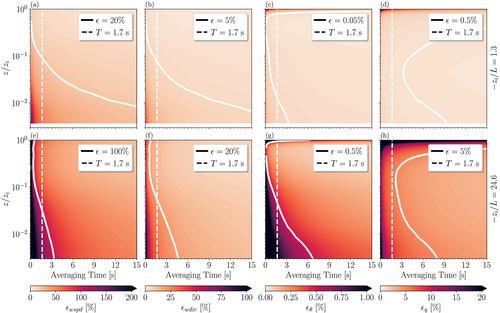
Uncrewed aircraft systems (UAS) demonstrate significant potential for filling data gaps in the atmospheric boundary layer. However, the extent to which UAS observations—typically vertical profiles taken over 15 min—are representative of the boundary layer as a whole remains poorly characterized. Using large eddy simulations (LES) of the daytime convective boundary layer (CBL), we quantify random errors in UAS measurements that occur due to insufficient statistical convergence of the time average to the true ensemble mean. Random errors in first-order moments increase as the CBL becomes increasingly unstable, and are largest near the surface for most quantities. Errors are on the order of 2–6 m for wind speed, 15–60 for wind direction, 0.2–3 K for potential temperature, and 0.1–1 g for specific humidity, with errors in turbulent fluxes on the order of 50%–100%. Sampling strategies that mitigate random errors are discussed in light of our results.
期刊介绍:
Geophysical Research Letters (GRL) publishes high-impact, innovative, and timely research on major scientific advances in all the major geoscience disciplines. Papers are communications-length articles and should have broad and immediate implications in their discipline or across the geosciences. GRLmaintains the fastest turn-around of all high-impact publications in the geosciences and works closely with authors to ensure broad visibility of top papers.






 京公网安备 11010802042870号
京ICP备2023020795号-1
京公网安备 11010802042870号
京ICP备2023020795号-1

 分享
分享
 求助内容:
求助内容: 应助结果提醒方式:
 扫码关注我们
