Latefa Ali Dardas, Obada Al-Leimon, Tracy Gladstone, Abd Arrahman Dabbas, Insaf Alammouri, Benjamin Van Voorhees
{"title":"约旦青少年数字抑郁预防项目的验证:随机对照试验中的文化适应和用户测试。","authors":"Latefa Ali Dardas, Obada Al-Leimon, Tracy Gladstone, Abd Arrahman Dabbas, Insaf Alammouri, Benjamin Van Voorhees","doi":"10.3389/fpsyt.2025.1529006","DOIUrl":null,"url":null,"abstract":"<p><strong>Purpose: </strong>Digital health interventions (DHIs) offer scalable solutions for improving mental health care access in underserved settings. This study is part of a multi-phased project aimed at adapting a depression prevention DHI for Jordanian adolescents. It evaluated the feasibility, cultural acceptability, and effectiveness of the translated and culturally adapted DHI, named Al-Khaizuran, with comparisons to school-based group CBT.</p><p><strong>Methods: </strong>A two-arm, single-blind randomized controlled trial with a mixed-methods design was conducted among 109 Jordanian adolescents aged 15-17 years experiencing mild to moderate depression. Participants were randomly assigned to either Al-Khaizuran DHI (n=55) or school-based group CBT (n=54). The adaptation of Al-Khaizuran DHI components was guided by the Ecological Validity Framework, while the procedural adaptation followed Barrera and Castro's Heuristic Framework, incorporating iterative refinement based on user feedback and contextual considerations.</p><p><strong>Results: </strong>Al-Khaizuran DHI was found to be a culturally relevant and acceptable intervention for Jordanian adolescent. Over half of the participants reported that the intervention was effective, empowering, and easy to use, with 51% expressing satisfaction and willingness to recommend it. However, challenges such as limited access to personal devices, privacy concerns, and participants' reliance on shared family resources emerged as significant barriers to consistent engagement. Participants showed a preference for individualized, blended interventions, with a significant reduction in support for group CBT. No significant difference was found in depression scores between the two groups. However, the Al-Khaizuran DHI group demonstrated higher post-intervention resilience scores (p=0.026). Beliefs about the effectiveness of the intervention significantly predicted behavioral intention (p=0.022), while perceived difficulty was a barrier to adherence (p=0.015).</p><p><strong>Conclusions: </strong>Al-Khaizuran DHI exemplifies the potential of culturally adapted digital interventions in bridging mental health care gaps in resource-limited settings. However, its effectiveness is contingent upon addressing barriers to access, enhancing program interactivity, and integrating hybrid support systems that combine digital tools with in-person guidance. Future implementations should consider strategies to actively engage parents to foster a supportive environment that promotes the well-being of adolescents.</p><p><strong>Clinical trial registration: </strong>https://doi.org/10.1186/ISRCTN14751844, identifier ISRCTN14751844.</p>","PeriodicalId":12605,"journal":{"name":"Frontiers in Psychiatry","volume":"16 ","pages":"1529006"},"PeriodicalIF":3.2000,"publicationDate":"2025-02-12","publicationTypes":"Journal Article","fieldsOfStudy":null,"isOpenAccess":false,"openAccessPdf":"https://www.ncbi.nlm.nih.gov/pmc/articles/PMC11860973/pdf/","citationCount":"0","resultStr":"{\"title\":\"Validating a digital depression prevention program for adolescents in Jordan: cultural adaptation and user testing in a randomized controlled trial.\",\"authors\":\"Latefa Ali Dardas, Obada Al-Leimon, Tracy Gladstone, Abd Arrahman Dabbas, Insaf Alammouri, Benjamin Van Voorhees\",\"doi\":\"10.3389/fpsyt.2025.1529006\",\"DOIUrl\":null,\"url\":null,\"abstract\":\"<p><strong>Purpose: </strong>Digital health interventions (DHIs) offer scalable solutions for improving mental health care access in underserved settings. This study is part of a multi-phased project aimed at adapting a depression prevention DHI for Jordanian adolescents. It evaluated the feasibility, cultural acceptability, and effectiveness of the translated and culturally adapted DHI, named Al-Khaizuran, with comparisons to school-based group CBT.</p><p><strong>Methods: </strong>A two-arm, single-blind randomized controlled trial with a mixed-methods design was conducted among 109 Jordanian adolescents aged 15-17 years experiencing mild to moderate depression. Participants were randomly assigned to either Al-Khaizuran DHI (n=55) or school-based group CBT (n=54). The adaptation of Al-Khaizuran DHI components was guided by the Ecological Validity Framework, while the procedural adaptation followed Barrera and Castro's Heuristic Framework, incorporating iterative refinement based on user feedback and contextual considerations.</p><p><strong>Results: </strong>Al-Khaizuran DHI was found to be a culturally relevant and acceptable intervention for Jordanian adolescent. Over half of the participants reported that the intervention was effective, empowering, and easy to use, with 51% expressing satisfaction and willingness to recommend it. However, challenges such as limited access to personal devices, privacy concerns, and participants' reliance on shared family resources emerged as significant barriers to consistent engagement. Participants showed a preference for individualized, blended interventions, with a significant reduction in support for group CBT. No significant difference was found in depression scores between the two groups. However, the Al-Khaizuran DHI group demonstrated higher post-intervention resilience scores (p=0.026). Beliefs about the effectiveness of the intervention significantly predicted behavioral intention (p=0.022), while perceived difficulty was a barrier to adherence (p=0.015).</p><p><strong>Conclusions: </strong>Al-Khaizuran DHI exemplifies the potential of culturally adapted digital interventions in bridging mental health care gaps in resource-limited settings. However, its effectiveness is contingent upon addressing barriers to access, enhancing program interactivity, and integrating hybrid support systems that combine digital tools with in-person guidance. Future implementations should consider strategies to actively engage parents to foster a supportive environment that promotes the well-being of adolescents.</p><p><strong>Clinical trial registration: </strong>https://doi.org/10.1186/ISRCTN14751844, identifier ISRCTN14751844.</p>\",\"PeriodicalId\":12605,\"journal\":{\"name\":\"Frontiers in Psychiatry\",\"volume\":\"16 \",\"pages\":\"1529006\"},\"PeriodicalIF\":3.2000,\"publicationDate\":\"2025-02-12\",\"publicationTypes\":\"Journal Article\",\"fieldsOfStudy\":null,\"isOpenAccess\":false,\"openAccessPdf\":\"https://www.ncbi.nlm.nih.gov/pmc/articles/PMC11860973/pdf/\",\"citationCount\":\"0\",\"resultStr\":null,\"platform\":\"Semanticscholar\",\"paperid\":null,\"PeriodicalName\":\"Frontiers in Psychiatry\",\"FirstCategoryId\":\"3\",\"ListUrlMain\":\"https://doi.org/10.3389/fpsyt.2025.1529006\",\"RegionNum\":3,\"RegionCategory\":\"医学\",\"ArticlePicture\":[],\"TitleCN\":null,\"AbstractTextCN\":null,\"PMCID\":null,\"EPubDate\":\"2025/1/1 0:00:00\",\"PubModel\":\"eCollection\",\"JCR\":\"Q2\",\"JCRName\":\"PSYCHIATRY\",\"Score\":null,\"Total\":0}","platform":"Semanticscholar","paperid":null,"PeriodicalName":"Frontiers in Psychiatry","FirstCategoryId":"3","ListUrlMain":"https://doi.org/10.3389/fpsyt.2025.1529006","RegionNum":3,"RegionCategory":"医学","ArticlePicture":[],"TitleCN":null,"AbstractTextCN":null,"PMCID":null,"EPubDate":"2025/1/1 0:00:00","PubModel":"eCollection","JCR":"Q2","JCRName":"PSYCHIATRY","Score":null,"Total":0}
Validating a digital depression prevention program for adolescents in Jordan: cultural adaptation and user testing in a randomized controlled trial.
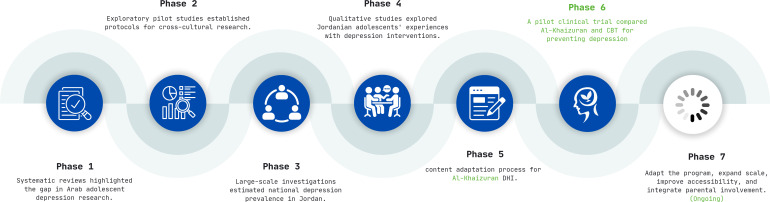
Purpose: Digital health interventions (DHIs) offer scalable solutions for improving mental health care access in underserved settings. This study is part of a multi-phased project aimed at adapting a depression prevention DHI for Jordanian adolescents. It evaluated the feasibility, cultural acceptability, and effectiveness of the translated and culturally adapted DHI, named Al-Khaizuran, with comparisons to school-based group CBT.
Methods: A two-arm, single-blind randomized controlled trial with a mixed-methods design was conducted among 109 Jordanian adolescents aged 15-17 years experiencing mild to moderate depression. Participants were randomly assigned to either Al-Khaizuran DHI (n=55) or school-based group CBT (n=54). The adaptation of Al-Khaizuran DHI components was guided by the Ecological Validity Framework, while the procedural adaptation followed Barrera and Castro's Heuristic Framework, incorporating iterative refinement based on user feedback and contextual considerations.
Results: Al-Khaizuran DHI was found to be a culturally relevant and acceptable intervention for Jordanian adolescent. Over half of the participants reported that the intervention was effective, empowering, and easy to use, with 51% expressing satisfaction and willingness to recommend it. However, challenges such as limited access to personal devices, privacy concerns, and participants' reliance on shared family resources emerged as significant barriers to consistent engagement. Participants showed a preference for individualized, blended interventions, with a significant reduction in support for group CBT. No significant difference was found in depression scores between the two groups. However, the Al-Khaizuran DHI group demonstrated higher post-intervention resilience scores (p=0.026). Beliefs about the effectiveness of the intervention significantly predicted behavioral intention (p=0.022), while perceived difficulty was a barrier to adherence (p=0.015).
Conclusions: Al-Khaizuran DHI exemplifies the potential of culturally adapted digital interventions in bridging mental health care gaps in resource-limited settings. However, its effectiveness is contingent upon addressing barriers to access, enhancing program interactivity, and integrating hybrid support systems that combine digital tools with in-person guidance. Future implementations should consider strategies to actively engage parents to foster a supportive environment that promotes the well-being of adolescents.
期刊介绍:
Frontiers in Psychiatry publishes rigorously peer-reviewed research across a wide spectrum of translational, basic and clinical research. Field Chief Editor Stefan Borgwardt at the University of Basel is supported by an outstanding Editorial Board of international researchers. This multidisciplinary open-access journal is at the forefront of disseminating and communicating scientific knowledge and impactful discoveries to researchers, academics, clinicians and the public worldwide.
The journal''s mission is to use translational approaches to improve therapeutic options for mental illness and consequently to improve patient treatment outcomes.






 京公网安备 11010802042870号
京ICP备2023020795号-1
京公网安备 11010802042870号
京ICP备2023020795号-1

 分享
分享
 求助内容:
求助内容: 应助结果提醒方式:
 扫码关注我们
