{"title":"编程CRISPRi以控制噬菌体T7的生命周期。","authors":"Tobias Bergmiller","doi":"10.3389/fmicb.2025.1497650","DOIUrl":null,"url":null,"abstract":"<p><p>Clustered Regularly Interspaced Short Palindromic Repeats interference (CRISPRi), based on catalytically dead Cas9 nuclease of <i>Streptococcus pyogenes</i>, is a programmable and highly flexible tool to investigate gene function and essentiality in bacteria due to its ability to block transcription elongation at nearly any desired DNA target. In this study, I assess how CRISPRi can be programmed to control the life cycle and infectivity of <i>Escherichia coli</i> bacteriophage T7, a highly virulent and obligatory lytic phage. This is achieved by blocking the expression of critical host-dependent promoters and genes that are required for T7 genome translocation and lifecycle progression. Specifically, I focus on the promoters within the non-coding internalisation signal region and the <i>E. coli</i>-recognised promoter <i>C</i> controlling T7 RNA polymerase (T7 RNAP) expression. Fluorescent reporter assays reveal that CRISPRi targeting of promoters in the internalisation signal is only moderately effective, whereas the downregulation of the phage's own T7 RNAP occurs very efficiently. Effects on the time to lysis were strongest when the left-most promoter on the leading end of the T7 genome or T7 RNAP was targeted. The stringency of the CRISPRi approach further improved when using multiplex sgRNAs to target multiple phage regions simultaneously, resulting in a 25% increase in the time to lysis and up to an 8-fold reduction in plaque size. Overall, this study expands dCas9-dependent CRISPRi as a flexible tool to non-invasively manipulate and probe the lifecycle and infectivity of otherwise native T7 phage.</p>","PeriodicalId":12466,"journal":{"name":"Frontiers in Microbiology","volume":"16 ","pages":"1497650"},"PeriodicalIF":4.0000,"publicationDate":"2025-02-12","publicationTypes":"Journal Article","fieldsOfStudy":null,"isOpenAccess":false,"openAccessPdf":"https://www.ncbi.nlm.nih.gov/pmc/articles/PMC11863960/pdf/","citationCount":"0","resultStr":"{\"title\":\"Programming CRISPRi to control the lifecycle of bacteriophage T7.\",\"authors\":\"Tobias Bergmiller\",\"doi\":\"10.3389/fmicb.2025.1497650\",\"DOIUrl\":null,\"url\":null,\"abstract\":\"<p><p>Clustered Regularly Interspaced Short Palindromic Repeats interference (CRISPRi), based on catalytically dead Cas9 nuclease of <i>Streptococcus pyogenes</i>, is a programmable and highly flexible tool to investigate gene function and essentiality in bacteria due to its ability to block transcription elongation at nearly any desired DNA target. In this study, I assess how CRISPRi can be programmed to control the life cycle and infectivity of <i>Escherichia coli</i> bacteriophage T7, a highly virulent and obligatory lytic phage. This is achieved by blocking the expression of critical host-dependent promoters and genes that are required for T7 genome translocation and lifecycle progression. Specifically, I focus on the promoters within the non-coding internalisation signal region and the <i>E. coli</i>-recognised promoter <i>C</i> controlling T7 RNA polymerase (T7 RNAP) expression. Fluorescent reporter assays reveal that CRISPRi targeting of promoters in the internalisation signal is only moderately effective, whereas the downregulation of the phage's own T7 RNAP occurs very efficiently. Effects on the time to lysis were strongest when the left-most promoter on the leading end of the T7 genome or T7 RNAP was targeted. The stringency of the CRISPRi approach further improved when using multiplex sgRNAs to target multiple phage regions simultaneously, resulting in a 25% increase in the time to lysis and up to an 8-fold reduction in plaque size. Overall, this study expands dCas9-dependent CRISPRi as a flexible tool to non-invasively manipulate and probe the lifecycle and infectivity of otherwise native T7 phage.</p>\",\"PeriodicalId\":12466,\"journal\":{\"name\":\"Frontiers in Microbiology\",\"volume\":\"16 \",\"pages\":\"1497650\"},\"PeriodicalIF\":4.0000,\"publicationDate\":\"2025-02-12\",\"publicationTypes\":\"Journal Article\",\"fieldsOfStudy\":null,\"isOpenAccess\":false,\"openAccessPdf\":\"https://www.ncbi.nlm.nih.gov/pmc/articles/PMC11863960/pdf/\",\"citationCount\":\"0\",\"resultStr\":null,\"platform\":\"Semanticscholar\",\"paperid\":null,\"PeriodicalName\":\"Frontiers in Microbiology\",\"FirstCategoryId\":\"99\",\"ListUrlMain\":\"https://doi.org/10.3389/fmicb.2025.1497650\",\"RegionNum\":2,\"RegionCategory\":\"生物学\",\"ArticlePicture\":[],\"TitleCN\":null,\"AbstractTextCN\":null,\"PMCID\":null,\"EPubDate\":\"2025/1/1 0:00:00\",\"PubModel\":\"eCollection\",\"JCR\":\"Q2\",\"JCRName\":\"MICROBIOLOGY\",\"Score\":null,\"Total\":0}","platform":"Semanticscholar","paperid":null,"PeriodicalName":"Frontiers in Microbiology","FirstCategoryId":"99","ListUrlMain":"https://doi.org/10.3389/fmicb.2025.1497650","RegionNum":2,"RegionCategory":"生物学","ArticlePicture":[],"TitleCN":null,"AbstractTextCN":null,"PMCID":null,"EPubDate":"2025/1/1 0:00:00","PubModel":"eCollection","JCR":"Q2","JCRName":"MICROBIOLOGY","Score":null,"Total":0}
Programming CRISPRi to control the lifecycle of bacteriophage T7.
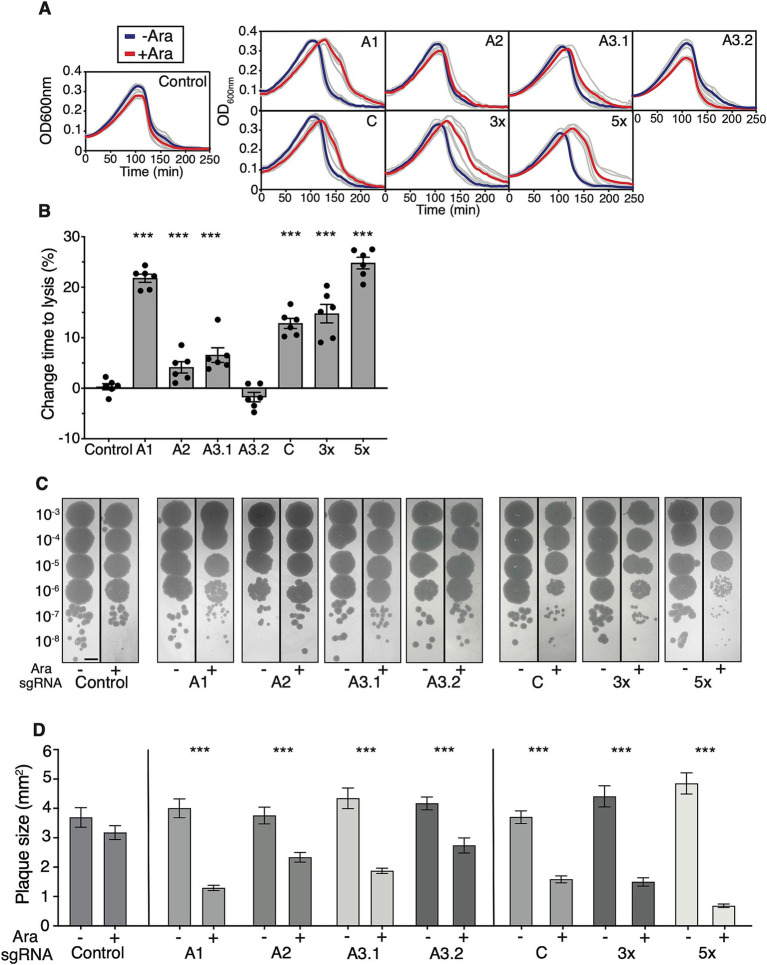
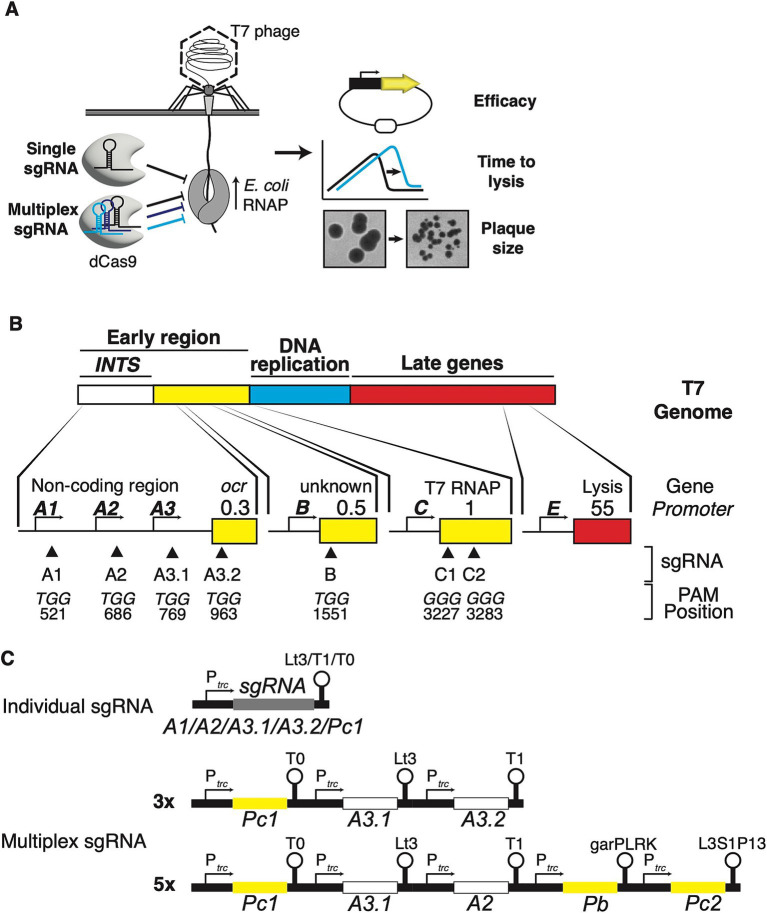
Clustered Regularly Interspaced Short Palindromic Repeats interference (CRISPRi), based on catalytically dead Cas9 nuclease of Streptococcus pyogenes, is a programmable and highly flexible tool to investigate gene function and essentiality in bacteria due to its ability to block transcription elongation at nearly any desired DNA target. In this study, I assess how CRISPRi can be programmed to control the life cycle and infectivity of Escherichia coli bacteriophage T7, a highly virulent and obligatory lytic phage. This is achieved by blocking the expression of critical host-dependent promoters and genes that are required for T7 genome translocation and lifecycle progression. Specifically, I focus on the promoters within the non-coding internalisation signal region and the E. coli-recognised promoter C controlling T7 RNA polymerase (T7 RNAP) expression. Fluorescent reporter assays reveal that CRISPRi targeting of promoters in the internalisation signal is only moderately effective, whereas the downregulation of the phage's own T7 RNAP occurs very efficiently. Effects on the time to lysis were strongest when the left-most promoter on the leading end of the T7 genome or T7 RNAP was targeted. The stringency of the CRISPRi approach further improved when using multiplex sgRNAs to target multiple phage regions simultaneously, resulting in a 25% increase in the time to lysis and up to an 8-fold reduction in plaque size. Overall, this study expands dCas9-dependent CRISPRi as a flexible tool to non-invasively manipulate and probe the lifecycle and infectivity of otherwise native T7 phage.
期刊介绍:
Frontiers in Microbiology is a leading journal in its field, publishing rigorously peer-reviewed research across the entire spectrum of microbiology. Field Chief Editor Martin G. Klotz at Washington State University is supported by an outstanding Editorial Board of international researchers. This multidisciplinary open-access journal is at the forefront of disseminating and communicating scientific knowledge and impactful discoveries to researchers, academics, clinicians and the public worldwide.





 京公网安备 11010802042870号
京ICP备2023020795号-1
京公网安备 11010802042870号
京ICP备2023020795号-1

 分享
分享
 求助内容:
求助内容: 应助结果提醒方式:
 扫码关注我们
