Houda Yasmine Ali Moussa, Kyung Chul Shin, Yongsoo Park
{"title":"Ca2+/钙调蛋白和蛋白激酶C (PKC)通过揭露PIP2逆转囊泡融合阻滞。","authors":"Houda Yasmine Ali Moussa, Kyung Chul Shin, Yongsoo Park","doi":"10.1126/sciadv.adr9859","DOIUrl":null,"url":null,"abstract":"<p><p>Vesicle fusion is a key process in cellular communication and membrane trafficking. Soluble <i>N</i>-ethylmaleimide-sensitive factor attachment protein receptor (SNARE) proteins drive vesicle fusion, and SNARE proteins seem to be partially assembled before fusion occurs. However, the molecular mechanisms of the vesicle fusion arrest and how vesicle fusion is rescued from the arrest remain not fully understood. We have previously shown that as a lipid catalyst, phosphatidylinositol 4,5-bisphosphate (PIP2) electrostatically triggers vesicle fusion by lowering the hydration energy, and masking PIP2 arrests vesicle fusion in a state of the partial SNARE assembly. In this study, we show that calmodulin and protein kinase C-epsilon unmask PIP2 through the dissociation of myristoylated alanine-rich C-kinase substrate from membranes and, thus, rescue basal fusion and potentiate synaptotagmin-1-mediated Ca<sup>2+</sup>-dependent vesicle fusion. We provide the model in which the arrest of vesicle fusion can be rescued by the unmasking of PIP2, a lipid catalyst for fusion.</p>","PeriodicalId":21609,"journal":{"name":"Science Advances","volume":"11 9","pages":"eadr9859"},"PeriodicalIF":12.5000,"publicationDate":"2025-02-28","publicationTypes":"Journal Article","fieldsOfStudy":null,"isOpenAccess":false,"openAccessPdf":"https://www.ncbi.nlm.nih.gov/pmc/articles/PMC11864169/pdf/","citationCount":"0","resultStr":"{\"title\":\"Ca<sup>2+</sup>/calmodulin and protein kinase C (PKC) reverse the vesicle fusion arrest by unmasking PIP<sub>2</sub>.\",\"authors\":\"Houda Yasmine Ali Moussa, Kyung Chul Shin, Yongsoo Park\",\"doi\":\"10.1126/sciadv.adr9859\",\"DOIUrl\":null,\"url\":null,\"abstract\":\"<p><p>Vesicle fusion is a key process in cellular communication and membrane trafficking. Soluble <i>N</i>-ethylmaleimide-sensitive factor attachment protein receptor (SNARE) proteins drive vesicle fusion, and SNARE proteins seem to be partially assembled before fusion occurs. However, the molecular mechanisms of the vesicle fusion arrest and how vesicle fusion is rescued from the arrest remain not fully understood. We have previously shown that as a lipid catalyst, phosphatidylinositol 4,5-bisphosphate (PIP2) electrostatically triggers vesicle fusion by lowering the hydration energy, and masking PIP2 arrests vesicle fusion in a state of the partial SNARE assembly. In this study, we show that calmodulin and protein kinase C-epsilon unmask PIP2 through the dissociation of myristoylated alanine-rich C-kinase substrate from membranes and, thus, rescue basal fusion and potentiate synaptotagmin-1-mediated Ca<sup>2+</sup>-dependent vesicle fusion. We provide the model in which the arrest of vesicle fusion can be rescued by the unmasking of PIP2, a lipid catalyst for fusion.</p>\",\"PeriodicalId\":21609,\"journal\":{\"name\":\"Science Advances\",\"volume\":\"11 9\",\"pages\":\"eadr9859\"},\"PeriodicalIF\":12.5000,\"publicationDate\":\"2025-02-28\",\"publicationTypes\":\"Journal Article\",\"fieldsOfStudy\":null,\"isOpenAccess\":false,\"openAccessPdf\":\"https://www.ncbi.nlm.nih.gov/pmc/articles/PMC11864169/pdf/\",\"citationCount\":\"0\",\"resultStr\":null,\"platform\":\"Semanticscholar\",\"paperid\":null,\"PeriodicalName\":\"Science Advances\",\"FirstCategoryId\":\"103\",\"ListUrlMain\":\"https://doi.org/10.1126/sciadv.adr9859\",\"RegionNum\":1,\"RegionCategory\":\"综合性期刊\",\"ArticlePicture\":[],\"TitleCN\":null,\"AbstractTextCN\":null,\"PMCID\":null,\"EPubDate\":\"2025/2/26 0:00:00\",\"PubModel\":\"Epub\",\"JCR\":\"Q1\",\"JCRName\":\"MULTIDISCIPLINARY SCIENCES\",\"Score\":null,\"Total\":0}","platform":"Semanticscholar","paperid":null,"PeriodicalName":"Science Advances","FirstCategoryId":"103","ListUrlMain":"https://doi.org/10.1126/sciadv.adr9859","RegionNum":1,"RegionCategory":"综合性期刊","ArticlePicture":[],"TitleCN":null,"AbstractTextCN":null,"PMCID":null,"EPubDate":"2025/2/26 0:00:00","PubModel":"Epub","JCR":"Q1","JCRName":"MULTIDISCIPLINARY SCIENCES","Score":null,"Total":0}
Ca2+/calmodulin and protein kinase C (PKC) reverse the vesicle fusion arrest by unmasking PIP2.
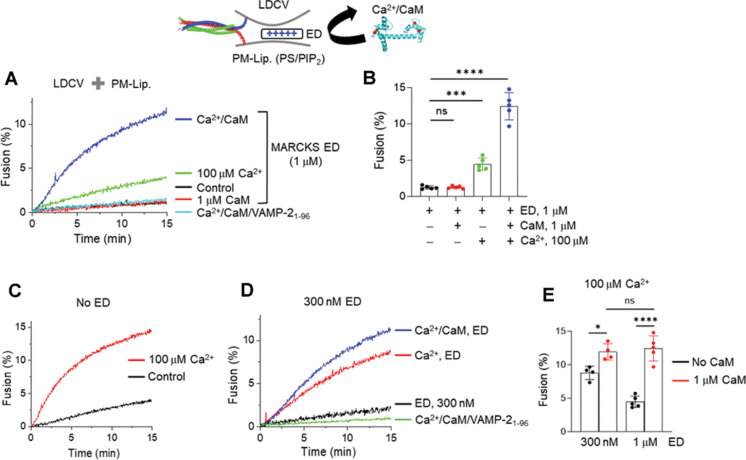
Vesicle fusion is a key process in cellular communication and membrane trafficking. Soluble N-ethylmaleimide-sensitive factor attachment protein receptor (SNARE) proteins drive vesicle fusion, and SNARE proteins seem to be partially assembled before fusion occurs. However, the molecular mechanisms of the vesicle fusion arrest and how vesicle fusion is rescued from the arrest remain not fully understood. We have previously shown that as a lipid catalyst, phosphatidylinositol 4,5-bisphosphate (PIP2) electrostatically triggers vesicle fusion by lowering the hydration energy, and masking PIP2 arrests vesicle fusion in a state of the partial SNARE assembly. In this study, we show that calmodulin and protein kinase C-epsilon unmask PIP2 through the dissociation of myristoylated alanine-rich C-kinase substrate from membranes and, thus, rescue basal fusion and potentiate synaptotagmin-1-mediated Ca2+-dependent vesicle fusion. We provide the model in which the arrest of vesicle fusion can be rescued by the unmasking of PIP2, a lipid catalyst for fusion.
期刊介绍:
Science Advances, an open-access journal by AAAS, publishes impactful research in diverse scientific areas. It aims for fair, fast, and expert peer review, providing freely accessible research to readers. Led by distinguished scientists, the journal supports AAAS's mission by extending Science magazine's capacity to identify and promote significant advances. Evolving digital publishing technologies play a crucial role in advancing AAAS's global mission for science communication and benefitting humankind.






 京公网安备 11010802042870号
京ICP备2023020795号-1
京公网安备 11010802042870号
京ICP备2023020795号-1

 分享
分享
 求助内容:
求助内容: 应助结果提醒方式:
 扫码关注我们
