Wing Ho Leung, Erin M. Leitao, Casparus Johannes Reinhard Verbeek
{"title":"反应挤出法制备聚对苯二甲酸乙酯为原料的芳香族-脂肪族共聚聚酯","authors":"Wing Ho Leung, Erin M. Leitao, Casparus Johannes Reinhard Verbeek","doi":"10.1021/acs.iecr.4c04229","DOIUrl":null,"url":null,"abstract":"Reactive extrusion (REX) was used to synthesize an aromatic–aliphatic copolyester by copolymerizing poly(ethylene terephthalate) (PET) and polycaprolactone (PCL) as a novel PET recycling strategy. Critical design parameters were evaluated, including reaction kinetics, screw configuration, and processing conditions, to optimize the REX process in a co-rotating twin-screw extruder. By integrating kneading blocks with varying staggering angles, an optimized screw design was proposed to mitigate significant challenges such as short residence times, mixing inefficiencies, and barrel blockage caused by drastic changes in melt viscosity. Although the feed rate is more influential than screw speed in determining the residence time, controlling screw speed is crucial for optimizing the degree of fill and shear rate to promote transesterification. In addition, a minimum of 4 min of residence time is required. To reach equilibrium in an equimolar PET/PCL blend with 1.5 pph Ti(OBu)<sub>4</sub>, kneading blocks covering over 50% of the screw length, it was essential to achieve a degree of fill of 0.5, ensuring sufficient mixing efficiency in low-viscosity melts against gravitational effects. Copolymers synthesized from virgin PET and municipal PET waste sources exhibit comparable thermomechanical properties and backbone structures, demonstrating that hard-to-recycle PET can be upcycled by catalytic transesterification. This study provides valuable insights and advances the design of REX systems, especially in the context of depolymerization-driven chemical recycling that involves significant viscosity changes.","PeriodicalId":39,"journal":{"name":"Industrial & Engineering Chemistry Research","volume":"30 1","pages":""},"PeriodicalIF":3.9000,"publicationDate":"2025-02-27","publicationTypes":"Journal Article","fieldsOfStudy":null,"isOpenAccess":false,"openAccessPdf":"","citationCount":"0","resultStr":"{\"title\":\"Synthesis of a Novel Aromatic–Aliphatic Copolyester from Poly(ethylene terephthalate) Using Reactive Extrusion\",\"authors\":\"Wing Ho Leung, Erin M. Leitao, Casparus Johannes Reinhard Verbeek\",\"doi\":\"10.1021/acs.iecr.4c04229\",\"DOIUrl\":null,\"url\":null,\"abstract\":\"Reactive extrusion (REX) was used to synthesize an aromatic–aliphatic copolyester by copolymerizing poly(ethylene terephthalate) (PET) and polycaprolactone (PCL) as a novel PET recycling strategy. Critical design parameters were evaluated, including reaction kinetics, screw configuration, and processing conditions, to optimize the REX process in a co-rotating twin-screw extruder. By integrating kneading blocks with varying staggering angles, an optimized screw design was proposed to mitigate significant challenges such as short residence times, mixing inefficiencies, and barrel blockage caused by drastic changes in melt viscosity. Although the feed rate is more influential than screw speed in determining the residence time, controlling screw speed is crucial for optimizing the degree of fill and shear rate to promote transesterification. In addition, a minimum of 4 min of residence time is required. To reach equilibrium in an equimolar PET/PCL blend with 1.5 pph Ti(OBu)<sub>4</sub>, kneading blocks covering over 50% of the screw length, it was essential to achieve a degree of fill of 0.5, ensuring sufficient mixing efficiency in low-viscosity melts against gravitational effects. Copolymers synthesized from virgin PET and municipal PET waste sources exhibit comparable thermomechanical properties and backbone structures, demonstrating that hard-to-recycle PET can be upcycled by catalytic transesterification. This study provides valuable insights and advances the design of REX systems, especially in the context of depolymerization-driven chemical recycling that involves significant viscosity changes.\",\"PeriodicalId\":39,\"journal\":{\"name\":\"Industrial & Engineering Chemistry Research\",\"volume\":\"30 1\",\"pages\":\"\"},\"PeriodicalIF\":3.9000,\"publicationDate\":\"2025-02-27\",\"publicationTypes\":\"Journal Article\",\"fieldsOfStudy\":null,\"isOpenAccess\":false,\"openAccessPdf\":\"\",\"citationCount\":\"0\",\"resultStr\":null,\"platform\":\"Semanticscholar\",\"paperid\":null,\"PeriodicalName\":\"Industrial & Engineering Chemistry Research\",\"FirstCategoryId\":\"5\",\"ListUrlMain\":\"https://doi.org/10.1021/acs.iecr.4c04229\",\"RegionNum\":3,\"RegionCategory\":\"工程技术\",\"ArticlePicture\":[],\"TitleCN\":null,\"AbstractTextCN\":null,\"PMCID\":null,\"EPubDate\":\"\",\"PubModel\":\"\",\"JCR\":\"Q2\",\"JCRName\":\"ENGINEERING, CHEMICAL\",\"Score\":null,\"Total\":0}","platform":"Semanticscholar","paperid":null,"PeriodicalName":"Industrial & Engineering Chemistry Research","FirstCategoryId":"5","ListUrlMain":"https://doi.org/10.1021/acs.iecr.4c04229","RegionNum":3,"RegionCategory":"工程技术","ArticlePicture":[],"TitleCN":null,"AbstractTextCN":null,"PMCID":null,"EPubDate":"","PubModel":"","JCR":"Q2","JCRName":"ENGINEERING, CHEMICAL","Score":null,"Total":0}
Synthesis of a Novel Aromatic–Aliphatic Copolyester from Poly(ethylene terephthalate) Using Reactive Extrusion
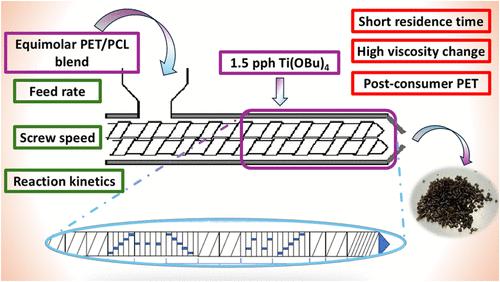
Reactive extrusion (REX) was used to synthesize an aromatic–aliphatic copolyester by copolymerizing poly(ethylene terephthalate) (PET) and polycaprolactone (PCL) as a novel PET recycling strategy. Critical design parameters were evaluated, including reaction kinetics, screw configuration, and processing conditions, to optimize the REX process in a co-rotating twin-screw extruder. By integrating kneading blocks with varying staggering angles, an optimized screw design was proposed to mitigate significant challenges such as short residence times, mixing inefficiencies, and barrel blockage caused by drastic changes in melt viscosity. Although the feed rate is more influential than screw speed in determining the residence time, controlling screw speed is crucial for optimizing the degree of fill and shear rate to promote transesterification. In addition, a minimum of 4 min of residence time is required. To reach equilibrium in an equimolar PET/PCL blend with 1.5 pph Ti(OBu)4, kneading blocks covering over 50% of the screw length, it was essential to achieve a degree of fill of 0.5, ensuring sufficient mixing efficiency in low-viscosity melts against gravitational effects. Copolymers synthesized from virgin PET and municipal PET waste sources exhibit comparable thermomechanical properties and backbone structures, demonstrating that hard-to-recycle PET can be upcycled by catalytic transesterification. This study provides valuable insights and advances the design of REX systems, especially in the context of depolymerization-driven chemical recycling that involves significant viscosity changes.
期刊介绍:
ndustrial & Engineering Chemistry, with variations in title and format, has been published since 1909 by the American Chemical Society. Industrial & Engineering Chemistry Research is a weekly publication that reports industrial and academic research in the broad fields of applied chemistry and chemical engineering with special focus on fundamentals, processes, and products.




 京公网安备 11010802042870号
京ICP备2023020795号-1
京公网安备 11010802042870号
京ICP备2023020795号-1

 分享
分享
 求助内容:
求助内容: 应助结果提醒方式:
 扫码关注我们
