{"title":"构建实用全固态锂金属电池的介电氟化固体电解质","authors":"Xianda Ma, Shuhui Ge, Shuo Chen, Liang Zhang, Rui Wang, Jianhua Yan, Shujie Liu, Bin Ding, Jianyong Yu","doi":"10.1021/acsnano.5c01171","DOIUrl":null,"url":null,"abstract":"The operation of all-solid-state lithium-metal batteries is primarily constrained by an inferior solid electrolyte. Here, we employ a porous dielectric fluorinated electrolyte to encapsulate a Li<sup>+</sup> complex, achieving rapid and stable ion conduction throughout cycling. The electrolyte comprises a porous nanofiber (NF) skeleton made of dielectric fluorinated BaTiO<sub>3</sub> (F-BaTiO<sub>3−δ</sub>) and all-trans block copolymer PVDF-<i>b</i>-PTFE, with an encapsulated poly(ethylene oxide) (PEO)-LiTFSI filler. The dielectric polarized NFs effectively dissociate LiTFSI to form a rapid conductive Li<sup>+</sup> complex, while F-BaTiO<sub>3−δ</sub> bonds with PVDF-<i>b</i>-PTFE and PEO to create stable cross-phase Li<sup>+</sup>-conduction paths. This results in an electrolyte with a high room-temperature conductivity of 5.64 × 10<sup>–4</sup> S cm<sup>–1</sup> and a low activation energy of 0.21 eV. Additionally, the polarized electrolyte achieves dynamic interface stability by eliminating the space charge layer on the cathode and internal stress on the anode. The all-solid-state LiFePO<sub>4</sub>//Li batteries can cycle stably 1000 times at 0.5 C with a high capacity retention of 87.45%. Furthermore, the NCM811//Li and 30-Ah-pouch cells also demonstrate high cycling stability, showcasing potential commercial applications.","PeriodicalId":21,"journal":{"name":"ACS Nano","volume":"28 1","pages":""},"PeriodicalIF":16.0000,"publicationDate":"2025-02-27","publicationTypes":"Journal Article","fieldsOfStudy":null,"isOpenAccess":false,"openAccessPdf":"","citationCount":"0","resultStr":"{\"title\":\"Constructing a Dielectric Fluorinated Solid Electrolyte for Practically Operated All-Solid-State Lithium-Metal Batteries\",\"authors\":\"Xianda Ma, Shuhui Ge, Shuo Chen, Liang Zhang, Rui Wang, Jianhua Yan, Shujie Liu, Bin Ding, Jianyong Yu\",\"doi\":\"10.1021/acsnano.5c01171\",\"DOIUrl\":null,\"url\":null,\"abstract\":\"The operation of all-solid-state lithium-metal batteries is primarily constrained by an inferior solid electrolyte. Here, we employ a porous dielectric fluorinated electrolyte to encapsulate a Li<sup>+</sup> complex, achieving rapid and stable ion conduction throughout cycling. The electrolyte comprises a porous nanofiber (NF) skeleton made of dielectric fluorinated BaTiO<sub>3</sub> (F-BaTiO<sub>3−δ</sub>) and all-trans block copolymer PVDF-<i>b</i>-PTFE, with an encapsulated poly(ethylene oxide) (PEO)-LiTFSI filler. The dielectric polarized NFs effectively dissociate LiTFSI to form a rapid conductive Li<sup>+</sup> complex, while F-BaTiO<sub>3−δ</sub> bonds with PVDF-<i>b</i>-PTFE and PEO to create stable cross-phase Li<sup>+</sup>-conduction paths. This results in an electrolyte with a high room-temperature conductivity of 5.64 × 10<sup>–4</sup> S cm<sup>–1</sup> and a low activation energy of 0.21 eV. Additionally, the polarized electrolyte achieves dynamic interface stability by eliminating the space charge layer on the cathode and internal stress on the anode. The all-solid-state LiFePO<sub>4</sub>//Li batteries can cycle stably 1000 times at 0.5 C with a high capacity retention of 87.45%. Furthermore, the NCM811//Li and 30-Ah-pouch cells also demonstrate high cycling stability, showcasing potential commercial applications.\",\"PeriodicalId\":21,\"journal\":{\"name\":\"ACS Nano\",\"volume\":\"28 1\",\"pages\":\"\"},\"PeriodicalIF\":16.0000,\"publicationDate\":\"2025-02-27\",\"publicationTypes\":\"Journal Article\",\"fieldsOfStudy\":null,\"isOpenAccess\":false,\"openAccessPdf\":\"\",\"citationCount\":\"0\",\"resultStr\":null,\"platform\":\"Semanticscholar\",\"paperid\":null,\"PeriodicalName\":\"ACS Nano\",\"FirstCategoryId\":\"88\",\"ListUrlMain\":\"https://doi.org/10.1021/acsnano.5c01171\",\"RegionNum\":1,\"RegionCategory\":\"材料科学\",\"ArticlePicture\":[],\"TitleCN\":null,\"AbstractTextCN\":null,\"PMCID\":null,\"EPubDate\":\"\",\"PubModel\":\"\",\"JCR\":\"Q1\",\"JCRName\":\"CHEMISTRY, MULTIDISCIPLINARY\",\"Score\":null,\"Total\":0}","platform":"Semanticscholar","paperid":null,"PeriodicalName":"ACS Nano","FirstCategoryId":"88","ListUrlMain":"https://doi.org/10.1021/acsnano.5c01171","RegionNum":1,"RegionCategory":"材料科学","ArticlePicture":[],"TitleCN":null,"AbstractTextCN":null,"PMCID":null,"EPubDate":"","PubModel":"","JCR":"Q1","JCRName":"CHEMISTRY, MULTIDISCIPLINARY","Score":null,"Total":0}
引用次数: 0
摘要
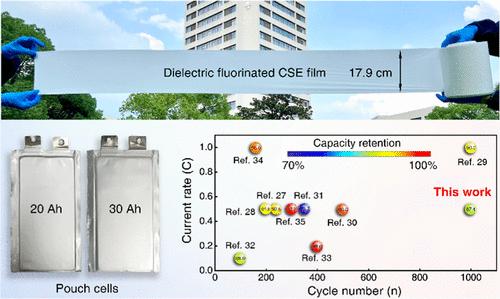
全固态锂金属电池的运行主要受到劣质固体电解质的限制。在这里,我们采用多孔介质氟化电解质封装Li+复合物,在整个循环过程中实现快速稳定的离子传导。电解质包括多孔纳米纤维(NF)骨架,由介电氟化BaTiO3 (F-BaTiO3−δ)和全反式嵌段共聚物PVDF-b-PTFE制成,并带有封装的聚环氧乙烷(PEO)-LiTFSI填料。而F-BaTiO3−δ与PVDF-b-PTFE和PEO结合,形成稳定的跨相Li+传导路径。这使得电解质具有5.64 × 10⁻⁴ S cm-1的高室温电导率和0.21 eV的低活化能。此外,极化电解质通过消除阴极上的空间电荷层和阳极上的内应力来实现动态界面稳定性。全固态LiFePO4//Li电池在0.5℃下可稳定循环1000次,容量保持率高达87.45%。此外,NCM811//Li和30ah袋电池也表现出高循环稳定性,展示了潜在的商业应用。
Constructing a Dielectric Fluorinated Solid Electrolyte for Practically Operated All-Solid-State Lithium-Metal Batteries
The operation of all-solid-state lithium-metal batteries is primarily constrained by an inferior solid electrolyte. Here, we employ a porous dielectric fluorinated electrolyte to encapsulate a Li+ complex, achieving rapid and stable ion conduction throughout cycling. The electrolyte comprises a porous nanofiber (NF) skeleton made of dielectric fluorinated BaTiO3 (F-BaTiO3−δ) and all-trans block copolymer PVDF-b-PTFE, with an encapsulated poly(ethylene oxide) (PEO)-LiTFSI filler. The dielectric polarized NFs effectively dissociate LiTFSI to form a rapid conductive Li+ complex, while F-BaTiO3−δ bonds with PVDF-b-PTFE and PEO to create stable cross-phase Li+-conduction paths. This results in an electrolyte with a high room-temperature conductivity of 5.64 × 10⁻⁴ S cm–1 and a low activation energy of 0.21 eV. Additionally, the polarized electrolyte achieves dynamic interface stability by eliminating the space charge layer on the cathode and internal stress on the anode. The all-solid-state LiFePO4//Li batteries can cycle stably 1000 times at 0.5 C with a high capacity retention of 87.45%. Furthermore, the NCM811//Li and 30-Ah-pouch cells also demonstrate high cycling stability, showcasing potential commercial applications.
期刊介绍:
ACS Nano, published monthly, serves as an international forum for comprehensive articles on nanoscience and nanotechnology research at the intersections of chemistry, biology, materials science, physics, and engineering. The journal fosters communication among scientists in these communities, facilitating collaboration, new research opportunities, and advancements through discoveries. ACS Nano covers synthesis, assembly, characterization, theory, and simulation of nanostructures, nanobiotechnology, nanofabrication, methods and tools for nanoscience and nanotechnology, and self- and directed-assembly. Alongside original research articles, it offers thorough reviews, perspectives on cutting-edge research, and discussions envisioning the future of nanoscience and nanotechnology.




 京公网安备 11010802042870号
京ICP备2023020795号-1
京公网安备 11010802042870号
京ICP备2023020795号-1

 分享
分享
 求助内容:
求助内容: 应助结果提醒方式:
 扫码关注我们
