{"title":"质子衰变的速度有多快?","authors":"Hooman Davoudiasl, Peter B. Denton","doi":"10.1103/physrevd.111.035026","DOIUrl":null,"url":null,"abstract":"Current laboratory bounds imply that protons are extremely long-lived. However, this conclusion may not hold for all time and in all of space. We find that the proton lifetime can be ∼</a:mo>15</a:mn></a:math> orders of magnitude shorter in the relatively recent past on Earth or at the present time elsewhere in the Milky Way. A number of terrestrial and astrophysical constraints are examined and potential signals are outlined. We also sketch possible models that could lead to spatial or temporal variations in the proton lifetime. A positive signal could be compelling evidence for a new long range force of nature, with important implications for the limitations of fundamental inferences based solely on laboratory measurements. <jats:supplementary-material> <jats:copyright-statement>Published by the American Physical Society</jats:copyright-statement> <jats:copyright-year>2025</jats:copyright-year> </jats:permissions> </jats:supplementary-material>","PeriodicalId":20167,"journal":{"name":"Physical Review D","volume":"33 1","pages":""},"PeriodicalIF":5.3000,"publicationDate":"2025-02-27","publicationTypes":"Journal Article","fieldsOfStudy":null,"isOpenAccess":false,"openAccessPdf":"","citationCount":"0","resultStr":"{\"title\":\"How fast can protons decay?\",\"authors\":\"Hooman Davoudiasl, Peter B. Denton\",\"doi\":\"10.1103/physrevd.111.035026\",\"DOIUrl\":null,\"url\":null,\"abstract\":\"Current laboratory bounds imply that protons are extremely long-lived. However, this conclusion may not hold for all time and in all of space. We find that the proton lifetime can be ∼</a:mo>15</a:mn></a:math> orders of magnitude shorter in the relatively recent past on Earth or at the present time elsewhere in the Milky Way. A number of terrestrial and astrophysical constraints are examined and potential signals are outlined. We also sketch possible models that could lead to spatial or temporal variations in the proton lifetime. A positive signal could be compelling evidence for a new long range force of nature, with important implications for the limitations of fundamental inferences based solely on laboratory measurements. <jats:supplementary-material> <jats:copyright-statement>Published by the American Physical Society</jats:copyright-statement> <jats:copyright-year>2025</jats:copyright-year> </jats:permissions> </jats:supplementary-material>\",\"PeriodicalId\":20167,\"journal\":{\"name\":\"Physical Review D\",\"volume\":\"33 1\",\"pages\":\"\"},\"PeriodicalIF\":5.3000,\"publicationDate\":\"2025-02-27\",\"publicationTypes\":\"Journal Article\",\"fieldsOfStudy\":null,\"isOpenAccess\":false,\"openAccessPdf\":\"\",\"citationCount\":\"0\",\"resultStr\":null,\"platform\":\"Semanticscholar\",\"paperid\":null,\"PeriodicalName\":\"Physical Review D\",\"FirstCategoryId\":\"101\",\"ListUrlMain\":\"https://doi.org/10.1103/physrevd.111.035026\",\"RegionNum\":2,\"RegionCategory\":\"物理与天体物理\",\"ArticlePicture\":[],\"TitleCN\":null,\"AbstractTextCN\":null,\"PMCID\":null,\"EPubDate\":\"\",\"PubModel\":\"\",\"JCR\":\"Q1\",\"JCRName\":\"Physics and Astronomy\",\"Score\":null,\"Total\":0}","platform":"Semanticscholar","paperid":null,"PeriodicalName":"Physical Review D","FirstCategoryId":"101","ListUrlMain":"https://doi.org/10.1103/physrevd.111.035026","RegionNum":2,"RegionCategory":"物理与天体物理","ArticlePicture":[],"TitleCN":null,"AbstractTextCN":null,"PMCID":null,"EPubDate":"","PubModel":"","JCR":"Q1","JCRName":"Physics and Astronomy","Score":null,"Total":0}
Current laboratory bounds imply that protons are extremely long-lived. However, this conclusion may not hold for all time and in all of space. We find that the proton lifetime can be ∼15 orders of magnitude shorter in the relatively recent past on Earth or at the present time elsewhere in the Milky Way. A number of terrestrial and astrophysical constraints are examined and potential signals are outlined. We also sketch possible models that could lead to spatial or temporal variations in the proton lifetime. A positive signal could be compelling evidence for a new long range force of nature, with important implications for the limitations of fundamental inferences based solely on laboratory measurements. Published by the American Physical Society2025
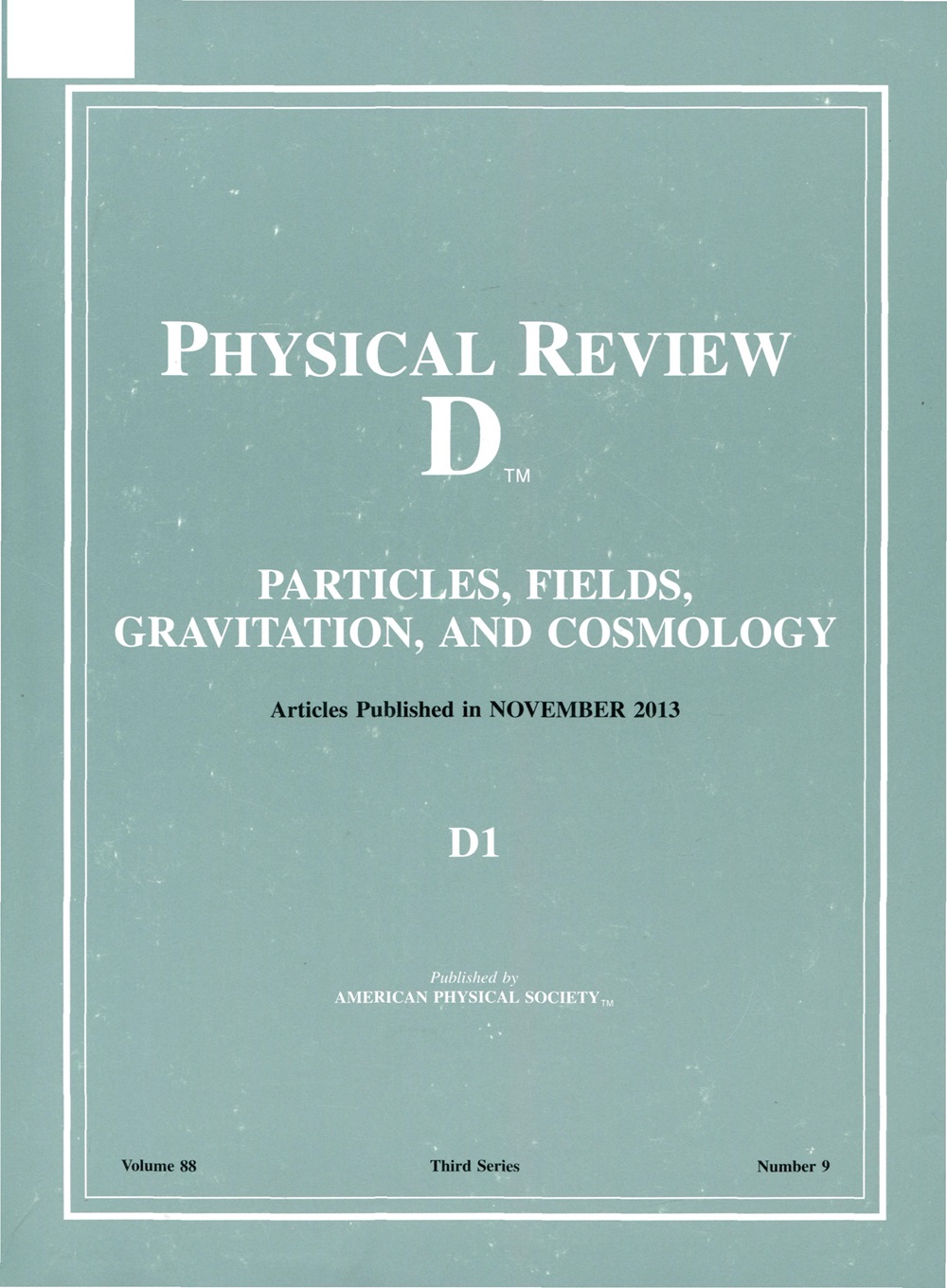
期刊介绍:
Physical Review D (PRD) is a leading journal in elementary particle physics, field theory, gravitation, and cosmology and is one of the top-cited journals in high-energy physics.
PRD covers experimental and theoretical results in all aspects of particle physics, field theory, gravitation and cosmology, including:
Particle physics experiments,
Electroweak interactions,
Strong interactions,
Lattice field theories, lattice QCD,
Beyond the standard model physics,
Phenomenological aspects of field theory, general methods,
Gravity, cosmology, cosmic rays,
Astrophysics and astroparticle physics,
General relativity,
Formal aspects of field theory, field theory in curved space,
String theory, quantum gravity, gauge/gravity duality.




 京公网安备 11010802042870号
京ICP备2023020795号-1
京公网安备 11010802042870号
京ICP备2023020795号-1

 分享
分享
 求助内容:
求助内容: 应助结果提醒方式:
 扫码关注我们
