{"title":"在独立石墨烯上生长的Ta2C薄膜的结晶度增强","authors":"K. Tanaka , H. Kindlund , S. Kodambaka","doi":"10.1016/j.surfcoat.2025.131981","DOIUrl":null,"url":null,"abstract":"<div><div>In an effort to understand the mechanisms leading to van der Waals epitaxy, using plan-view transmission electron microscopy and diffraction, we compare and contrast the microstructures of ultra-thin (≈ 9 nm) Ta<sub>2</sub>C layers sputter-deposited simultaneously on graphene and 8-nm-thick, amorphous silicon nitride (a-SiN<sub><em>x</em></sub>) membranes supported by holey transmission electron microscopy grids. On both graphene and a-SiN<sub><em>x</em></sub> membranes, we obtain polycrystalline trigonal <span><math><mi>α</mi></math></span>-Ta<sub>2</sub>C layers with similar grain sizes. However, the Ta<sub>2</sub>C layers deposited on graphene exhibit an in-plane orientation relationship: <span><math><msub><mfenced><mrow><mn>2</mn><mover><mn>1</mn><mo>¯</mo></mover><mover><mn>1</mn><mo>¯</mo></mover><mn>0</mn></mrow></mfenced><mrow><msub><mi>Ta</mi><mn>2</mn></msub><mi>C</mi></mrow></msub></math></span>||<span><math><msub><mfenced><mrow><mn>10</mn><mover><mn>1</mn><mo>¯</mo></mover><mn>0</mn></mrow></mfenced><mtext>graphene</mtext></msub></math></span>. Our results reveal that the onset of epitaxy can be observed even on one-atom-thick crystals.</div></div>","PeriodicalId":22009,"journal":{"name":"Surface & Coatings Technology","volume":"502 ","pages":"Article 131981"},"PeriodicalIF":6.1000,"publicationDate":"2025-04-15","publicationTypes":"Journal Article","fieldsOfStudy":null,"isOpenAccess":false,"openAccessPdf":"","citationCount":"0","resultStr":"{\"title\":\"Enhanced crystallinity in Ta2C thin films grown on free-standing graphene\",\"authors\":\"K. Tanaka , H. Kindlund , S. Kodambaka\",\"doi\":\"10.1016/j.surfcoat.2025.131981\",\"DOIUrl\":null,\"url\":null,\"abstract\":\"<div><div>In an effort to understand the mechanisms leading to van der Waals epitaxy, using plan-view transmission electron microscopy and diffraction, we compare and contrast the microstructures of ultra-thin (≈ 9 nm) Ta<sub>2</sub>C layers sputter-deposited simultaneously on graphene and 8-nm-thick, amorphous silicon nitride (a-SiN<sub><em>x</em></sub>) membranes supported by holey transmission electron microscopy grids. On both graphene and a-SiN<sub><em>x</em></sub> membranes, we obtain polycrystalline trigonal <span><math><mi>α</mi></math></span>-Ta<sub>2</sub>C layers with similar grain sizes. However, the Ta<sub>2</sub>C layers deposited on graphene exhibit an in-plane orientation relationship: <span><math><msub><mfenced><mrow><mn>2</mn><mover><mn>1</mn><mo>¯</mo></mover><mover><mn>1</mn><mo>¯</mo></mover><mn>0</mn></mrow></mfenced><mrow><msub><mi>Ta</mi><mn>2</mn></msub><mi>C</mi></mrow></msub></math></span>||<span><math><msub><mfenced><mrow><mn>10</mn><mover><mn>1</mn><mo>¯</mo></mover><mn>0</mn></mrow></mfenced><mtext>graphene</mtext></msub></math></span>. Our results reveal that the onset of epitaxy can be observed even on one-atom-thick crystals.</div></div>\",\"PeriodicalId\":22009,\"journal\":{\"name\":\"Surface & Coatings Technology\",\"volume\":\"502 \",\"pages\":\"Article 131981\"},\"PeriodicalIF\":6.1000,\"publicationDate\":\"2025-04-15\",\"publicationTypes\":\"Journal Article\",\"fieldsOfStudy\":null,\"isOpenAccess\":false,\"openAccessPdf\":\"\",\"citationCount\":\"0\",\"resultStr\":null,\"platform\":\"Semanticscholar\",\"paperid\":null,\"PeriodicalName\":\"Surface & Coatings Technology\",\"FirstCategoryId\":\"88\",\"ListUrlMain\":\"https://www.sciencedirect.com/science/article/pii/S0257897225002555\",\"RegionNum\":2,\"RegionCategory\":\"材料科学\",\"ArticlePicture\":[],\"TitleCN\":null,\"AbstractTextCN\":null,\"PMCID\":null,\"EPubDate\":\"2025/2/26 0:00:00\",\"PubModel\":\"Epub\",\"JCR\":\"Q1\",\"JCRName\":\"MATERIALS SCIENCE, COATINGS & FILMS\",\"Score\":null,\"Total\":0}","platform":"Semanticscholar","paperid":null,"PeriodicalName":"Surface & Coatings Technology","FirstCategoryId":"88","ListUrlMain":"https://www.sciencedirect.com/science/article/pii/S0257897225002555","RegionNum":2,"RegionCategory":"材料科学","ArticlePicture":[],"TitleCN":null,"AbstractTextCN":null,"PMCID":null,"EPubDate":"2025/2/26 0:00:00","PubModel":"Epub","JCR":"Q1","JCRName":"MATERIALS SCIENCE, COATINGS & FILMS","Score":null,"Total":0}
Enhanced crystallinity in Ta2C thin films grown on free-standing graphene
In an effort to understand the mechanisms leading to van der Waals epitaxy, using plan-view transmission electron microscopy and diffraction, we compare and contrast the microstructures of ultra-thin (≈ 9 nm) Ta2C layers sputter-deposited simultaneously on graphene and 8-nm-thick, amorphous silicon nitride (a-SiNx) membranes supported by holey transmission electron microscopy grids. On both graphene and a-SiNx membranes, we obtain polycrystalline trigonal -Ta2C layers with similar grain sizes. However, the Ta2C layers deposited on graphene exhibit an in-plane orientation relationship: ||. Our results reveal that the onset of epitaxy can be observed even on one-atom-thick crystals.
期刊介绍:
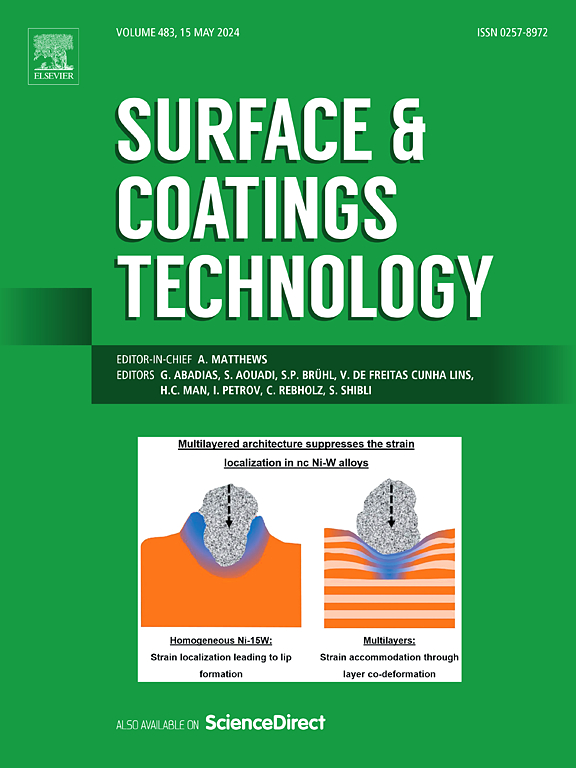
Surface and Coatings Technology is an international archival journal publishing scientific papers on significant developments in surface and interface engineering to modify and improve the surface properties of materials for protection in demanding contact conditions or aggressive environments, or for enhanced functional performance. Contributions range from original scientific articles concerned with fundamental and applied aspects of research or direct applications of metallic, inorganic, organic and composite coatings, to invited reviews of current technology in specific areas. Papers submitted to this journal are expected to be in line with the following aspects in processes, and properties/performance:
A. Processes: Physical and chemical vapour deposition techniques, thermal and plasma spraying, surface modification by directed energy techniques such as ion, electron and laser beams, thermo-chemical treatment, wet chemical and electrochemical processes such as plating, sol-gel coating, anodization, plasma electrolytic oxidation, etc., but excluding painting.
B. Properties/performance: friction performance, wear resistance (e.g., abrasion, erosion, fretting, etc), corrosion and oxidation resistance, thermal protection, diffusion resistance, hydrophilicity/hydrophobicity, and properties relevant to smart materials behaviour and enhanced multifunctional performance for environmental, energy and medical applications, but excluding device aspects.




 京公网安备 11010802042870号
京ICP备2023020795号-1
京公网安备 11010802042870号
京ICP备2023020795号-1

 分享
分享
 求助内容:
求助内容: 应助结果提醒方式:
 扫码关注我们
