{"title":"使用统一的电化学电位模型对混合离子电子导体电解质的固体氧化物电池进行建模","authors":"Mingda Sun, Cheng Bao, Xingyu Lu","doi":"10.1016/j.apenergy.2025.125592","DOIUrl":null,"url":null,"abstract":"<div><div>Mixed ionic electronic conductors (MIEC) ceramic solid electrolytes have been widely used in solid oxide fuel cells (SOFCs) and electrolysis cells (SOECs). Existing full-cell models are typically difficult to capture the oxygen chemical potential (OCP) profile in electrodes and have poor generality. However, the OCP transition by overpotential is closely related to both degradation near the electrodes of SOECs and the drop in open-circuit voltage (OCV) of SOFCs. Based on phenomenological equations, we develop a unified mathematical framework for charge transport in solid oxide cells (SOCs). Our model quantifies the OCP in electrodes by directly relating the local OCP to the electrode overpotential, thus providing insights into the relationship between overpotential and OCP. Our results show that there is a ubiquitous OCP transition in the electrodes and that is extremely sensitive to electrode overpotentials. The oxygen potential peaks and valleys found in the Yttria-stabilized Zirconia (YSZ) of the multilayer electrolyte SOEC provide new opportunities to understand degradation phenomena in the relevant literature. In addition, our predictions of leakage current and OCV illustrate the generality of the model for cell performance pre diction. The results may offer new methods and insights for predicting the performance and understanding the degradation mechanisms of SOCs with MIEC electrolytes or multilayer electrolytes.</div></div>","PeriodicalId":246,"journal":{"name":"Applied Energy","volume":"387 ","pages":"Article 125592"},"PeriodicalIF":12.2000,"publicationDate":"2025-06-01","publicationTypes":"Journal Article","fieldsOfStudy":null,"isOpenAccess":false,"openAccessPdf":"","citationCount":"0","resultStr":"{\"title\":\"Modeling of solid oxide cells with mixed ionic electronic conductor electrolytes using a unified electrochemical potential model\",\"authors\":\"Mingda Sun, Cheng Bao, Xingyu Lu\",\"doi\":\"10.1016/j.apenergy.2025.125592\",\"DOIUrl\":null,\"url\":null,\"abstract\":\"<div><div>Mixed ionic electronic conductors (MIEC) ceramic solid electrolytes have been widely used in solid oxide fuel cells (SOFCs) and electrolysis cells (SOECs). Existing full-cell models are typically difficult to capture the oxygen chemical potential (OCP) profile in electrodes and have poor generality. However, the OCP transition by overpotential is closely related to both degradation near the electrodes of SOECs and the drop in open-circuit voltage (OCV) of SOFCs. Based on phenomenological equations, we develop a unified mathematical framework for charge transport in solid oxide cells (SOCs). Our model quantifies the OCP in electrodes by directly relating the local OCP to the electrode overpotential, thus providing insights into the relationship between overpotential and OCP. Our results show that there is a ubiquitous OCP transition in the electrodes and that is extremely sensitive to electrode overpotentials. The oxygen potential peaks and valleys found in the Yttria-stabilized Zirconia (YSZ) of the multilayer electrolyte SOEC provide new opportunities to understand degradation phenomena in the relevant literature. In addition, our predictions of leakage current and OCV illustrate the generality of the model for cell performance pre diction. The results may offer new methods and insights for predicting the performance and understanding the degradation mechanisms of SOCs with MIEC electrolytes or multilayer electrolytes.</div></div>\",\"PeriodicalId\":246,\"journal\":{\"name\":\"Applied Energy\",\"volume\":\"387 \",\"pages\":\"Article 125592\"},\"PeriodicalIF\":12.2000,\"publicationDate\":\"2025-06-01\",\"publicationTypes\":\"Journal Article\",\"fieldsOfStudy\":null,\"isOpenAccess\":false,\"openAccessPdf\":\"\",\"citationCount\":\"0\",\"resultStr\":null,\"platform\":\"Semanticscholar\",\"paperid\":null,\"PeriodicalName\":\"Applied Energy\",\"FirstCategoryId\":\"5\",\"ListUrlMain\":\"https://www.sciencedirect.com/science/article/pii/S0306261925003228\",\"RegionNum\":1,\"RegionCategory\":\"工程技术\",\"ArticlePicture\":[],\"TitleCN\":null,\"AbstractTextCN\":null,\"PMCID\":null,\"EPubDate\":\"2025/3/1 0:00:00\",\"PubModel\":\"Epub\",\"JCR\":\"Q1\",\"JCRName\":\"ENERGY & FUELS\",\"Score\":null,\"Total\":0}","platform":"Semanticscholar","paperid":null,"PeriodicalName":"Applied Energy","FirstCategoryId":"5","ListUrlMain":"https://www.sciencedirect.com/science/article/pii/S0306261925003228","RegionNum":1,"RegionCategory":"工程技术","ArticlePicture":[],"TitleCN":null,"AbstractTextCN":null,"PMCID":null,"EPubDate":"2025/3/1 0:00:00","PubModel":"Epub","JCR":"Q1","JCRName":"ENERGY & FUELS","Score":null,"Total":0}
Modeling of solid oxide cells with mixed ionic electronic conductor electrolytes using a unified electrochemical potential model
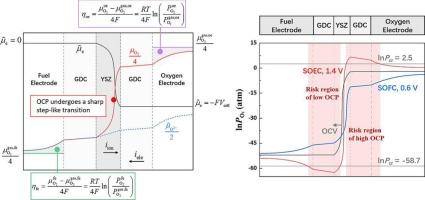
Mixed ionic electronic conductors (MIEC) ceramic solid electrolytes have been widely used in solid oxide fuel cells (SOFCs) and electrolysis cells (SOECs). Existing full-cell models are typically difficult to capture the oxygen chemical potential (OCP) profile in electrodes and have poor generality. However, the OCP transition by overpotential is closely related to both degradation near the electrodes of SOECs and the drop in open-circuit voltage (OCV) of SOFCs. Based on phenomenological equations, we develop a unified mathematical framework for charge transport in solid oxide cells (SOCs). Our model quantifies the OCP in electrodes by directly relating the local OCP to the electrode overpotential, thus providing insights into the relationship between overpotential and OCP. Our results show that there is a ubiquitous OCP transition in the electrodes and that is extremely sensitive to electrode overpotentials. The oxygen potential peaks and valleys found in the Yttria-stabilized Zirconia (YSZ) of the multilayer electrolyte SOEC provide new opportunities to understand degradation phenomena in the relevant literature. In addition, our predictions of leakage current and OCV illustrate the generality of the model for cell performance pre diction. The results may offer new methods and insights for predicting the performance and understanding the degradation mechanisms of SOCs with MIEC electrolytes or multilayer electrolytes.
期刊介绍:
Applied Energy serves as a platform for sharing innovations, research, development, and demonstrations in energy conversion, conservation, and sustainable energy systems. The journal covers topics such as optimal energy resource use, environmental pollutant mitigation, and energy process analysis. It welcomes original papers, review articles, technical notes, and letters to the editor. Authors are encouraged to submit manuscripts that bridge the gap between research, development, and implementation. The journal addresses a wide spectrum of topics, including fossil and renewable energy technologies, energy economics, and environmental impacts. Applied Energy also explores modeling and forecasting, conservation strategies, and the social and economic implications of energy policies, including climate change mitigation. It is complemented by the open-access journal Advances in Applied Energy.




 京公网安备 11010802042870号
京ICP备2023020795号-1
京公网安备 11010802042870号
京ICP备2023020795号-1

 分享
分享
 求助内容:
求助内容: 应助结果提醒方式:
 扫码关注我们
