Guanqiao Ding , Jie Guo , Dan Yi , Minghao Ou , Guishan Yang
{"title":"未来城市发展驱动的生境隔离性评价:景观连通性视角","authors":"Guanqiao Ding , Jie Guo , Dan Yi , Minghao Ou , Guishan Yang","doi":"10.1016/j.eiar.2025.107886","DOIUrl":null,"url":null,"abstract":"<div><div>Natural habitats in rapidly urbanizing regions face significant human disturbances due to urban development. However, the extent to which future urban growth will further isolate these habitats remains inadequately explored. To address this gap, we developed a comprehensive framework that integrates habitat isolation assessment with future urban growth models, using the Nanjing Metropolitan Area from 2020 to 2050 as a case study. We employed Morphological Spatial Pattern Analysis (MSPA) to delineate natural habitat patches and identified urban pixels causing isolation through an ecological network approach. The Isolation Effect Index (IEI) and the Isolation Degree Index (IDI) were used to quantify the isolation impacts of urban areas at the pixel scale and the degree of isolation for individual habitat patches. Utilizing the Patch-Generating Land Use Simulation (PLUS) model, we projected land use changes under five Shared Socioeconomic Pathways (SSPs) to analyze the dynamics of IEI and IDI from 2020 to 2050. Our findings reveal that urban pixels in the central area are hotspots for causing isolation, severely impacting surrounding natural habitats. Increases in habitat isolation are primarily driven by newly-added urban pixels, particularly from low expansion intensity, indicating that non-intensified urban expansion exacerbates habitat isolation. This study quantifies the habitat isolation caused by future urban growth, with the isolation mitigation strategies are both essential for understanding human impacts on natural habitats and improving ecological protection policies.</div></div>","PeriodicalId":309,"journal":{"name":"Environmental Impact Assessment Review","volume":"113 ","pages":"Article 107886"},"PeriodicalIF":11.2000,"publicationDate":"2025-06-01","publicationTypes":"Journal Article","fieldsOfStudy":null,"isOpenAccess":false,"openAccessPdf":"","citationCount":"0","resultStr":"{\"title\":\"Evaluating habitat isolation driven by future urban growth: A landscape connectivity perspective\",\"authors\":\"Guanqiao Ding , Jie Guo , Dan Yi , Minghao Ou , Guishan Yang\",\"doi\":\"10.1016/j.eiar.2025.107886\",\"DOIUrl\":null,\"url\":null,\"abstract\":\"<div><div>Natural habitats in rapidly urbanizing regions face significant human disturbances due to urban development. However, the extent to which future urban growth will further isolate these habitats remains inadequately explored. To address this gap, we developed a comprehensive framework that integrates habitat isolation assessment with future urban growth models, using the Nanjing Metropolitan Area from 2020 to 2050 as a case study. We employed Morphological Spatial Pattern Analysis (MSPA) to delineate natural habitat patches and identified urban pixels causing isolation through an ecological network approach. The Isolation Effect Index (IEI) and the Isolation Degree Index (IDI) were used to quantify the isolation impacts of urban areas at the pixel scale and the degree of isolation for individual habitat patches. Utilizing the Patch-Generating Land Use Simulation (PLUS) model, we projected land use changes under five Shared Socioeconomic Pathways (SSPs) to analyze the dynamics of IEI and IDI from 2020 to 2050. Our findings reveal that urban pixels in the central area are hotspots for causing isolation, severely impacting surrounding natural habitats. Increases in habitat isolation are primarily driven by newly-added urban pixels, particularly from low expansion intensity, indicating that non-intensified urban expansion exacerbates habitat isolation. This study quantifies the habitat isolation caused by future urban growth, with the isolation mitigation strategies are both essential for understanding human impacts on natural habitats and improving ecological protection policies.</div></div>\",\"PeriodicalId\":309,\"journal\":{\"name\":\"Environmental Impact Assessment Review\",\"volume\":\"113 \",\"pages\":\"Article 107886\"},\"PeriodicalIF\":11.2000,\"publicationDate\":\"2025-06-01\",\"publicationTypes\":\"Journal Article\",\"fieldsOfStudy\":null,\"isOpenAccess\":false,\"openAccessPdf\":\"\",\"citationCount\":\"0\",\"resultStr\":null,\"platform\":\"Semanticscholar\",\"paperid\":null,\"PeriodicalName\":\"Environmental Impact Assessment Review\",\"FirstCategoryId\":\"90\",\"ListUrlMain\":\"https://www.sciencedirect.com/science/article/pii/S0195925525000836\",\"RegionNum\":1,\"RegionCategory\":\"社会学\",\"ArticlePicture\":[],\"TitleCN\":null,\"AbstractTextCN\":null,\"PMCID\":null,\"EPubDate\":\"2025/3/1 0:00:00\",\"PubModel\":\"Epub\",\"JCR\":\"Q1\",\"JCRName\":\"ENVIRONMENTAL STUDIES\",\"Score\":null,\"Total\":0}","platform":"Semanticscholar","paperid":null,"PeriodicalName":"Environmental Impact Assessment Review","FirstCategoryId":"90","ListUrlMain":"https://www.sciencedirect.com/science/article/pii/S0195925525000836","RegionNum":1,"RegionCategory":"社会学","ArticlePicture":[],"TitleCN":null,"AbstractTextCN":null,"PMCID":null,"EPubDate":"2025/3/1 0:00:00","PubModel":"Epub","JCR":"Q1","JCRName":"ENVIRONMENTAL STUDIES","Score":null,"Total":0}
Evaluating habitat isolation driven by future urban growth: A landscape connectivity perspective
Natural habitats in rapidly urbanizing regions face significant human disturbances due to urban development. However, the extent to which future urban growth will further isolate these habitats remains inadequately explored. To address this gap, we developed a comprehensive framework that integrates habitat isolation assessment with future urban growth models, using the Nanjing Metropolitan Area from 2020 to 2050 as a case study. We employed Morphological Spatial Pattern Analysis (MSPA) to delineate natural habitat patches and identified urban pixels causing isolation through an ecological network approach. The Isolation Effect Index (IEI) and the Isolation Degree Index (IDI) were used to quantify the isolation impacts of urban areas at the pixel scale and the degree of isolation for individual habitat patches. Utilizing the Patch-Generating Land Use Simulation (PLUS) model, we projected land use changes under five Shared Socioeconomic Pathways (SSPs) to analyze the dynamics of IEI and IDI from 2020 to 2050. Our findings reveal that urban pixels in the central area are hotspots for causing isolation, severely impacting surrounding natural habitats. Increases in habitat isolation are primarily driven by newly-added urban pixels, particularly from low expansion intensity, indicating that non-intensified urban expansion exacerbates habitat isolation. This study quantifies the habitat isolation caused by future urban growth, with the isolation mitigation strategies are both essential for understanding human impacts on natural habitats and improving ecological protection policies.
期刊介绍:
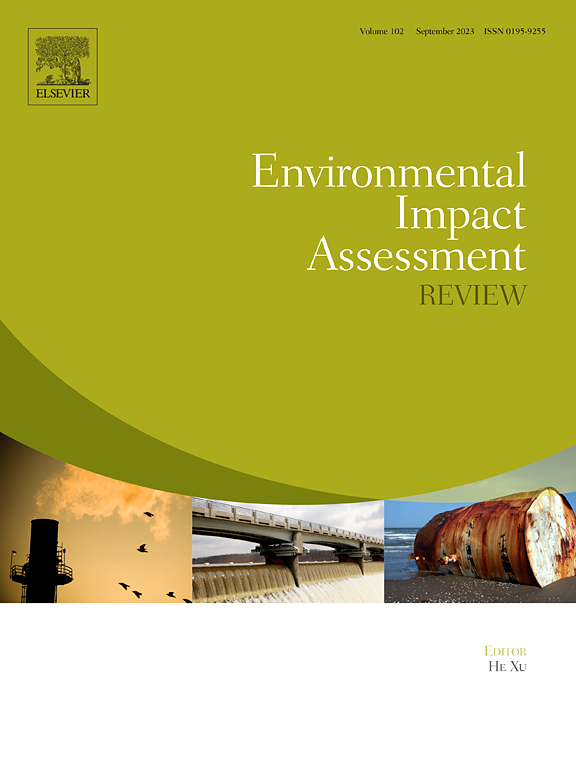
Environmental Impact Assessment Review is an interdisciplinary journal that serves a global audience of practitioners, policymakers, and academics involved in assessing the environmental impact of policies, projects, processes, and products. The journal focuses on innovative theory and practice in environmental impact assessment (EIA). Papers are expected to present innovative ideas, be topical, and coherent. The journal emphasizes concepts, methods, techniques, approaches, and systems related to EIA theory and practice.




 京公网安备 11010802042870号
京ICP备2023020795号-1
京公网安备 11010802042870号
京ICP备2023020795号-1

 分享
分享
 求助内容:
求助内容: 应助结果提醒方式:
 扫码关注我们
