{"title":"评估基于证据的跌倒预防项目的有效性:参与者风险水平和项目一致性的研究。","authors":"Cathy S Elrod, Rita A Wong","doi":"10.3389/fpubh.2025.1517322","DOIUrl":null,"url":null,"abstract":"<p><strong>Background: </strong>Falls are a leading cause of injury and injury-related deaths in older adults. A variety of community-delivered, evidence-based, fall risk-reduction programs have been developed and proven effective. These evidence-based fall prevention programs (EBFPP) have been classified along a fall-risk continuum, indicating the target fall-risk level of participants. The congruency between the program's targeted and enrolled fall-risk level of participants is unknown. This study creates a fall-risk classification index, places participants into one of three fall risk categories, and then examines congruency of actual vs. recommended fall-risk of participants, by program.</p><p><strong>Methods: </strong>Data came from the Healthy Aging Programs Integrated Database, created by the National Council on Aging (NCOA) funded by the Administration for Community Living (ACL) for use by ACL falls prevention program grantees. Using data from a pre-participation survey designed by the ACDL for their grantees, a fall risk index was created. The fall risk levels of the participants were then compared to the fall risk profile of the EBFPPs as identified in NCOA's Evidence-based Falls Prevention Programs Risk Continuum Guidance for Program Selection in which they were enrolled.</p><p><strong>Results: </strong>Between July 2016 and June 2022, 105,323 older adults participated in one of eight EBFPPs. Participant characteristics varied among programs. Applying the fall risk index to the fall risk sample (31,064 older adults), 29% of participants were identified as being at high risk, 41% at moderate risk, and 30% at low risk. When the fall risk level of participants, by program, was compared to the target risk profile of the associated EBFPP, programs that had a risk profile targeting individuals at moderate to low risk were found to enroll a larger percentage of adults at high risk than expected. All programs enrolled at least some participants at each of the three risk levels.</p><p><strong>Conclusion: </strong>All eight EBFPPs enrolled participants across all three fall-risk levels with most programs being at least somewhat congruent with the fall-risk program continuum recommendations. More research is needed to better understand inconsistencies between risk-levels of program, target risk-levels, and actual participant risk-level, to guide either adaptations in the risk-level classification or program modifications to accommodate different risk-levels.</p>","PeriodicalId":12548,"journal":{"name":"Frontiers in Public Health","volume":"13 ","pages":"1517322"},"PeriodicalIF":4.1000,"publicationDate":"2025-02-13","publicationTypes":"Journal Article","fieldsOfStudy":null,"isOpenAccess":false,"openAccessPdf":"https://www.ncbi.nlm.nih.gov/pmc/articles/PMC11864948/pdf/","citationCount":"0","resultStr":"{\"title\":\"Evaluating the effectiveness of evidence-based falls prevention programs: a study on participant risk levels and program congruency.\",\"authors\":\"Cathy S Elrod, Rita A Wong\",\"doi\":\"10.3389/fpubh.2025.1517322\",\"DOIUrl\":null,\"url\":null,\"abstract\":\"<p><strong>Background: </strong>Falls are a leading cause of injury and injury-related deaths in older adults. A variety of community-delivered, evidence-based, fall risk-reduction programs have been developed and proven effective. These evidence-based fall prevention programs (EBFPP) have been classified along a fall-risk continuum, indicating the target fall-risk level of participants. The congruency between the program's targeted and enrolled fall-risk level of participants is unknown. This study creates a fall-risk classification index, places participants into one of three fall risk categories, and then examines congruency of actual vs. recommended fall-risk of participants, by program.</p><p><strong>Methods: </strong>Data came from the Healthy Aging Programs Integrated Database, created by the National Council on Aging (NCOA) funded by the Administration for Community Living (ACL) for use by ACL falls prevention program grantees. Using data from a pre-participation survey designed by the ACDL for their grantees, a fall risk index was created. The fall risk levels of the participants were then compared to the fall risk profile of the EBFPPs as identified in NCOA's Evidence-based Falls Prevention Programs Risk Continuum Guidance for Program Selection in which they were enrolled.</p><p><strong>Results: </strong>Between July 2016 and June 2022, 105,323 older adults participated in one of eight EBFPPs. Participant characteristics varied among programs. Applying the fall risk index to the fall risk sample (31,064 older adults), 29% of participants were identified as being at high risk, 41% at moderate risk, and 30% at low risk. When the fall risk level of participants, by program, was compared to the target risk profile of the associated EBFPP, programs that had a risk profile targeting individuals at moderate to low risk were found to enroll a larger percentage of adults at high risk than expected. All programs enrolled at least some participants at each of the three risk levels.</p><p><strong>Conclusion: </strong>All eight EBFPPs enrolled participants across all three fall-risk levels with most programs being at least somewhat congruent with the fall-risk program continuum recommendations. More research is needed to better understand inconsistencies between risk-levels of program, target risk-levels, and actual participant risk-level, to guide either adaptations in the risk-level classification or program modifications to accommodate different risk-levels.</p>\",\"PeriodicalId\":12548,\"journal\":{\"name\":\"Frontiers in Public Health\",\"volume\":\"13 \",\"pages\":\"1517322\"},\"PeriodicalIF\":4.1000,\"publicationDate\":\"2025-02-13\",\"publicationTypes\":\"Journal Article\",\"fieldsOfStudy\":null,\"isOpenAccess\":false,\"openAccessPdf\":\"https://www.ncbi.nlm.nih.gov/pmc/articles/PMC11864948/pdf/\",\"citationCount\":\"0\",\"resultStr\":null,\"platform\":\"Semanticscholar\",\"paperid\":null,\"PeriodicalName\":\"Frontiers in Public Health\",\"FirstCategoryId\":\"3\",\"ListUrlMain\":\"https://doi.org/10.3389/fpubh.2025.1517322\",\"RegionNum\":3,\"RegionCategory\":\"医学\",\"ArticlePicture\":[],\"TitleCN\":null,\"AbstractTextCN\":null,\"PMCID\":null,\"EPubDate\":\"2025/1/1 0:00:00\",\"PubModel\":\"eCollection\",\"JCR\":\"Q2\",\"JCRName\":\"PUBLIC, ENVIRONMENTAL & OCCUPATIONAL HEALTH\",\"Score\":null,\"Total\":0}","platform":"Semanticscholar","paperid":null,"PeriodicalName":"Frontiers in Public Health","FirstCategoryId":"3","ListUrlMain":"https://doi.org/10.3389/fpubh.2025.1517322","RegionNum":3,"RegionCategory":"医学","ArticlePicture":[],"TitleCN":null,"AbstractTextCN":null,"PMCID":null,"EPubDate":"2025/1/1 0:00:00","PubModel":"eCollection","JCR":"Q2","JCRName":"PUBLIC, ENVIRONMENTAL & OCCUPATIONAL HEALTH","Score":null,"Total":0}
Evaluating the effectiveness of evidence-based falls prevention programs: a study on participant risk levels and program congruency.
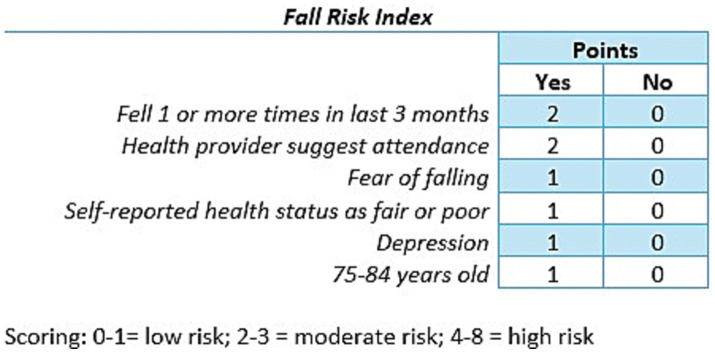
Background: Falls are a leading cause of injury and injury-related deaths in older adults. A variety of community-delivered, evidence-based, fall risk-reduction programs have been developed and proven effective. These evidence-based fall prevention programs (EBFPP) have been classified along a fall-risk continuum, indicating the target fall-risk level of participants. The congruency between the program's targeted and enrolled fall-risk level of participants is unknown. This study creates a fall-risk classification index, places participants into one of three fall risk categories, and then examines congruency of actual vs. recommended fall-risk of participants, by program.
Methods: Data came from the Healthy Aging Programs Integrated Database, created by the National Council on Aging (NCOA) funded by the Administration for Community Living (ACL) for use by ACL falls prevention program grantees. Using data from a pre-participation survey designed by the ACDL for their grantees, a fall risk index was created. The fall risk levels of the participants were then compared to the fall risk profile of the EBFPPs as identified in NCOA's Evidence-based Falls Prevention Programs Risk Continuum Guidance for Program Selection in which they were enrolled.
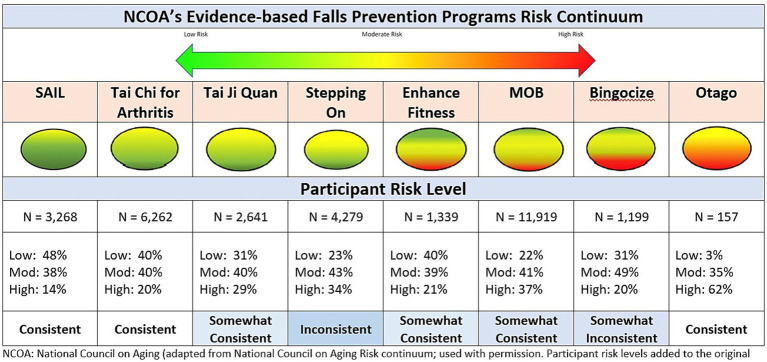
Results: Between July 2016 and June 2022, 105,323 older adults participated in one of eight EBFPPs. Participant characteristics varied among programs. Applying the fall risk index to the fall risk sample (31,064 older adults), 29% of participants were identified as being at high risk, 41% at moderate risk, and 30% at low risk. When the fall risk level of participants, by program, was compared to the target risk profile of the associated EBFPP, programs that had a risk profile targeting individuals at moderate to low risk were found to enroll a larger percentage of adults at high risk than expected. All programs enrolled at least some participants at each of the three risk levels.
Conclusion: All eight EBFPPs enrolled participants across all three fall-risk levels with most programs being at least somewhat congruent with the fall-risk program continuum recommendations. More research is needed to better understand inconsistencies between risk-levels of program, target risk-levels, and actual participant risk-level, to guide either adaptations in the risk-level classification or program modifications to accommodate different risk-levels.
期刊介绍:
Frontiers in Public Health is a multidisciplinary open-access journal which publishes rigorously peer-reviewed research and is at the forefront of disseminating and communicating scientific knowledge and impactful discoveries to researchers, academics, clinicians, policy makers and the public worldwide. The journal aims at overcoming current fragmentation in research and publication, promoting consistency in pursuing relevant scientific themes, and supporting finding dissemination and translation into practice.
Frontiers in Public Health is organized into Specialty Sections that cover different areas of research in the field. Please refer to the author guidelines for details on article types and the submission process.





 京公网安备 11010802042870号
京ICP备2023020795号-1
京公网安备 11010802042870号
京ICP备2023020795号-1

 分享
分享
 求助内容:
求助内容: 应助结果提醒方式:
 扫码关注我们
