Lu-Yao Wang, Guang Che, Ya-Ru Gong, Wei-Ting Yang, Yuan Lin, Jiao-Rong Liu, Shu-Yu Chen, Meng-Dan Xiao, Xu-Dong Tian and Zhong-Min Su
{"title":"用于高效光催化二氧化碳还原的铀酰有机框架的温度驱动生长","authors":"Lu-Yao Wang, Guang Che, Ya-Ru Gong, Wei-Ting Yang, Yuan Lin, Jiao-Rong Liu, Shu-Yu Chen, Meng-Dan Xiao, Xu-Dong Tian and Zhong-Min Su","doi":"10.1039/D5QI00141B","DOIUrl":null,"url":null,"abstract":"<p >The design of efficient photocatalysts to convert CO<small><sub>2</sub></small> into CO and other high-value-added chemicals is an effective strategy for solving environmental issues and the energy crisis. Herein, a uranyl-organic framework (UOF) photocatalyst, HNU-94, with uranyl ions as catalytically active centers was designed and prepared by a simple solvothermal method for photocatalytic CO<small><sub>2</sub></small> reduction. Particularly, the reaction temperature has an obvious influence on the morphology, which is further reflected in the photocatalytic performance of HNU-94. The morphology of HNU-94 evolves from strip to cluster to flower-like when the temperature rises from 80 °C to 120 °C. The sample obtained at 120 °C can reduce CO<small><sub>2</sub></small> to CO under visible light, and the yield reaches 2.57 mmol g<small><sup>−1</sup></small> after 2 h, which is significantly higher than that of HNU-94 obtained at 80 °C (0.53 mmol g<small><sup>−1</sup></small>). The study demonstrates the efficient photocatalytic activity of uranyl ions for reducing CO<small><sub>2</sub></small> and provides an effective method for the logical design of UOF catalysts.</p>","PeriodicalId":79,"journal":{"name":"Inorganic Chemistry Frontiers","volume":" 8","pages":" 3262-3269"},"PeriodicalIF":6.4000,"publicationDate":"2025-02-28","publicationTypes":"Journal Article","fieldsOfStudy":null,"isOpenAccess":false,"openAccessPdf":"","citationCount":"0","resultStr":"{\"title\":\"Temperature-driven growth of uranyl-organic frameworks for efficient photocatalytic CO2 reduction†\",\"authors\":\"Lu-Yao Wang, Guang Che, Ya-Ru Gong, Wei-Ting Yang, Yuan Lin, Jiao-Rong Liu, Shu-Yu Chen, Meng-Dan Xiao, Xu-Dong Tian and Zhong-Min Su\",\"doi\":\"10.1039/D5QI00141B\",\"DOIUrl\":null,\"url\":null,\"abstract\":\"<p >The design of efficient photocatalysts to convert CO<small><sub>2</sub></small> into CO and other high-value-added chemicals is an effective strategy for solving environmental issues and the energy crisis. Herein, a uranyl-organic framework (UOF) photocatalyst, HNU-94, with uranyl ions as catalytically active centers was designed and prepared by a simple solvothermal method for photocatalytic CO<small><sub>2</sub></small> reduction. Particularly, the reaction temperature has an obvious influence on the morphology, which is further reflected in the photocatalytic performance of HNU-94. The morphology of HNU-94 evolves from strip to cluster to flower-like when the temperature rises from 80 °C to 120 °C. The sample obtained at 120 °C can reduce CO<small><sub>2</sub></small> to CO under visible light, and the yield reaches 2.57 mmol g<small><sup>−1</sup></small> after 2 h, which is significantly higher than that of HNU-94 obtained at 80 °C (0.53 mmol g<small><sup>−1</sup></small>). The study demonstrates the efficient photocatalytic activity of uranyl ions for reducing CO<small><sub>2</sub></small> and provides an effective method for the logical design of UOF catalysts.</p>\",\"PeriodicalId\":79,\"journal\":{\"name\":\"Inorganic Chemistry Frontiers\",\"volume\":\" 8\",\"pages\":\" 3262-3269\"},\"PeriodicalIF\":6.4000,\"publicationDate\":\"2025-02-28\",\"publicationTypes\":\"Journal Article\",\"fieldsOfStudy\":null,\"isOpenAccess\":false,\"openAccessPdf\":\"\",\"citationCount\":\"0\",\"resultStr\":null,\"platform\":\"Semanticscholar\",\"paperid\":null,\"PeriodicalName\":\"Inorganic Chemistry Frontiers\",\"FirstCategoryId\":\"92\",\"ListUrlMain\":\"https://pubs.rsc.org/en/content/articlelanding/2025/qi/d5qi00141b\",\"RegionNum\":1,\"RegionCategory\":\"化学\",\"ArticlePicture\":[],\"TitleCN\":null,\"AbstractTextCN\":null,\"PMCID\":null,\"EPubDate\":\"\",\"PubModel\":\"\",\"JCR\":\"Q1\",\"JCRName\":\"CHEMISTRY, INORGANIC & NUCLEAR\",\"Score\":null,\"Total\":0}","platform":"Semanticscholar","paperid":null,"PeriodicalName":"Inorganic Chemistry Frontiers","FirstCategoryId":"92","ListUrlMain":"https://pubs.rsc.org/en/content/articlelanding/2025/qi/d5qi00141b","RegionNum":1,"RegionCategory":"化学","ArticlePicture":[],"TitleCN":null,"AbstractTextCN":null,"PMCID":null,"EPubDate":"","PubModel":"","JCR":"Q1","JCRName":"CHEMISTRY, INORGANIC & NUCLEAR","Score":null,"Total":0}
Temperature-driven growth of uranyl-organic frameworks for efficient photocatalytic CO2 reduction†
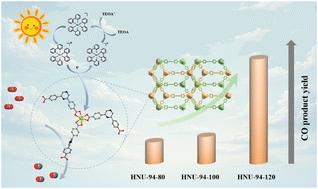
The design of efficient photocatalysts to convert CO2 into CO and other high-value-added chemicals is an effective strategy for solving environmental issues and the energy crisis. Herein, a uranyl-organic framework (UOF) photocatalyst, HNU-94, with uranyl ions as catalytically active centers was designed and prepared by a simple solvothermal method for photocatalytic CO2 reduction. Particularly, the reaction temperature has an obvious influence on the morphology, which is further reflected in the photocatalytic performance of HNU-94. The morphology of HNU-94 evolves from strip to cluster to flower-like when the temperature rises from 80 °C to 120 °C. The sample obtained at 120 °C can reduce CO2 to CO under visible light, and the yield reaches 2.57 mmol g−1 after 2 h, which is significantly higher than that of HNU-94 obtained at 80 °C (0.53 mmol g−1). The study demonstrates the efficient photocatalytic activity of uranyl ions for reducing CO2 and provides an effective method for the logical design of UOF catalysts.





 京公网安备 11010802042870号
京ICP备2023020795号-1
京公网安备 11010802042870号
京ICP备2023020795号-1

 分享
分享
 求助内容:
求助内容: 应助结果提醒方式:
 扫码关注我们
