{"title":"基于PID控制和参考跟踪的双神经网络方法提高采收率","authors":"Keyvan Ahangar Darabi, Majid Ahmadlouydarab","doi":"10.1002/adts.202401168","DOIUrl":null,"url":null,"abstract":"<p>An innovative method is introduced to improve oil recovery techniques by combining Artificial Neural Networks with Proportional-Integral-Derivative control systems. Acknowledging the significant progress in artificial intelligence, the study primarily focuses on employing Artificial Neural Networks to model the steam injection of alumina nanoparticles into a 2D porous medium, simulating steam injection-enhanced oil Recovery scenarios. The data from numerical simulations and the Levenberg-Marquardt backpropagation algorithm are used to train nine distinct neural networks using MATLAB neural network fitting, achieving an impressive mean squared error <0.001 at optimal performance. The general simulation structure features a dual neural network system, where one network simulates the recovery process and receives stable input values to generate a variable reference recovery factor for the controller. This setup utilizes feedback from the process-representing neural network to produce a control signal, enabling real-time adjustments to the neural network inputs for optimizing the recovery factor. The study investigates both open-loop and closed-loop responses to disturbances, demonstrating that while controlling nanoparticle concentration and temperature does not effectively maintain the desired recovery factor, adjusting the injection velocity through the control scheme successfully mitigated disturbances. This approach ensures precise reference tracking, achieving an average mean squared error <0.002.</p>","PeriodicalId":7219,"journal":{"name":"Advanced Theory and Simulations","volume":"8 6","pages":""},"PeriodicalIF":3.2000,"publicationDate":"2025-02-26","publicationTypes":"Journal Article","fieldsOfStudy":null,"isOpenAccess":false,"openAccessPdf":"","citationCount":"0","resultStr":"{\"title\":\"A Dual Neural Network Approach with PID Control and Reference Tracking to Enhance Oil Recovery\",\"authors\":\"Keyvan Ahangar Darabi, Majid Ahmadlouydarab\",\"doi\":\"10.1002/adts.202401168\",\"DOIUrl\":null,\"url\":null,\"abstract\":\"<p>An innovative method is introduced to improve oil recovery techniques by combining Artificial Neural Networks with Proportional-Integral-Derivative control systems. Acknowledging the significant progress in artificial intelligence, the study primarily focuses on employing Artificial Neural Networks to model the steam injection of alumina nanoparticles into a 2D porous medium, simulating steam injection-enhanced oil Recovery scenarios. The data from numerical simulations and the Levenberg-Marquardt backpropagation algorithm are used to train nine distinct neural networks using MATLAB neural network fitting, achieving an impressive mean squared error <0.001 at optimal performance. The general simulation structure features a dual neural network system, where one network simulates the recovery process and receives stable input values to generate a variable reference recovery factor for the controller. This setup utilizes feedback from the process-representing neural network to produce a control signal, enabling real-time adjustments to the neural network inputs for optimizing the recovery factor. The study investigates both open-loop and closed-loop responses to disturbances, demonstrating that while controlling nanoparticle concentration and temperature does not effectively maintain the desired recovery factor, adjusting the injection velocity through the control scheme successfully mitigated disturbances. This approach ensures precise reference tracking, achieving an average mean squared error <0.002.</p>\",\"PeriodicalId\":7219,\"journal\":{\"name\":\"Advanced Theory and Simulations\",\"volume\":\"8 6\",\"pages\":\"\"},\"PeriodicalIF\":3.2000,\"publicationDate\":\"2025-02-26\",\"publicationTypes\":\"Journal Article\",\"fieldsOfStudy\":null,\"isOpenAccess\":false,\"openAccessPdf\":\"\",\"citationCount\":\"0\",\"resultStr\":null,\"platform\":\"Semanticscholar\",\"paperid\":null,\"PeriodicalName\":\"Advanced Theory and Simulations\",\"FirstCategoryId\":\"5\",\"ListUrlMain\":\"https://advanced.onlinelibrary.wiley.com/doi/10.1002/adts.202401168\",\"RegionNum\":4,\"RegionCategory\":\"工程技术\",\"ArticlePicture\":[],\"TitleCN\":null,\"AbstractTextCN\":null,\"PMCID\":null,\"EPubDate\":\"\",\"PubModel\":\"\",\"JCR\":\"Q1\",\"JCRName\":\"MULTIDISCIPLINARY SCIENCES\",\"Score\":null,\"Total\":0}","platform":"Semanticscholar","paperid":null,"PeriodicalName":"Advanced Theory and Simulations","FirstCategoryId":"5","ListUrlMain":"https://advanced.onlinelibrary.wiley.com/doi/10.1002/adts.202401168","RegionNum":4,"RegionCategory":"工程技术","ArticlePicture":[],"TitleCN":null,"AbstractTextCN":null,"PMCID":null,"EPubDate":"","PubModel":"","JCR":"Q1","JCRName":"MULTIDISCIPLINARY SCIENCES","Score":null,"Total":0}
A Dual Neural Network Approach with PID Control and Reference Tracking to Enhance Oil Recovery
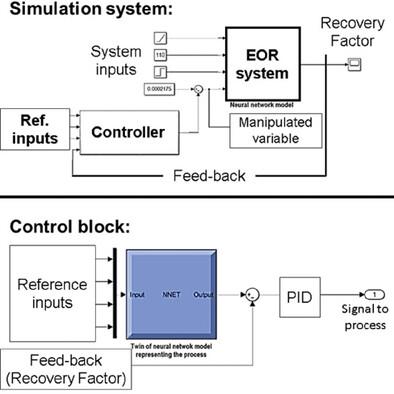
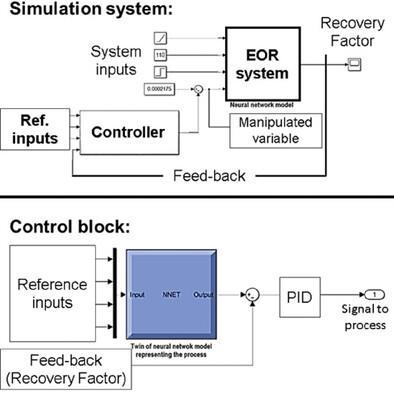
An innovative method is introduced to improve oil recovery techniques by combining Artificial Neural Networks with Proportional-Integral-Derivative control systems. Acknowledging the significant progress in artificial intelligence, the study primarily focuses on employing Artificial Neural Networks to model the steam injection of alumina nanoparticles into a 2D porous medium, simulating steam injection-enhanced oil Recovery scenarios. The data from numerical simulations and the Levenberg-Marquardt backpropagation algorithm are used to train nine distinct neural networks using MATLAB neural network fitting, achieving an impressive mean squared error <0.001 at optimal performance. The general simulation structure features a dual neural network system, where one network simulates the recovery process and receives stable input values to generate a variable reference recovery factor for the controller. This setup utilizes feedback from the process-representing neural network to produce a control signal, enabling real-time adjustments to the neural network inputs for optimizing the recovery factor. The study investigates both open-loop and closed-loop responses to disturbances, demonstrating that while controlling nanoparticle concentration and temperature does not effectively maintain the desired recovery factor, adjusting the injection velocity through the control scheme successfully mitigated disturbances. This approach ensures precise reference tracking, achieving an average mean squared error <0.002.
期刊介绍:
Advanced Theory and Simulations is an interdisciplinary, international, English-language journal that publishes high-quality scientific results focusing on the development and application of theoretical methods, modeling and simulation approaches in all natural science and medicine areas, including:
materials, chemistry, condensed matter physics
engineering, energy
life science, biology, medicine
atmospheric/environmental science, climate science
planetary science, astronomy, cosmology
method development, numerical methods, statistics







 京公网安备 11010802042870号
京ICP备2023020795号-1
京公网安备 11010802042870号
京ICP备2023020795号-1

 分享
分享
 求助内容:
求助内容: 应助结果提醒方式:
 扫码关注我们
